I returned to Bing Theatre, located inside the sprawling USC campus south of downtown LA, for the opening night (4/22) of The Turn of the Screw. Put on by the USC Thornton School of Music’s opera and symphony divisions, the show promised to be a faithful retelling of the classic ghost story, first written by Henry James in 1898 and then adapted into an opera by composer Benjamin Britten and librettist Myfanwy Piper in 1954.
This is my second time at Bing Theatre and my third time seeing USC Opera put on a show, after seeing The Cunning Little Vixen here last year. I’ve found the USC performers to be talented and worthy of an audience despite still being students, so I was excited to see tonight’s show.
[Editorial note: more photos will be added to this article at a later date.]
Arrival
Getting to USC is always easy for me, since it’s right off of a metro stop. The E line (formerly the gold/yellow line) takes you right next to a campus entrance.
Sometimes there are security guards who will stop and question your purpose in coming onto campus. But tonight they waved me through with barely a glance. It’s a 5-10 minute walk to the theater building depending on which entrance you use, but it’s a peaceful and pretty walk.
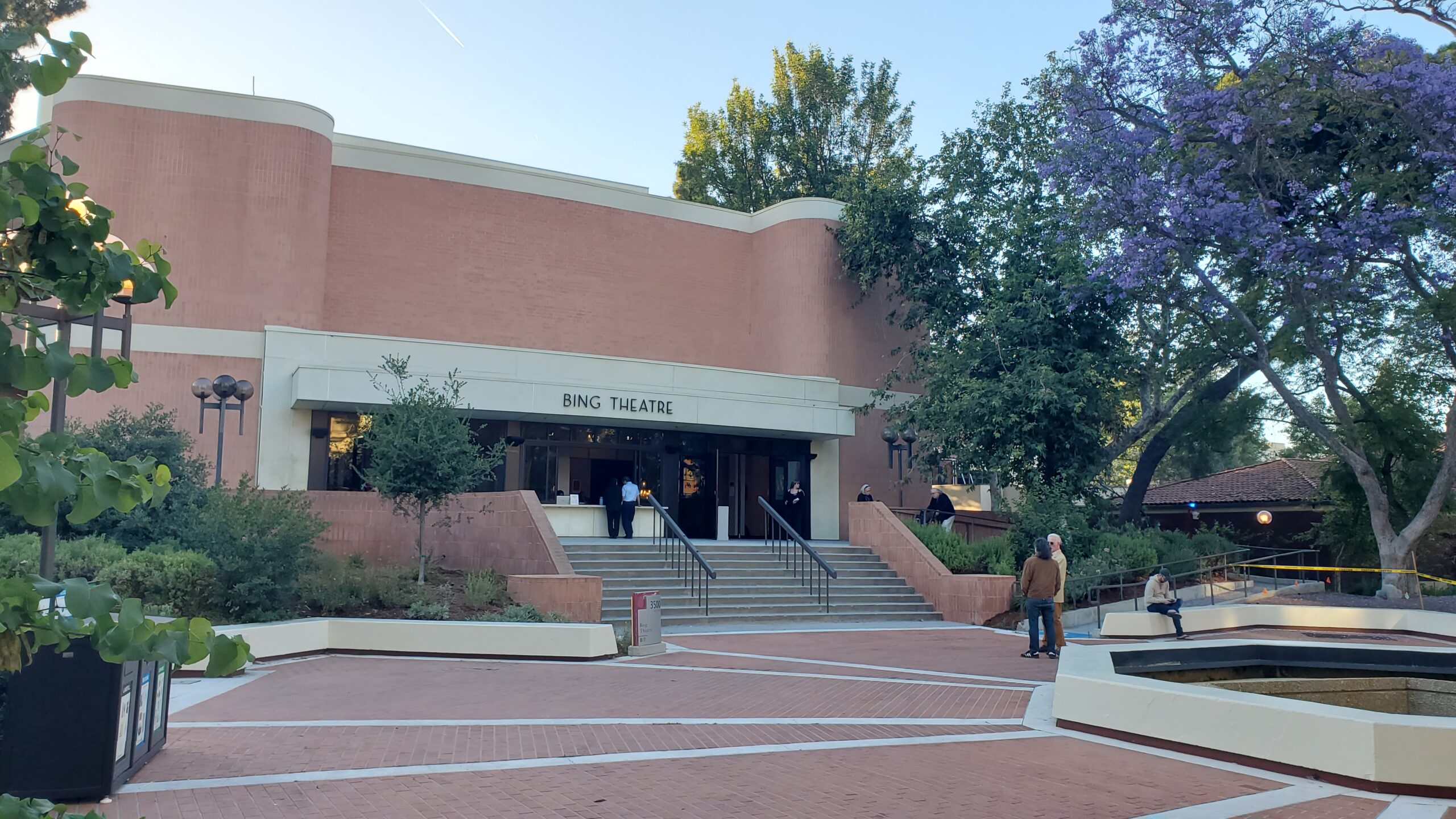
Bing Theatre is low-pressure and relaxed. You’re handed a program by a friendly student while another scans your ticket and lets you in.
There are good bathrooms and water fountains and a photo backdrop, which I think is a great touch for the college department to have invested in.
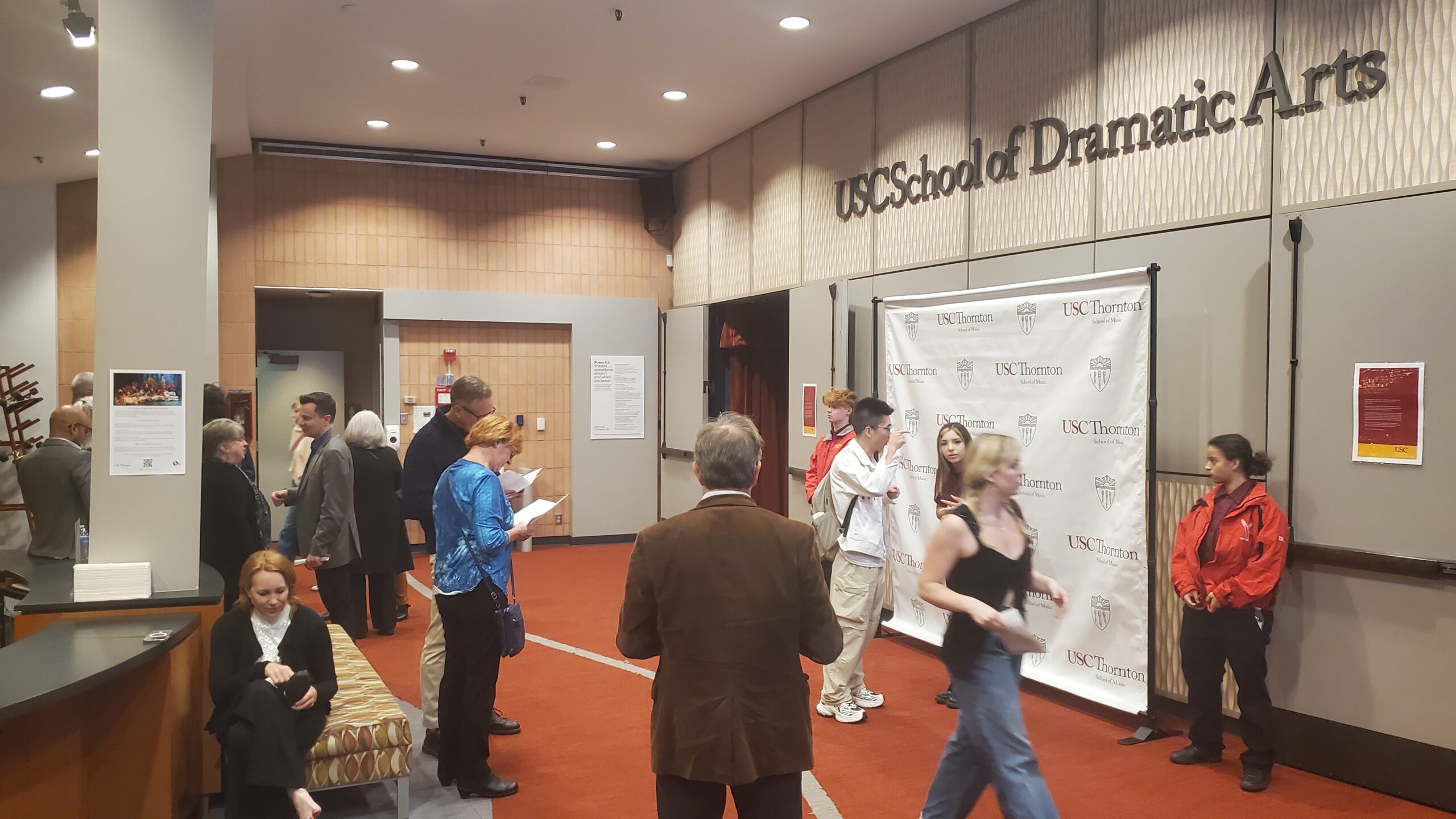
Seating is always general admission, and I have not seen the theater ever fill up, so it’s always possible to get a great seat for a very good price.
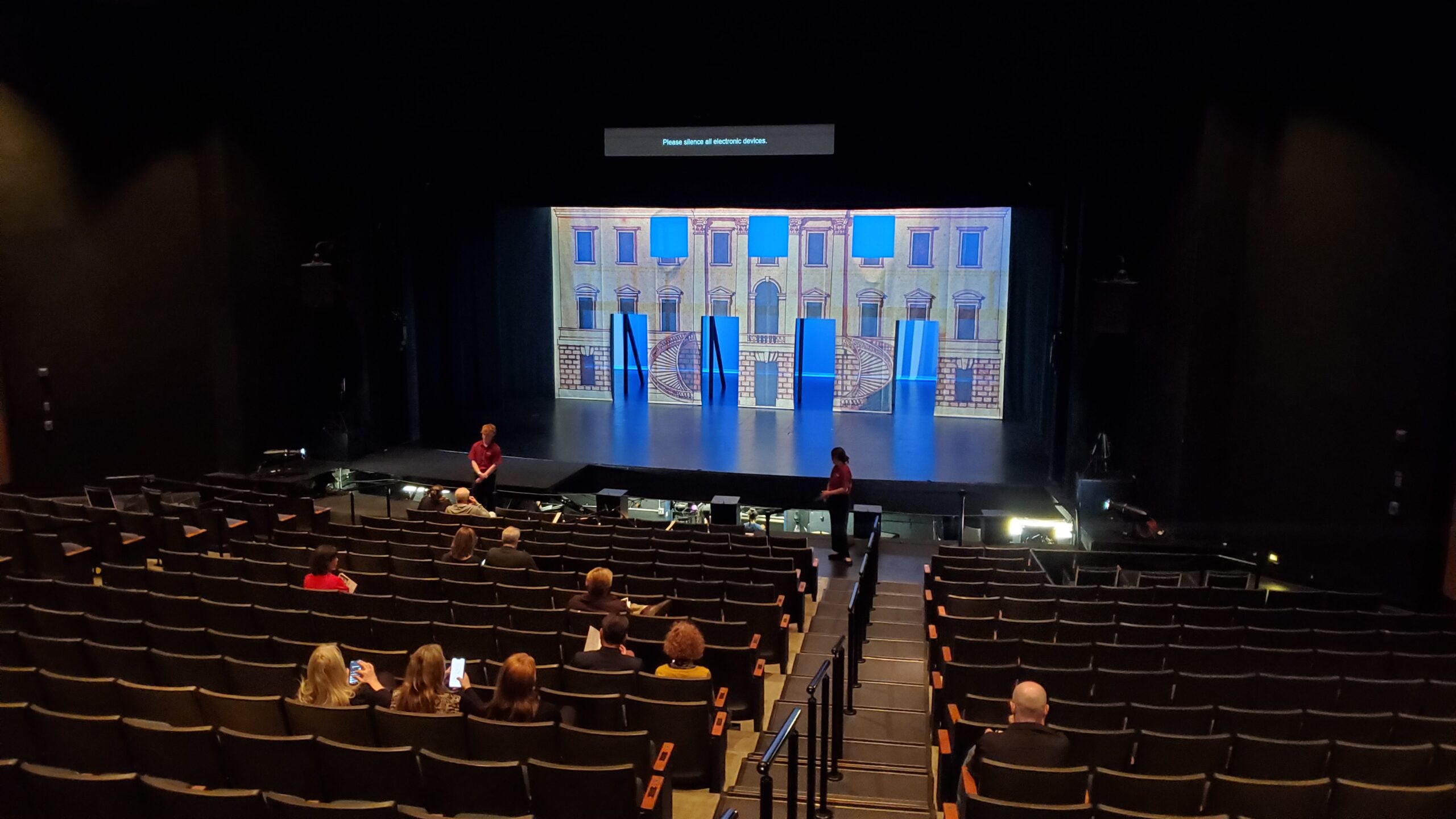
As I waited, I recognized some of the crowd as other opera students I had seen in the past. Some of the audience walked up to the pit and waved at friends. I got the feeling that maybe half of the audience knew each other, and most were likely related to the performers, if not their fellow classmates.
The show started about ten minutes after the showtime.
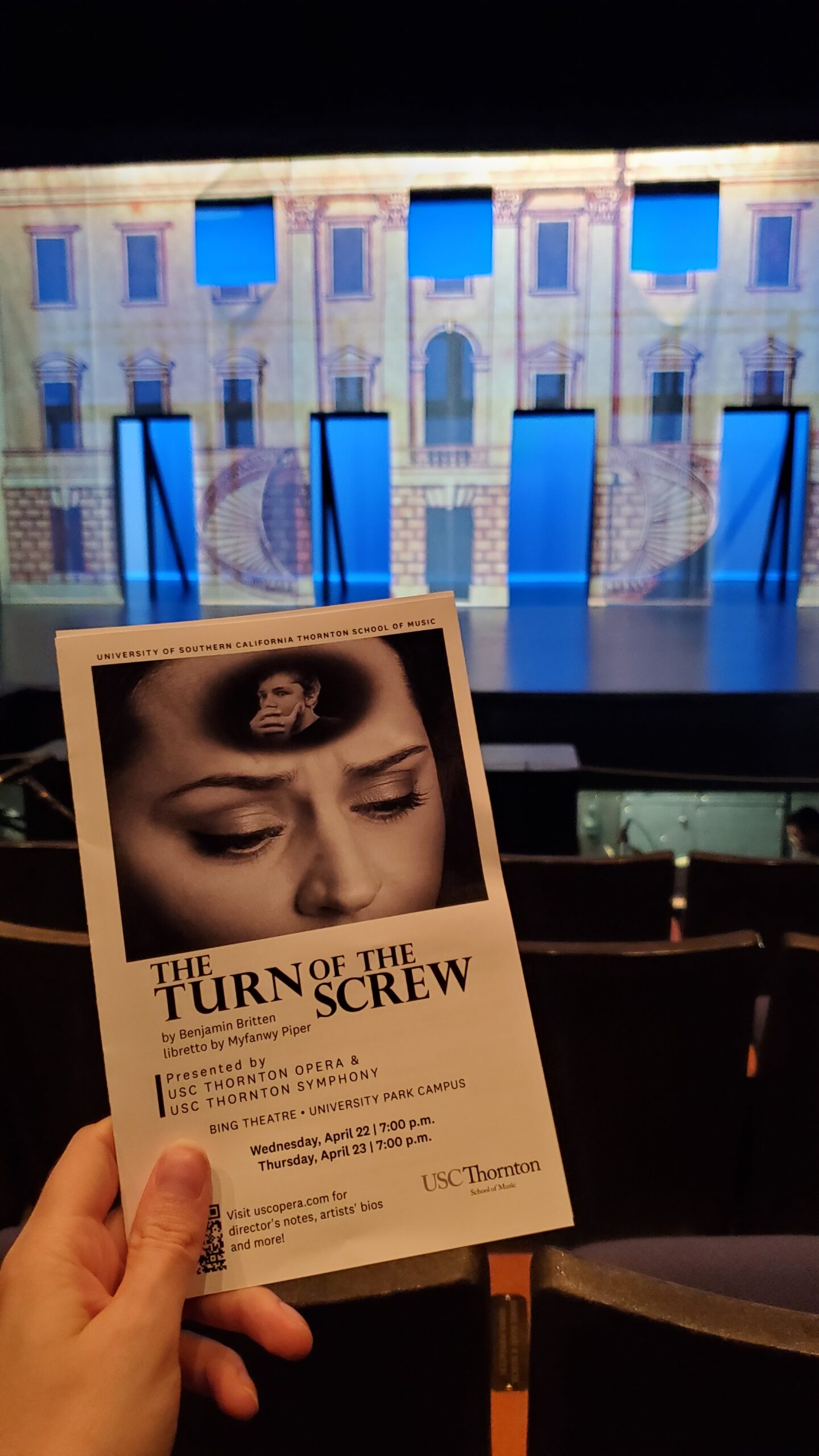
The Performance
While I was familiar with Turn of the Screw in general, I had never seen it all the way through.
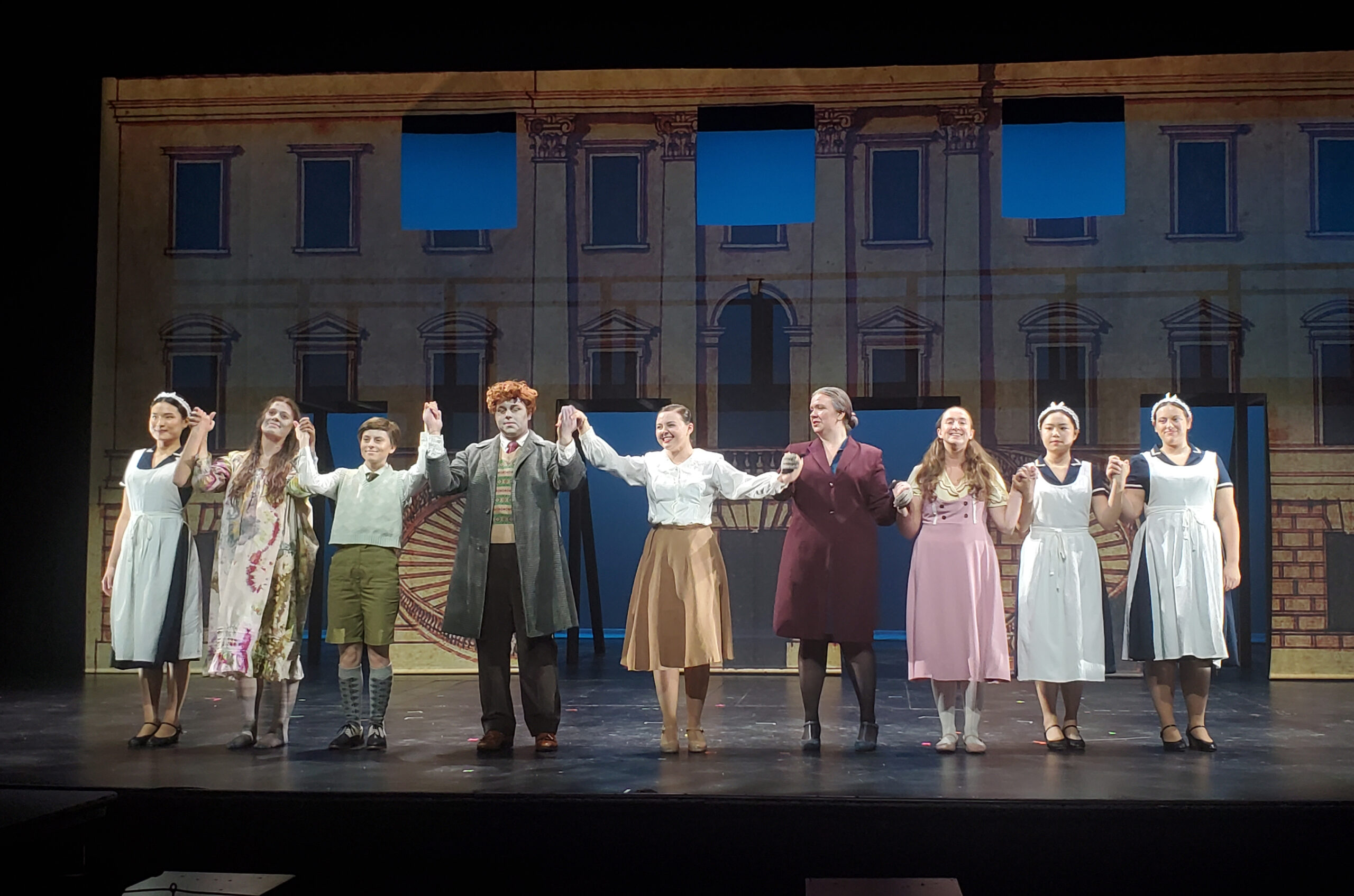
The set was simple and clean, with a lit backdrop in the far back, a translucent screen showing an old-fashioned building exterior, with various door portals and–I noticed just a bit later–a catwalk running behind it, elevated, with the stairs on each side fully off-stage. The translucency was a great effect which really enhanced the ghostly mood.
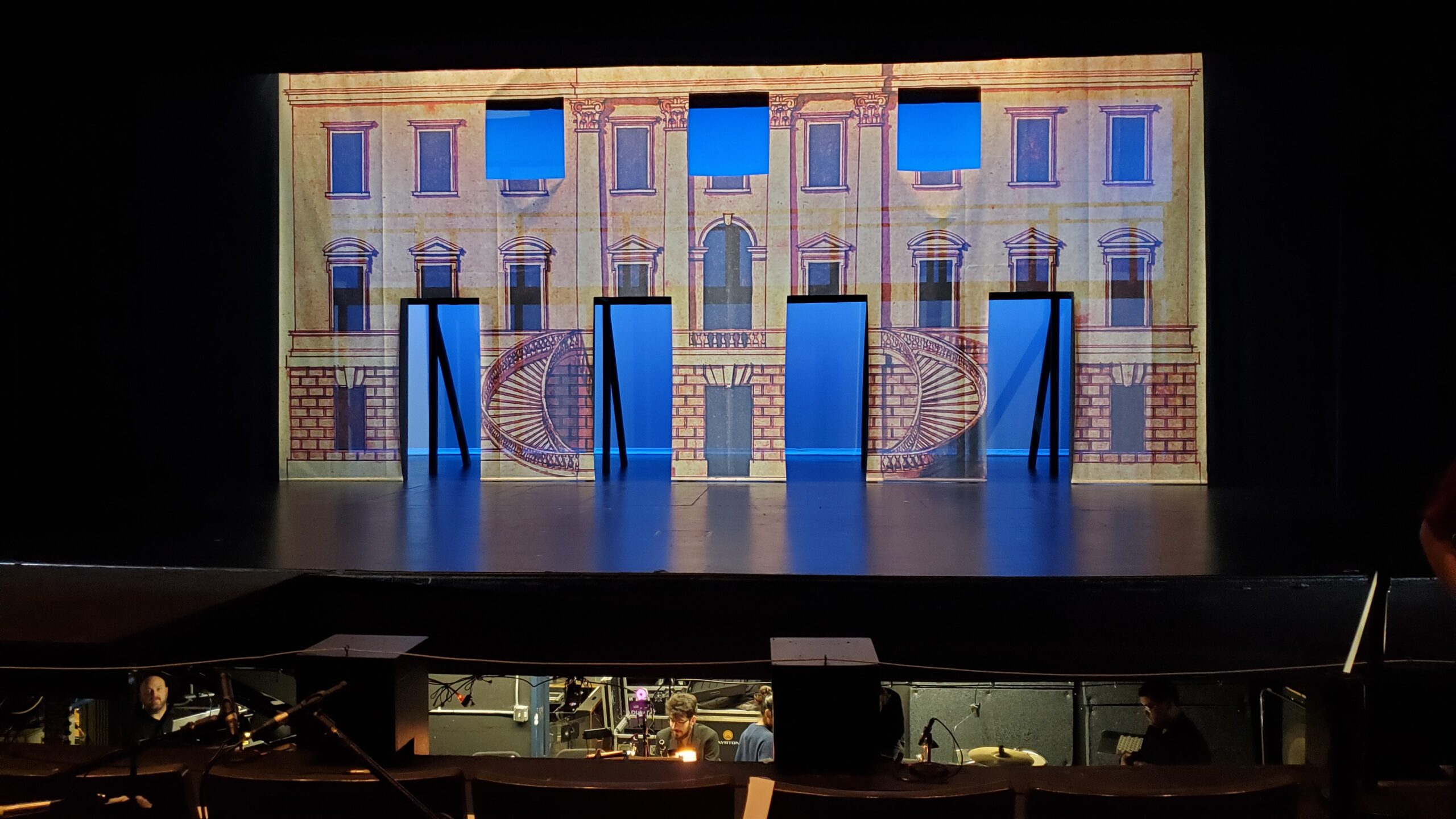
There were other small set elements wheeled on and off by a crew of “maid” stagehands–some chairs, a bed, a desk–and a double door that was lowered down on a wire from the ceiling. I don’t know why they chose to lower the door down instead of wheeling that in too, but in a later scene they did leave it oddly hanging halfway above. I presume this was to communicate an uneasy, uncertain mood in the scene but I’m not sure I fully grasped that aspect of staging. Not that it made a difference either way.
It was a smaller cast than Cunning Little Vixen, but I noticed in the program that the cast was completely different on the next night they were putting this on. There were some names I recognized from Vixen in the second night that I would’ve loved to see too.
The lighting was one of the best elements of the physical production. Great spotlighting, great effects, great gradual changes in color and warmth. For what I imagine is equipment more limited than a full opera house, the lighting technicians did a noticeably excellent job at bringing the paranormal to life. (I have since learned after writing this that the lighting director, David Jacques, is a seasoned professional and has worked with the director Ken Cazan for 22 years, and this is his final show before retirement.)
The lead, Mariah Schaumberg, played the Governess, a person brought in to help take care of some children while gradually realizing there are supernatural forces at work corrupting them.
(Or are there? Perhaps it’s all in her head? Sometimes this production can get a little mind-bendy with whether the ghosts are real, or if it’s all psychological manifestations in the Governess’s mind that she is then inflicting on these poor, harmless children. The USC production didn’t seem to go this route, though–the ghosts are definitely there for the Governess, even if only for her.)
Schaumberg started out just fine, if a bit quiet, but it felt like she stepped into herself more by the second act. She was best during the tense moments when she was singing against Mrs. Grose and the children and/or spirits.
Mrs. Grose, the housekeeper, was also solid, especially by act 2. I think her “old lady makeup” was a bit much; the black lines likely drawn with eyeliner across her forehead for wrinkles seemed a bit too obvious. However, Grose (played by Lydia Rae Brown) could sing impressively.
David Roitberg played Peter Quint (the ghost) and the smaller Prologue part. The makeup for Roitberg was great–the blue-green dead face was striking, especially in all the light effects. Roitberg played a great schoolmaster in Vixen and was good in the collection of opera scenes I saw earlier too. I liked him as Quint especially when his performance leaned more physical and strange. When he was getting uncomfortably close to other actors, pressing his head against them, pushing and pulling them around–this was the best, and helped sell the fear and strangeness. I would’ve liked to have seen that dialed up even further, and used more consistently throughout.
Miles, the most troublesome child, was played by Chloe Owens. This was some great costume and wig work; Owens was surprisingly convincing. Her expressions were one of the highest points of the show, with various smirks and looks and boyish physicality. Owens played the gamekeeper’s wife and a woodpecker in Vixen, both smaller roles, but here in Screw she showed she could take on a more central part without issue.
Alessia Jensen played a thoroughly drowned-looking ghost of Miss Jessel, who had fewer great moments to work with in the libretto but definitely made her presence known on the stage. Caroline Duers played Flora, the other child, who was styled so convincingly childlike that it was a real surprise when her powerful voice emerged.
I have mentioned the costume and makeup a few times here, and I must mention that the costuming was top-notch for the entire cast. For Vixen I noted that the costumes, while not bad, were very much “college production” level; for Screw they really delivered on a higher level. And with the one exception of Miss Jessel, the makeup and wig team did a great job as well.
The USC symphony orchestra played a great show too. I was especially struck by the bells.
The one aspect of the otherwise-good staging that I would’ve liked to see improved was the ending, which takes place near the river–I think? Or perhaps after finding Flora, the Governess goes back to their home to have the ending scene with Miles? I’m not sure, because there weren’t really any distinct stage elements for the lake, and none of the “home” setting elements were brought in for the scene with Miles. I think they could have done something starker with the lake, some kind of gnarled tree or cloth for water (an effect they used earlier on). Maybe the stage was bare to draw focus to the action, but it became too bare to fully establish location.
Overall, though, my complaints are minor, especially considering this is a student production. I’m surprised I don’t see more opera fans at these events regularly, because they are well worth it.
Full Cast & Context
The Turn of the Screw (the opera) is by Benjamin Britten, and the libretto is by Myfanwy Piper. The original story was written by Henry James.
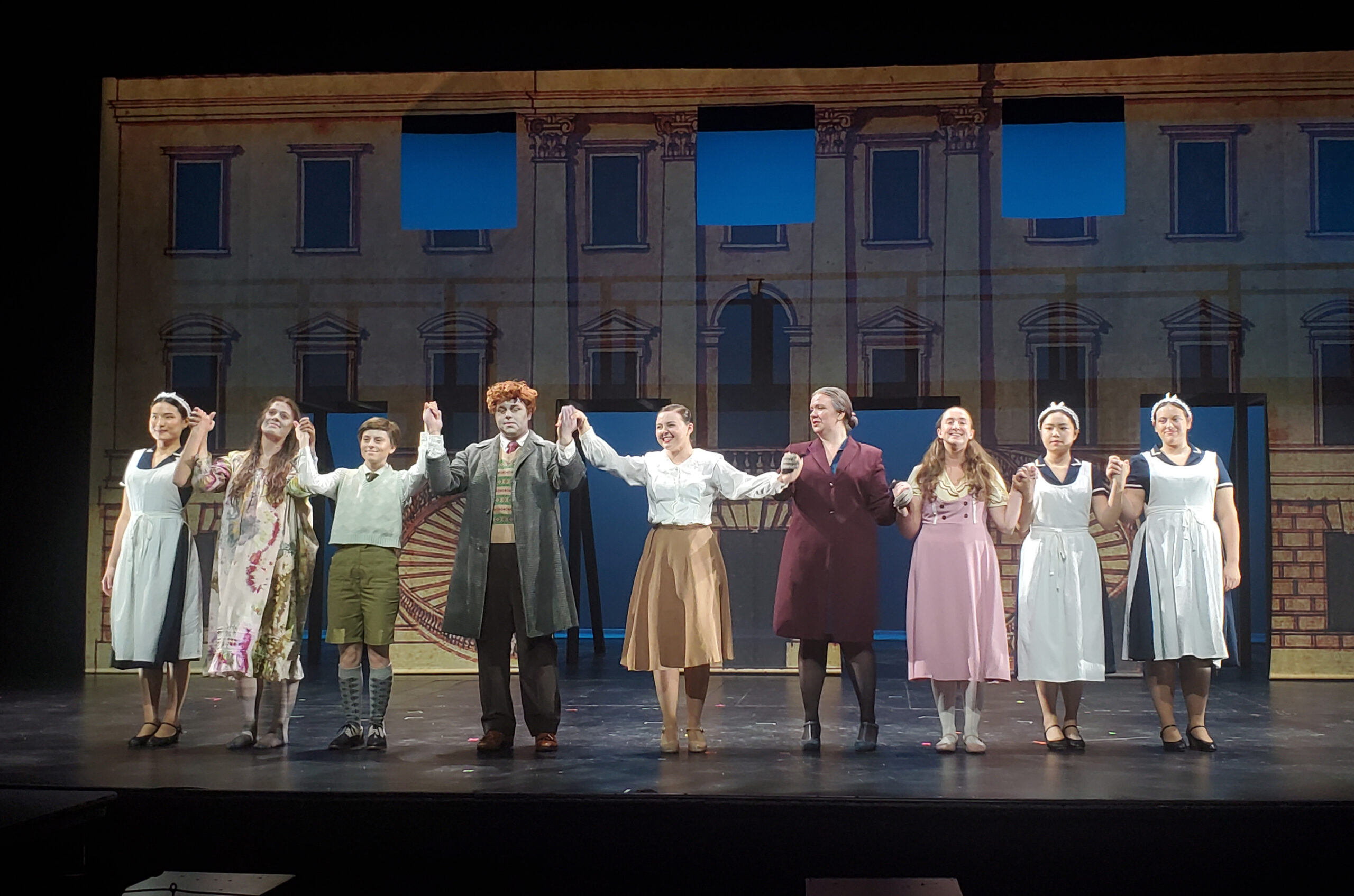
The Wednesday cast, which I saw, included:
- David Roitberg: Prologue / Peter Quint
- Mariah Schaumberg: Governess
- Chloe Owens: Miles
- Caroline Duers: Flora
- Lydia Rae Brown: Mrs. Grose
- Alessia Jensen: Miss Jessel
The Thursday cast included:
- Domen Vurnik: Prologue / Peter Quint
- Tanvi Thatai: Governess
- Citlali Garcia: Miles
- Madeline Braun: Flora
- Joo Won Chae: Mrs. Grose
- Rachel Fagerberg: Miss Jessel
The servants (stagehands) were:
- Kaylee An
- Yuxuan Lin
- Nikki Smith
- Keilah Mora
The main creative team included:
- Brent McMunn: Conductor
- Ken Cazan: Stage Director / Set Designer
- Elena Flores: Costume Designer
- David Jaques: Lighting Designer
- Kelsey Araghi: Associate Lighting Designer
- David Anglin: English Super Titles
- Carl St. Clair: Principal Conductor & Artistic Leader (USC Thornton Symphony)
- Sharon Lavery: Resident Conductor (USC Thornton Symphony)
The opera production crew included:
- Kat Denning: Stage Manager
- Keilah Mora: Assistant Stage Manager, Performances
- Paige Speaker: Assistant Stage Manager, Performances
- Christopher Hoffman: Technical Director
- Ben Altman: Scenic Crew
- Alexander Hathaway: Scenic Crew
- Eileen Den Adel: Assistant Costume Designer
- Nia Heinrich: Wardrobe Assistant
- Kelsey Araghi: Associate Lighting Designer
- Colin Postley: Head Electrician
- Cynthia Ayala: Console Programmer & Operator
- Izzat Marchi: Electrician / Board Operator
- Karen Forrest: Deck Electrician
- Jose Donado: Deck Electrician
- Frank Perez: Deck Electrician
- Theodore Gordon: Driver
- Kirk Graves: Props Master
- Cortney Heiser: Lead Makeup Artist
- Gratia Arguelles: Lead Hair & Wig Stylist
- Chris Paci: Theatre Manager
- Edgard Tom De Dios: Assistant Theatre Manager
- Adam Borecki: Audio & Video Live Streaming Engineer
- Dario Griffin: Production Photographer
- Lalaina Rabetsimba: Supertitles Operator
The orchestra included:
- Juchao Zhao: Violin I
- Diana Dawydchak: Violin II
- Matthew Pakola: Viola
- Jaemin Lee: Cello
- Julien Henry: Bass
- Carter Williams: Harp
- Dennis Papazyan: Alto Flute / Piccolo
- Connor Feyen: Oboe / English Horn
- Mauricio Castillo: Clarinet / Bass Clarinet
- Anjali Pillai: Bassoon
- Jean Smith: Horn
- Luciano Valdes: Timpani / Percussion
- Carl Pantle: Piano
The Turn of the Screw is a chamber opera based on a ghost story by Henry James. The lore is loose, but the score is tight and eerie, built from a theme and variations that keep tightening the tension as it goes.
Benjamin Britten, who composed the opera adaption of Screw in 1954, lived from 1913-1976 and was one of the central British composers of the 20th century. He’s also known for works like Peter Grimes and Billy Budd that can show layers of psychological depth.
Henry James (1843-1916) was a novelist and short story writer known for his precise, psychologically intense prose. He was born in the US but eventually became a British citizen.
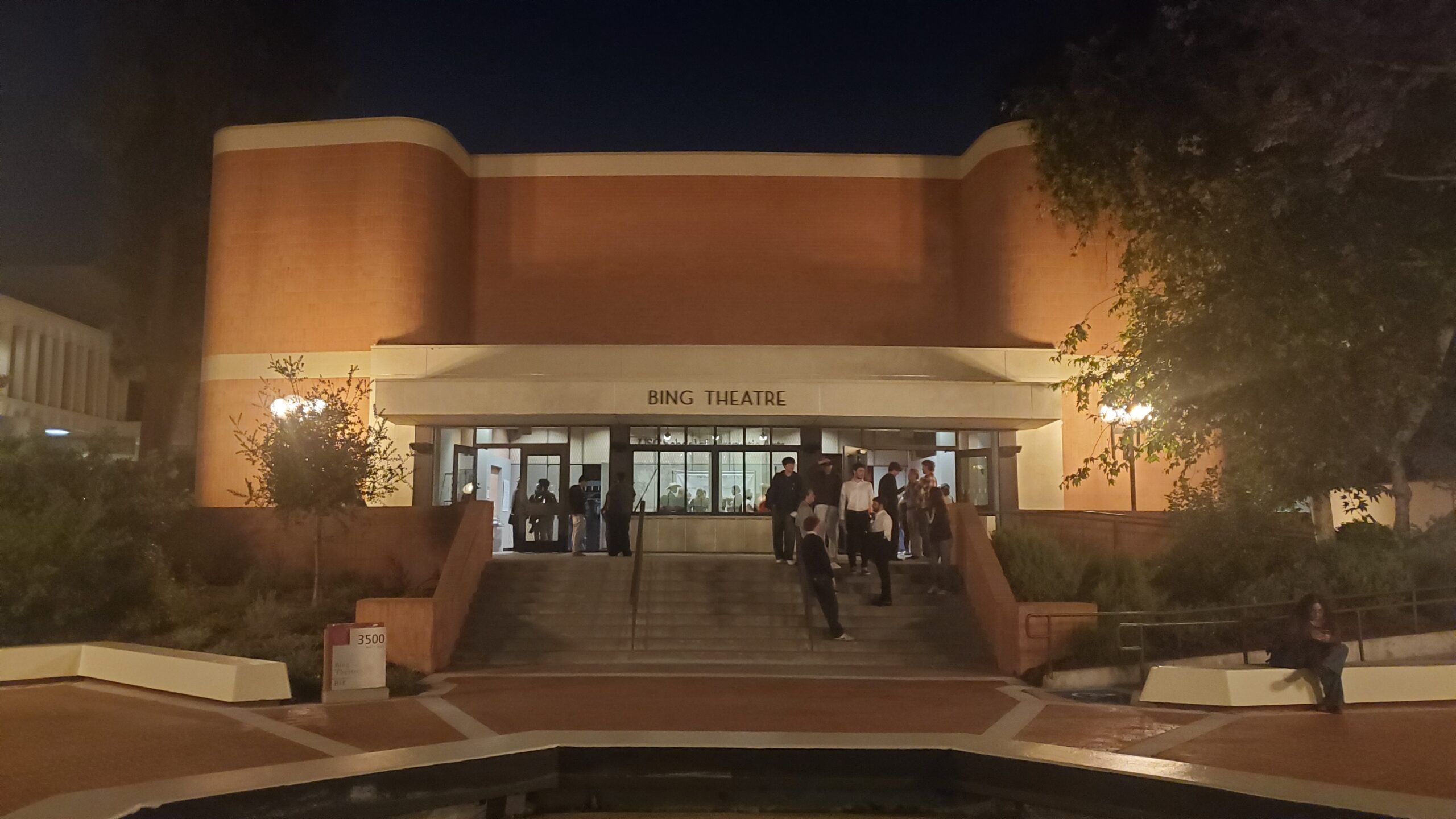
The University of Southern California (USC) was founded in 1880, making it one of LA’s oldest major schools. It’s just south of downtown and has its fingers everywhere in SoCal culture. Bing Theatre opened in 1976 and is named for USC trustee Anna Bing Arnold, in thanks for her generous gift.
USC Thornton School of Music is USC’s music conservatory-level division. It’s named after Flora L. Thornton, a philanthropist whose 1999 gift led to the naming rights. It’s known for classical works, composition, and contemporary music programs, and is a training ground for professional-level performance.