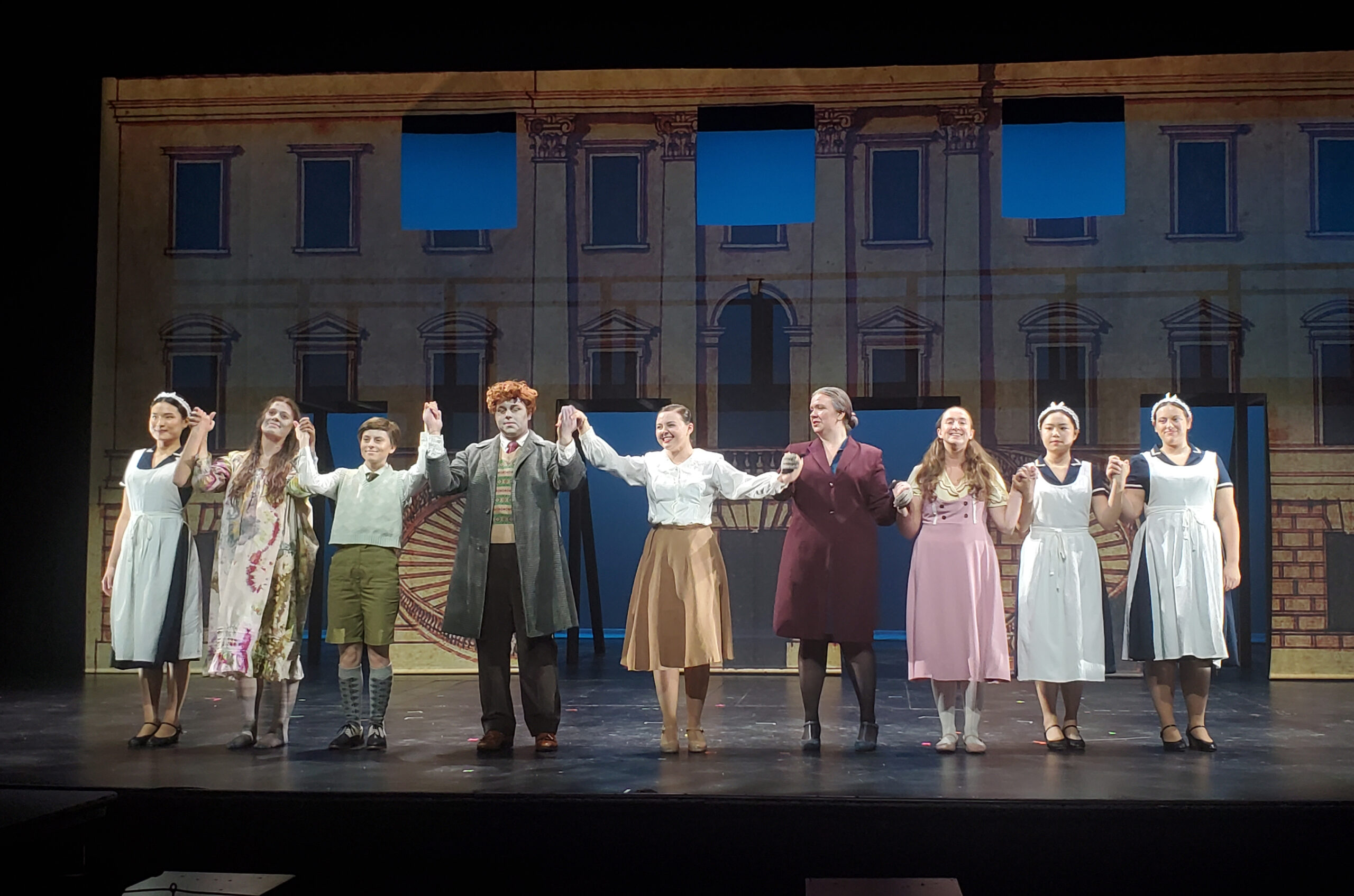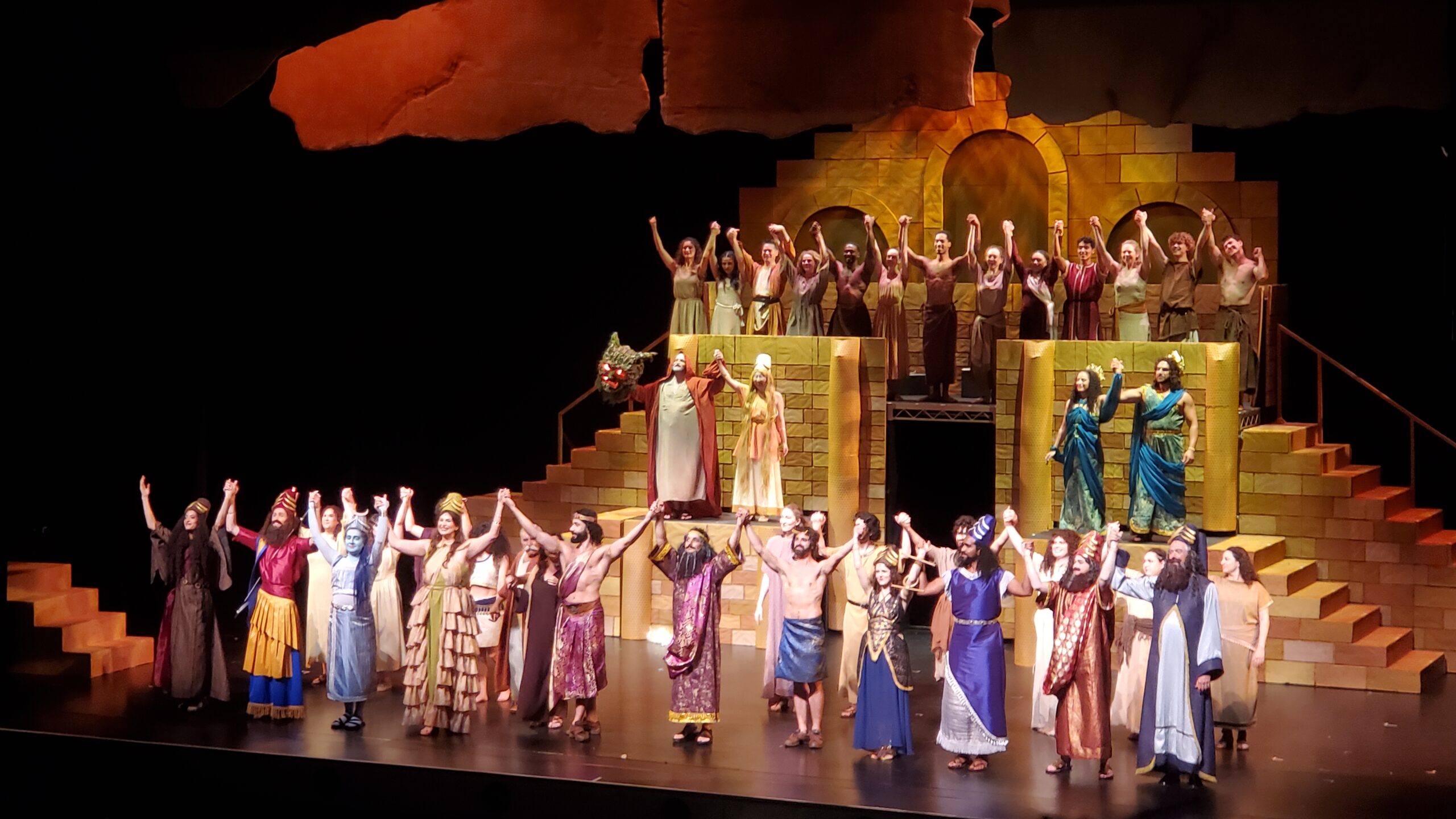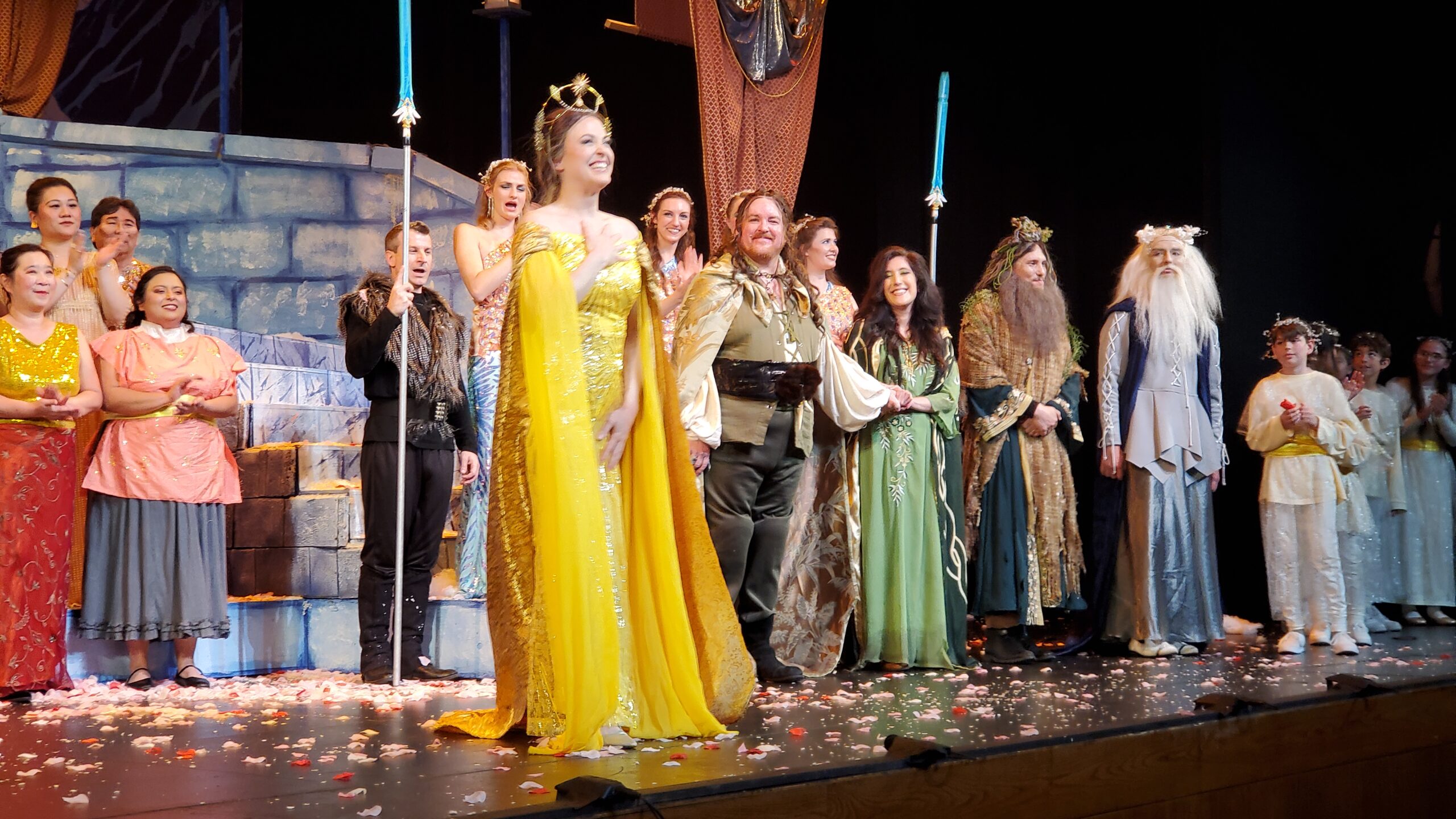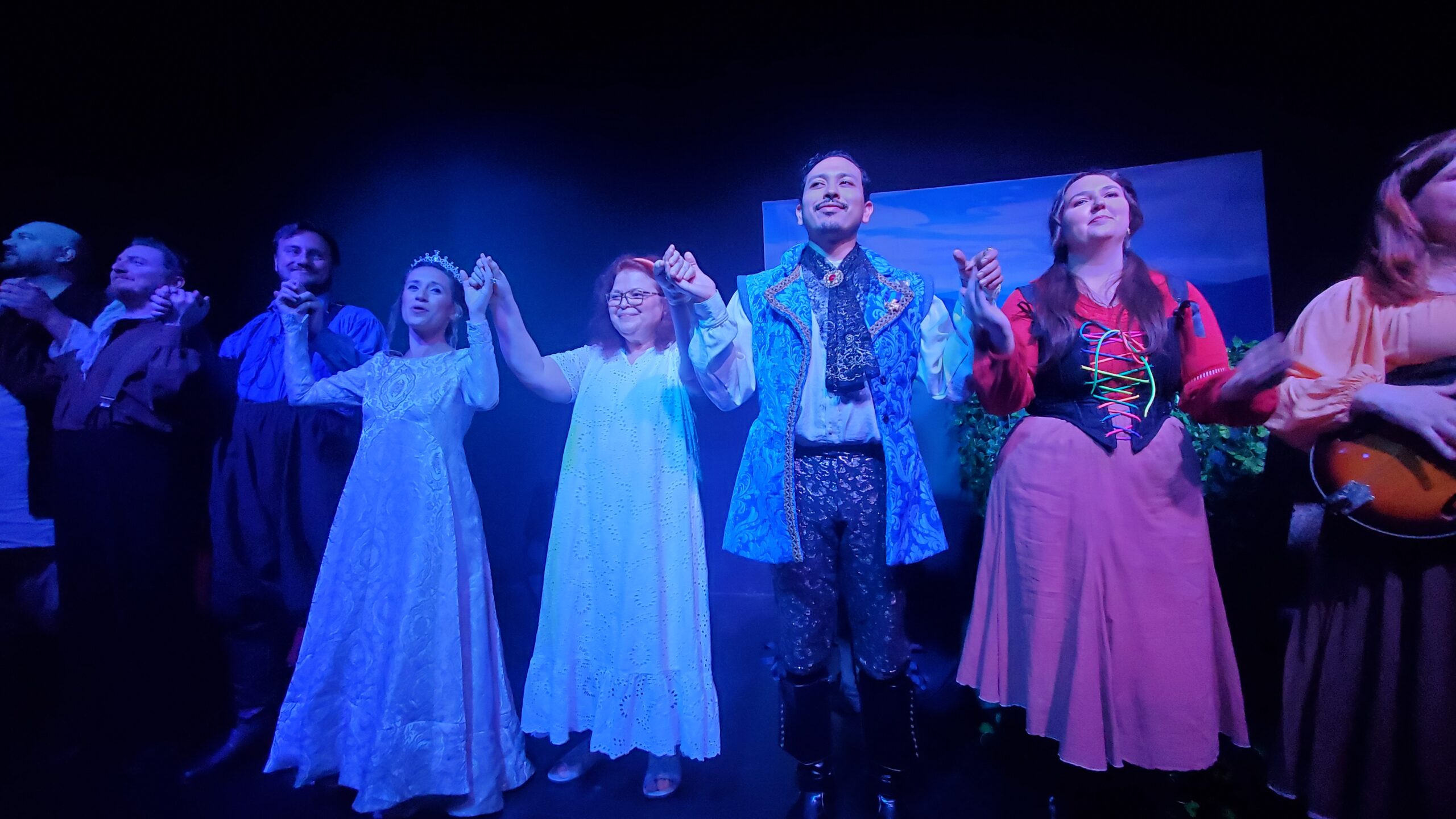
When researching opera opportunities in Los Angeles, I stumbled onto the University of Southern California’s opera program, through their Thornton School of Music. So I decided to go to their next show, which happened to be the somewhat more obscure The Cunning Little Vixen by Leoš Janáček.
This isn’t exactly a rare opera, but not exactly a common one either. In Europe, especially in Czechia and Germany, it’s a lot more common, since it originally premiered in Brno (Czechoslovakia) in 1924. In the US, it comes around now and then. It’s a good choice for a college music program since it can work with a large cast who can all have smaller parts if necessary.
This ended up being a delightful performance. While obviously the student opera isn’t quite at the level of a professional company, the difference is not really that wide. As long as you’re not expecting LA Opera levels of production value, I think you’ll be pleasantly surprised–and you’ll get to see the next generation of opera stars early on.
Arriving
Cunning Little Vixen was being performed at Bing Theatre, which is on the USC campus. This is an easy metro ride, with an E line train stop right next to one of the campus entrances. I went on 11/19/2025.
USC is a gated campus with a couple controlled access points. You may have to tell someone you’re here for a specific show and going to a specific hall, and they can help you with directions, too.
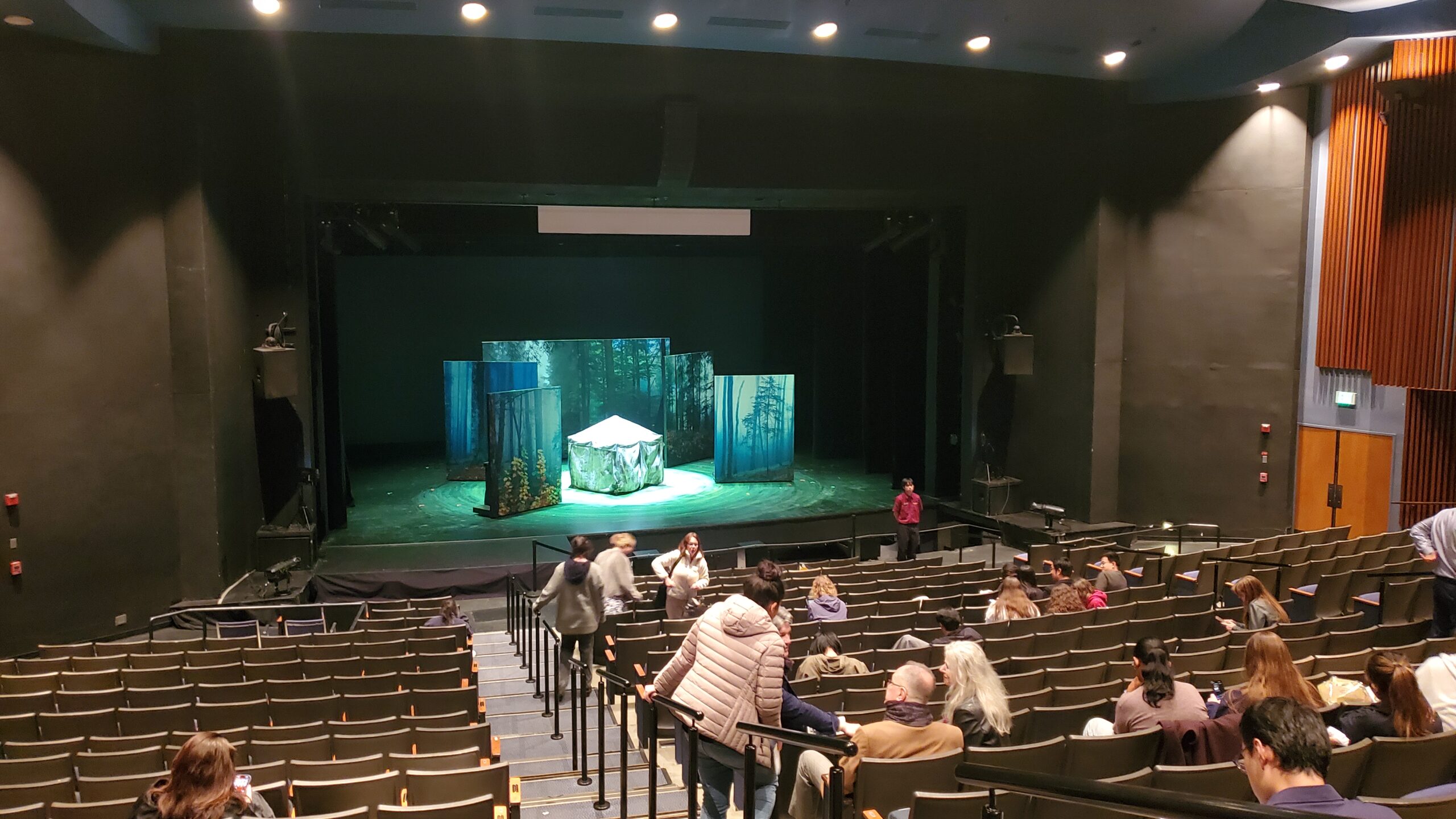
I arrived pretty early, and it was fun to walk around the campus a bit and see the architecture and statues. Then I made my way to Bing Theatre, which is a traditional theater space with 550 seats, the school’s largest venue.
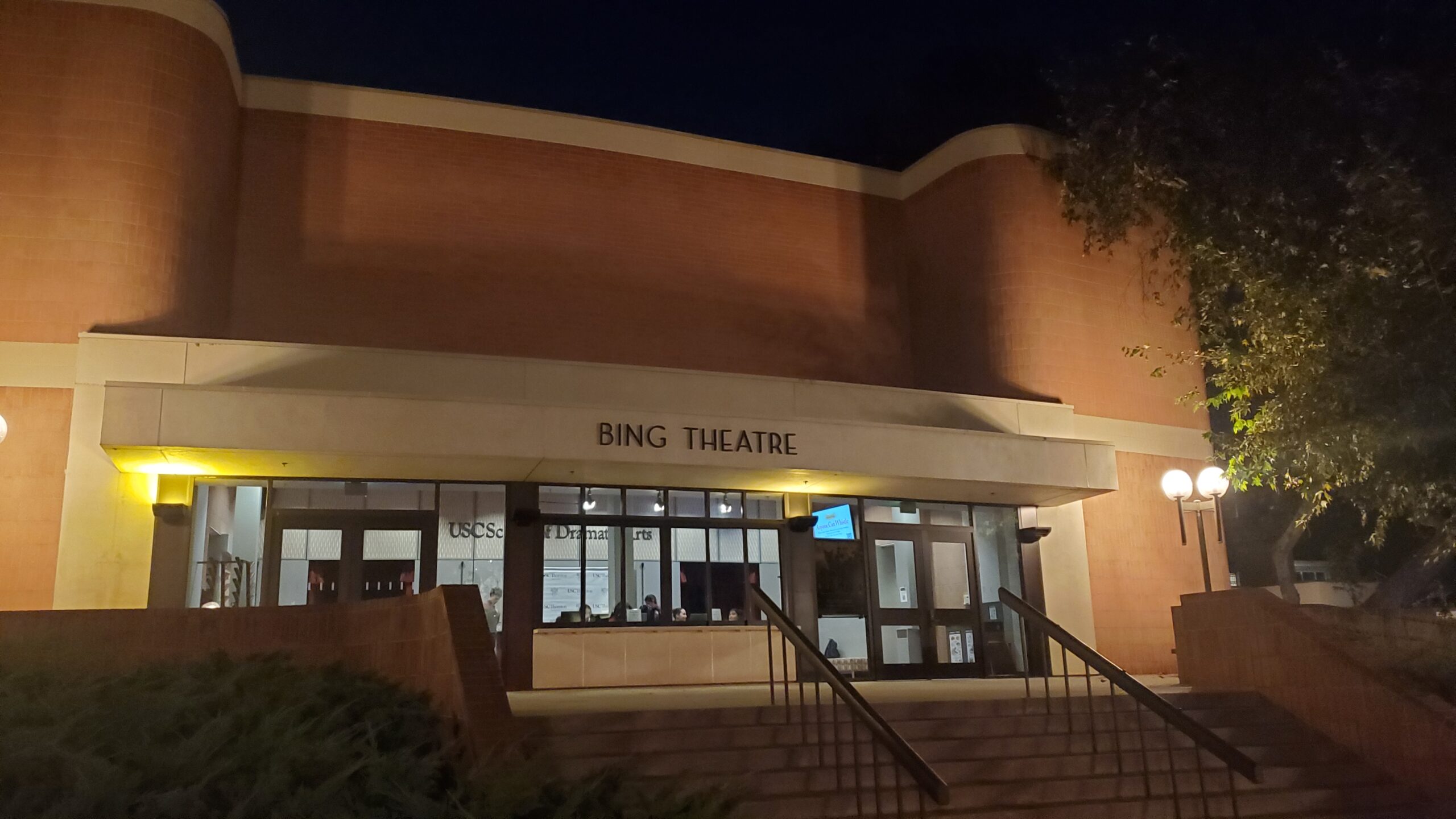
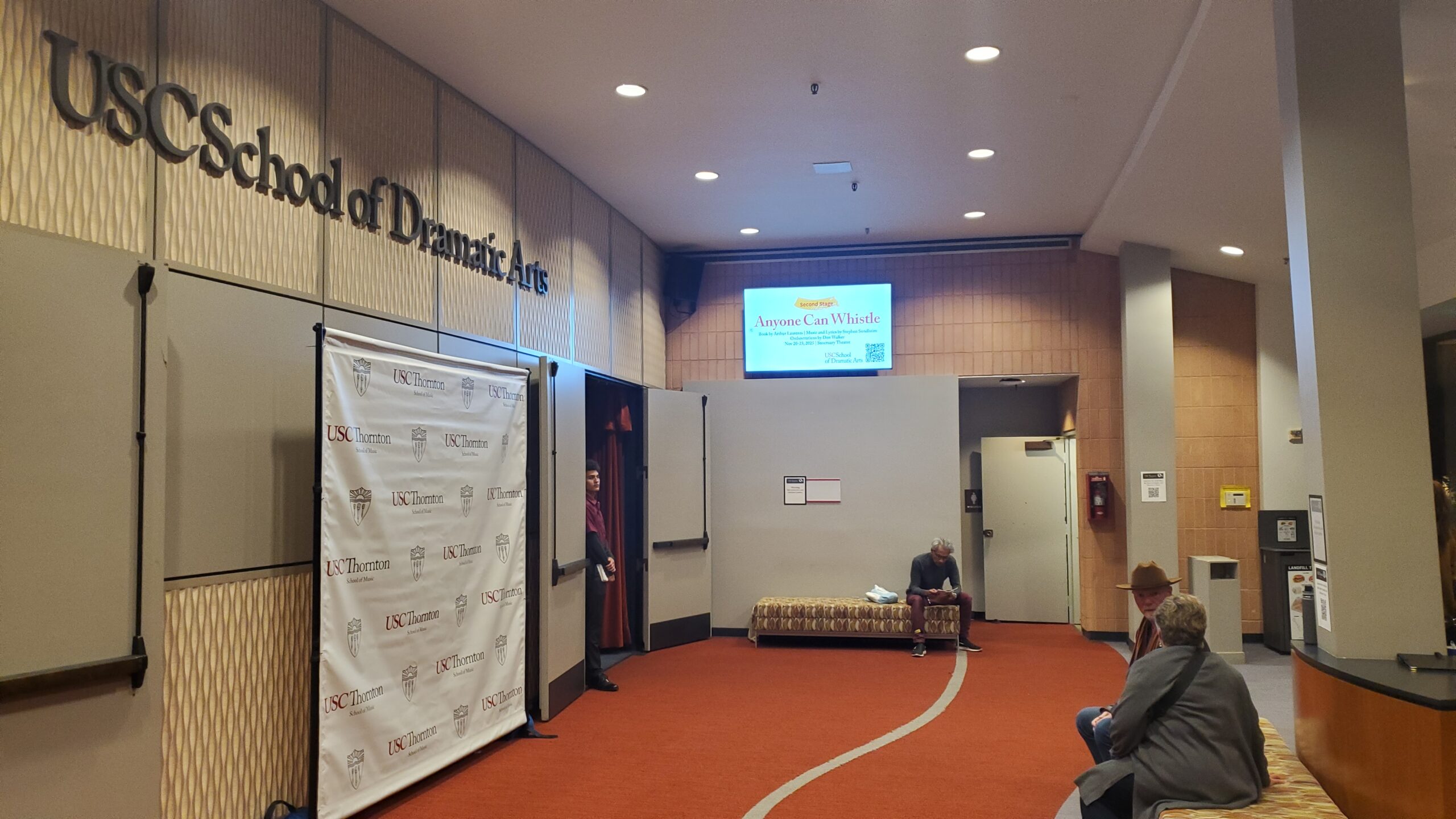
There is a nice lobby space, and the student staff was all very friendly.
Bing Theatre was a very nice space. It’s a large theater, with no balcony but nicely sloping seats, so those in the back rows could see easily too. I took a few shots of the interior so you could get an idea of the whole space. I especially appreciate the wide aisles with two lanes and railings, which make it easy for the elderly to make their way down, and also easy for those who walk faster to have more room to leave.
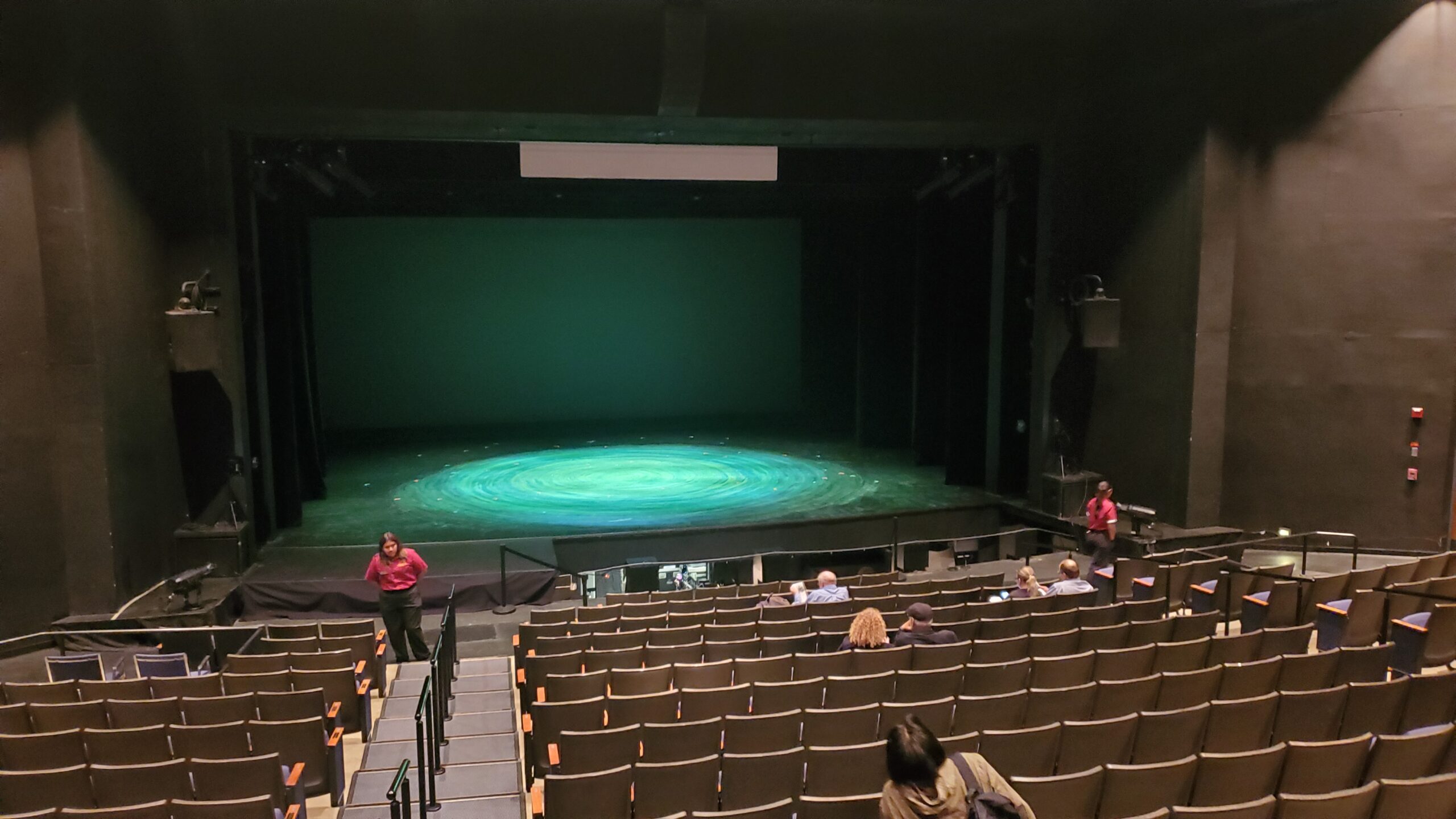
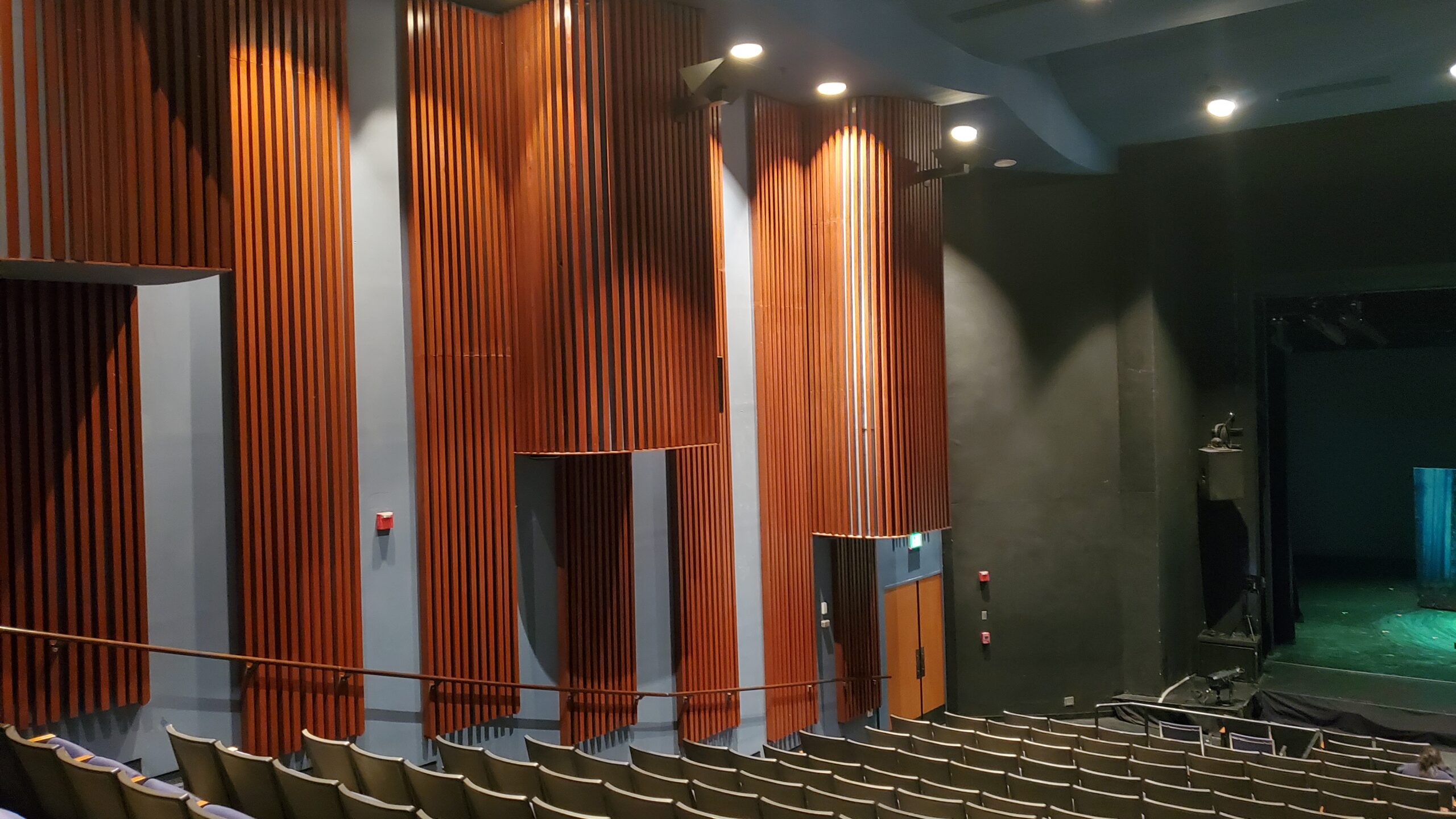
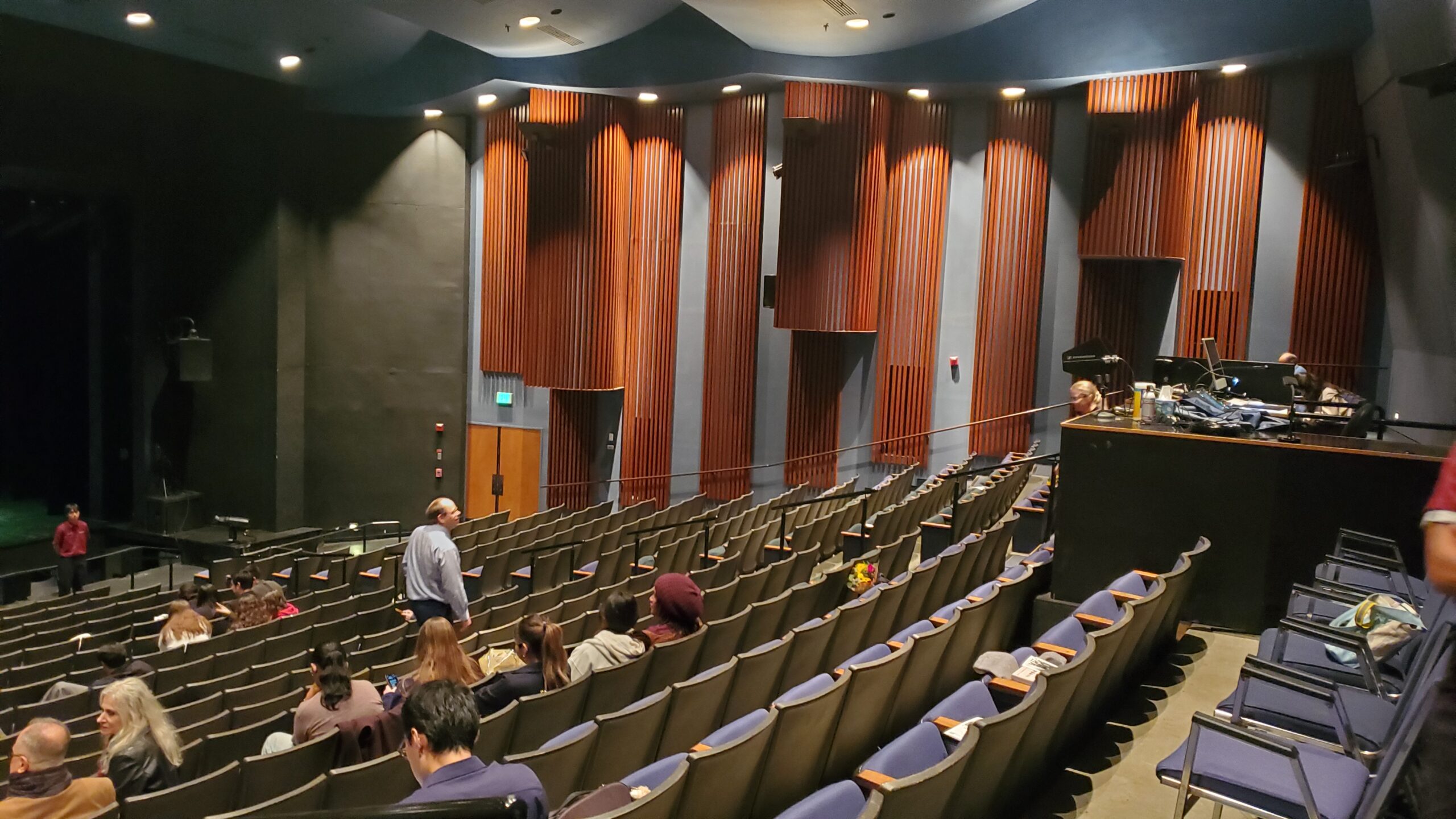
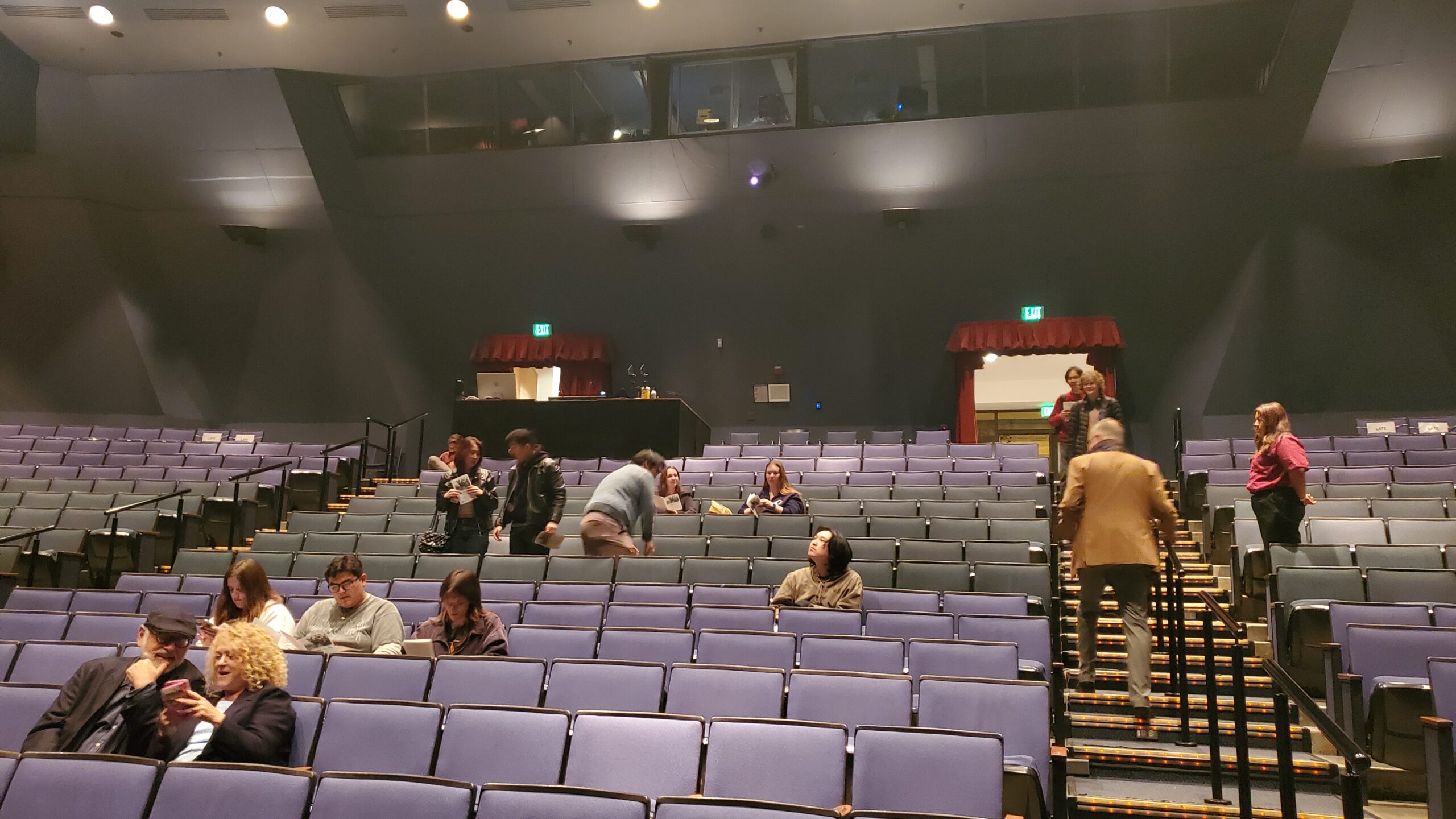
The orchestra pit was, for once, a real pit in front of and below the stage, and it even had its own lower-floor access points, so performers could come and go without having to step over awkward boundaries or go through the audience exits.
Normally, the conventional wisdom in opera seating states that you don’t sit in the very front next to the pit, because at that distance, the orchestra will overshadow the voices of the performers. I had always wondered how true that was, and since this was a lower-stakes “sit anywhere” type of event, I decided to sit in the very front row center.
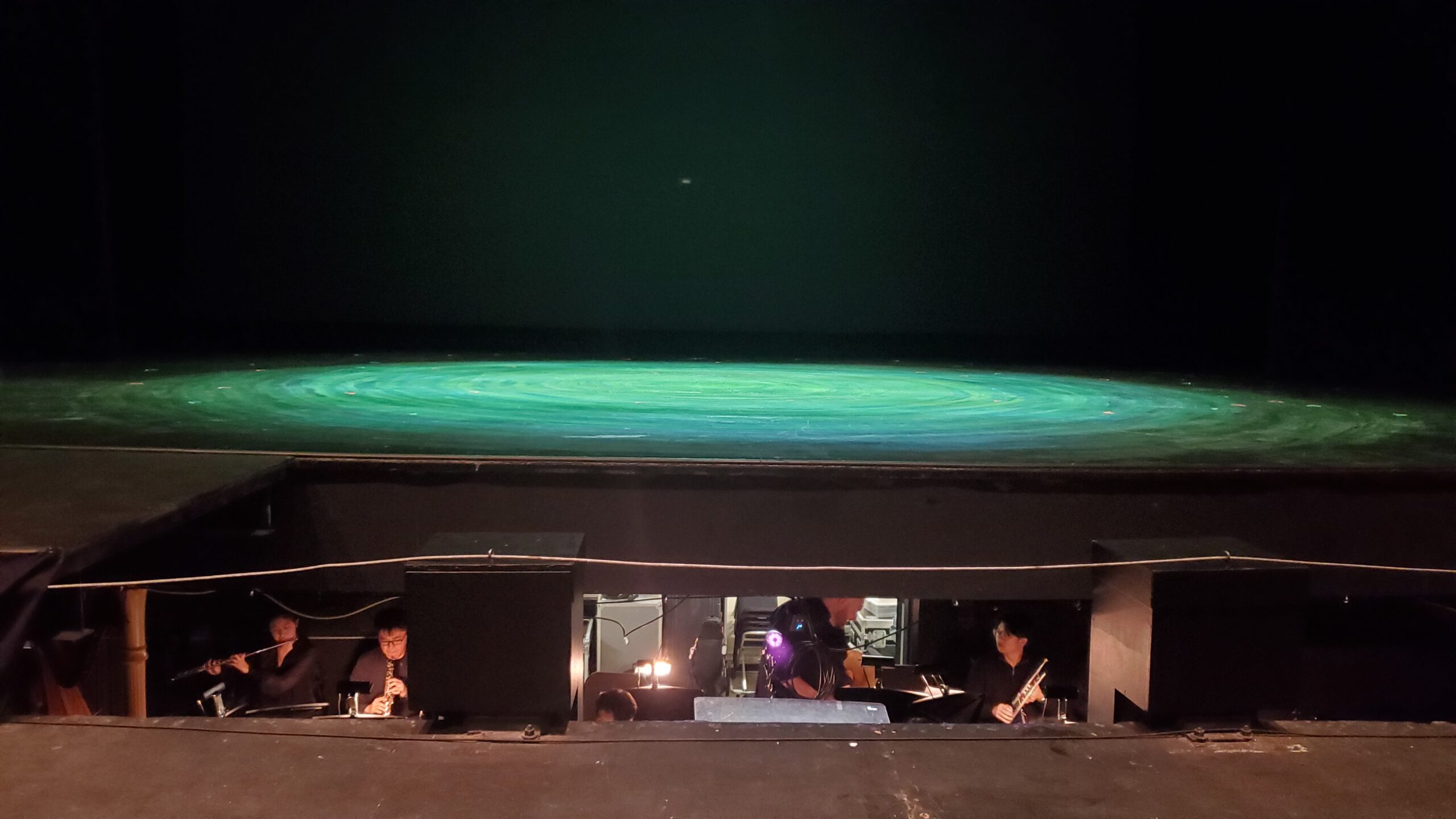
As more of a crowd filtered in, the lights eventually dimmed and the show began.
The Performance
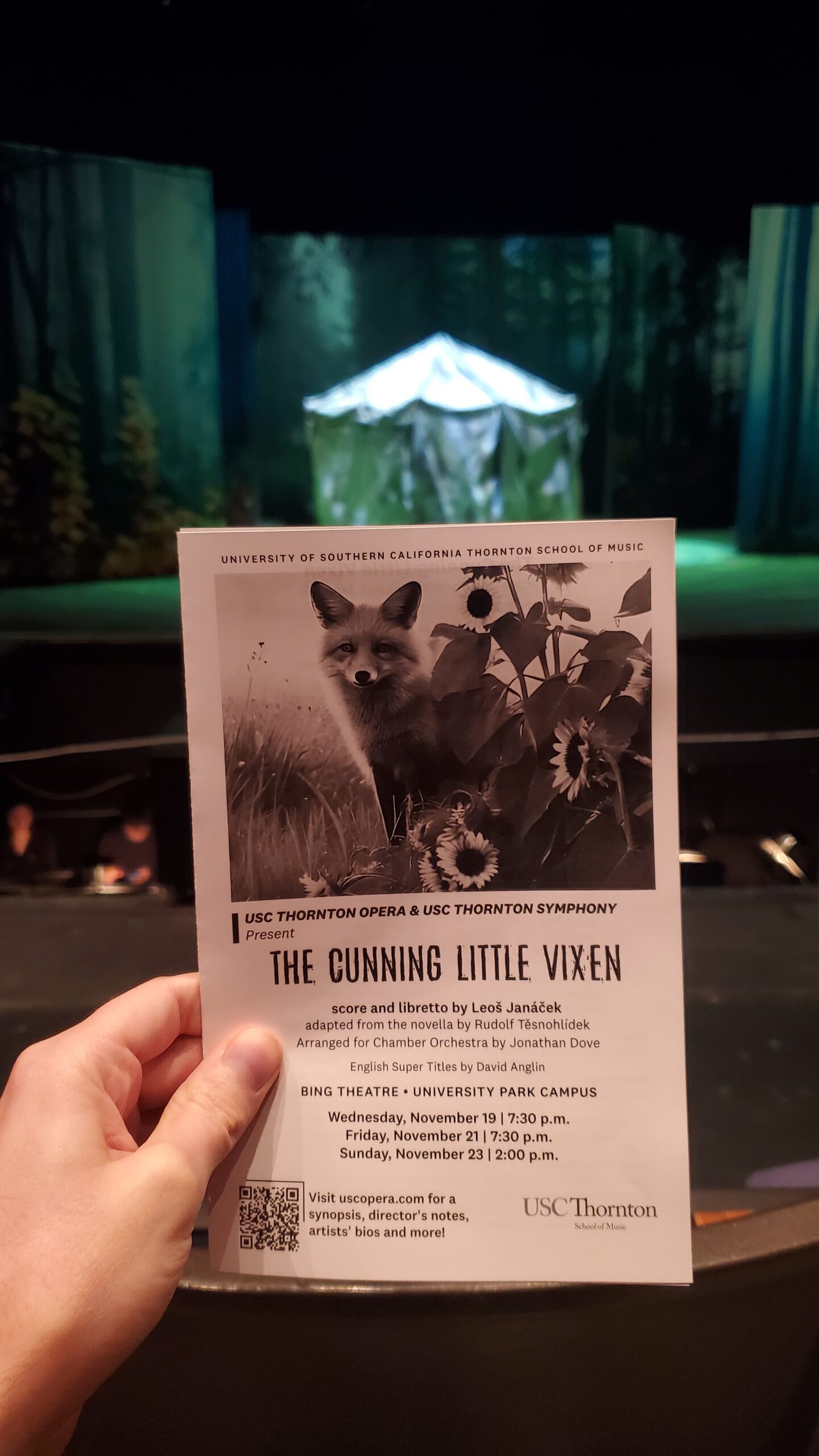
The Cunning Little Vixen opens with a gamekeeper (Matthew Weir) in the woods, who captures a sharp, spirited little fox cub–the eponymous cunning little vixen–and brings her home for his kids to play with. Our vixen is played by Yealim Kim.
She grows up in captivity, getting bothered and fed up with human nonsense, including the gamekeeper’s wife (Chloe Owens) and their dog Lapák (Trinity del Regno). She finally bites back and escapes to her freedom, back to the forest. Empowered by her time with the humans, she outsmarts a pompous badger (Christopher Renfro) and takes over his burrow.
The forest is constantly filled by a large cast of different animals darting around, with a dozen or so creatures always doing something or other. The costumes are light and silly, and I suspect the budget may have been stretched on this aspect; no costume was bad by any means, but this was perhaps the area where the “college production” aspect was most evident.
We also see interspersed scenes with the human gamekeeper again, along with the schoolmaster (David Roitberg), the parson (Michael Mensah), and a nastier poacher named Harašta (William Jacobson). They grumble about lost love, missed chances, and melancholy regret, while drinking too much at a bar owned by the beleaguered Mrs. Pásková (Yuxuan Lin). Aging up college actors to look middle-aged or older is another area where the “college production” aspect shows, where a regular company would simply cast older actors, but there’s nothing you can do about that here.
Our vixen meets another fox, a handsome male (Julia Sapeta), and the two have a quick, flirtatious courtship. There’s a wedding. The forest scenes are high-energy, full of light and color and motion, although there’s also an undercurrent of something older and more uncaring deeper within the spirit of the ancient trees.
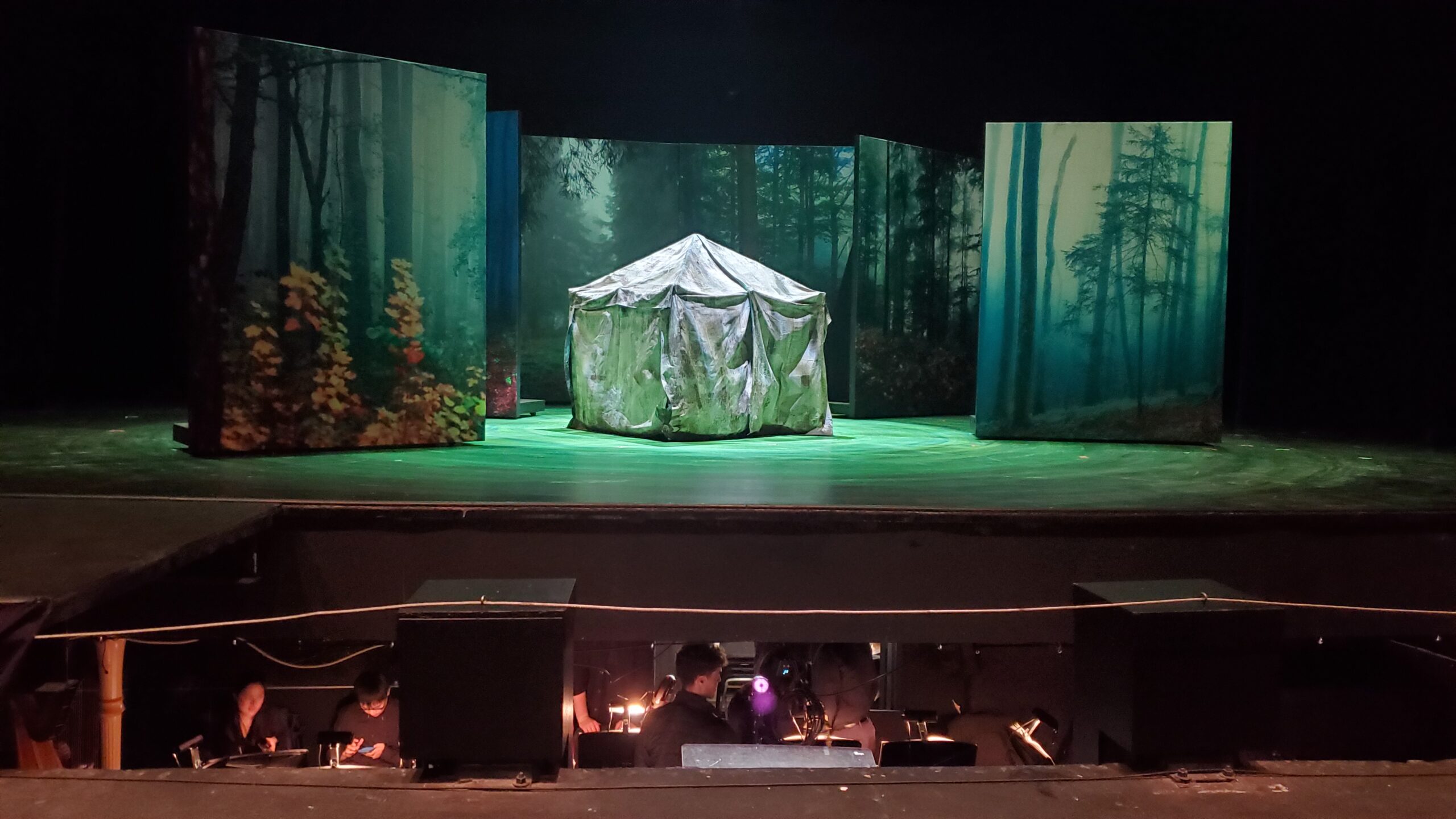
There’s a short intermission, and when we return, our vixen and our fox have produced a litter (portrayed with stuffed animals). One, then another, then another–Sapeta’s male fox is suddenly overwhelmed by the number of children he now has to support!
In the final act, set a little later, our vixen comes across Harašta, the poacher, and gives him the same mischief she’s delivered on others. He wants her fur to use to woo some poor woman in the village; the vixen helps her cubs avoid his trap and leads him away on a chase. Shockingly, Harašta just shoots her.
It’s sudden, abrupt, and unsentimental, though it still felt very sad. A forest funeral is held. And yet–life goes on. Finally, the gamekeeper returns to the woods, older and reflective, and encounters a young fox cub (Yealim Kim once again–a descendent of our original vixen). He’s reminded of the vixen, and realizes that the cycle of life simply keeps on turning. He passes away in the forest, with young animals around him, looking on. The opera ends, not in tragedy, not in comedy, but in a quiet sort of reflection on the nature of living.
I had a great time–this was a very good show. To be clear, by the end I was not thinking “this is a great college performance,” I was thinking “this is a very good performance,” no qualifiers necessary. It helped that the material itself wasn’t too simplistic. It was a piece I needed to reflect on after seeing.
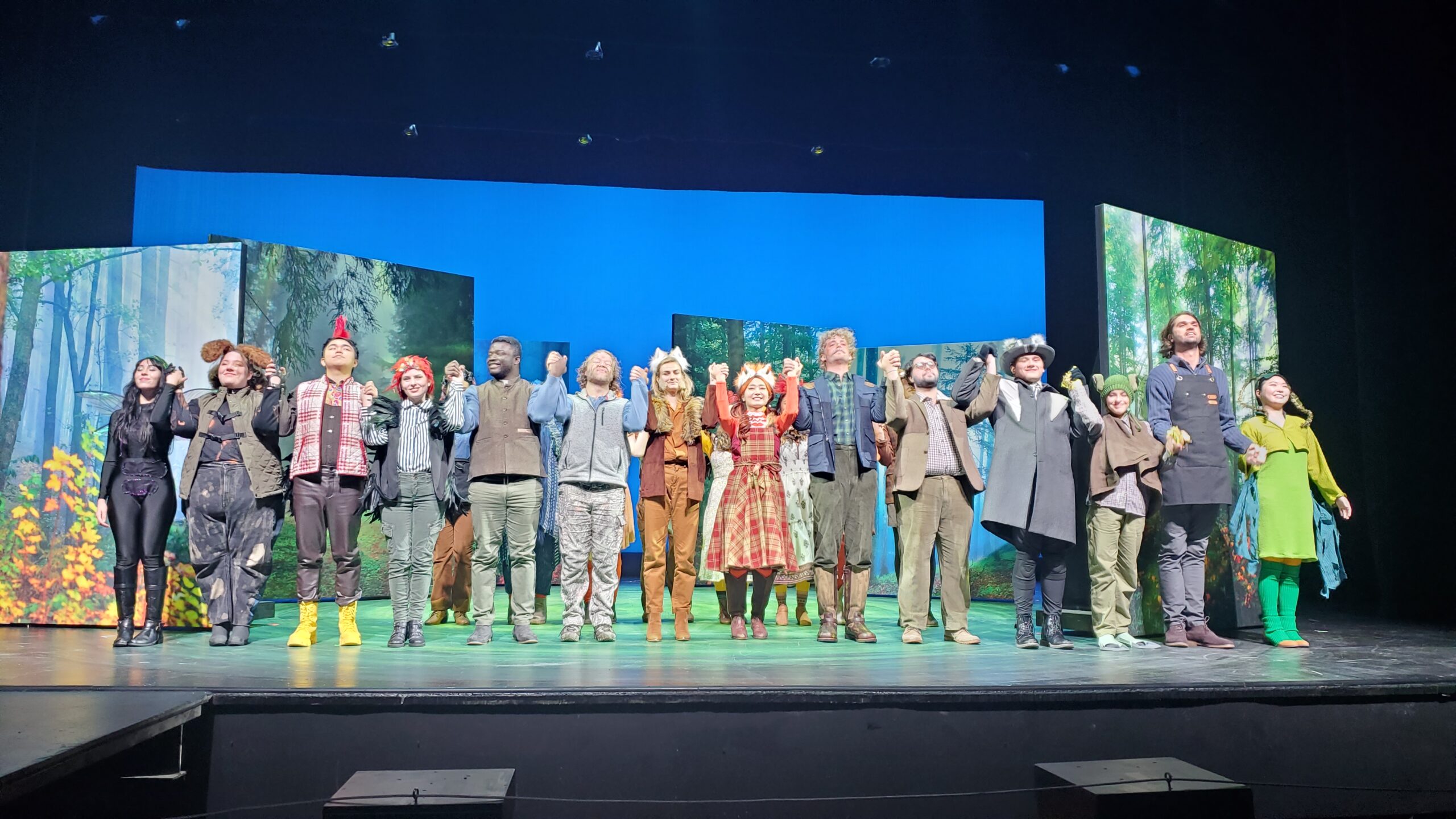
Staging was one aspect that succeeded very well here, with simple-enough elements used very well and accompanied by very good lighting design. This helped a lot.
Performance-wise, the obvious standouts, Kim and Sapeta, did an excellent job as the fox couple. Kim was vocally precise and had very fun stage energy, completely believable as a sassy fox, and got to show off her wonderful voice. Sapeta performed well too, especially as she had to work through some accidental costume difficulties. Some of her expressions and reactions were among the funniest parts of the night.
For the humans, I enjoyed Weir, Roitberg, Mensah, and Jacobson as well. Weir was solid as the main human figure in the story, and portrayed him well as not necessarily a good or evil figure. Jacobson stood out as the poacher Harašta, who was a recurring presence with just the right amount of uncaring chaotic energy which ultimately led to the vixen’s death.
Finally, although the part involved little to no singing, I thought that Citlali Garcia played the role of Dragonfly with a mesmerizing and nimble stage presence that was always a delight to see. While perhaps a less challenging role, it helped tie scenes together well.
The orchestra was also comprised of students from the USC Thornton Symphony. They were quite good, certainly on the level of any average professional orchestra pit I’ve seen.
The result of my experiment of sitting so close to the orchestra, by the way, was that yes, it did feel a little imbalanced at times, with the orchestra a bit louder than the vocals, but not so much that it made a huge difference to my enjoyment. Being up front was not an operatic crime, at least not in this theater. It was also fun to get to see down into the pit the whole time too.
Attending this performance was a delight, and I can’t wait to see some of these students go on to professional productions in the future.
Full Cast & Context
The large student cast of The Cunning Little Vixen was:
- Yealim Kim: Vixen Bystrouška
- Julia Sapeta: Fox
- Matthew Weir: Gamekeeper (also known as the Forester)
- Chloe Owens: Gamekeeper’s Wife, Woodpecker, Voice of the Forest
- David Roitberg: Schoolmaster, Voice of the Forest
- Michael Mensah: Parson, Voice of the Forest
- William Jacobson: Harašta (poacher), Voice of the Forest
- Domen Vurnik: Pásek, Voice of the Forest
- Yuxuan Lin: Mrs. Pásková, Owl, Forest Creature, Voice of the Forest
- Julia Ruddy: Pepík, Cricket, Baby Fox, Forest Creature, Voice of the Forest
- Brianna Raygoza: Frantík, Baby Fox, Voice of the Forest
- Kaitlyn Son: Grasshopper, Hen, Forest Creature, Voice of the Forest
- Brook Lebron: Young Frog, Baby Fox, Forest Creature, Voice of the Forest
- Leverett Wilson: Mosquito, Voice of the Forest
- Trinity del Regno: Lapák (a dog), Voice of the Forest
- Bingkai Meng: Cock, Voice of the Forest
- Karah Rhoades: Chocholka (a hen), Jay Baby Fox, Forest Creature, Voice of the Forest
- Christopher Renfro: Badger, Voice of the Forest
- Lindsay LaFollete: Hen
- Camila Ruiz: Hen, Baby Fox, Voice of the Forest
- Aileen Conner: Hen, Voice of the Forest
- Citlali Garcia: Dragonfly
The program lists the members of the USC Thornton School of Music symphony orchestra, but I’m confident that all of these people were not down in that pit! Only a handful of the following people were there, and I don’t know which, so while I’ll list them all, I’ll refrain from tagging them.
- Anna Renton: Concertmaster, Violin I
- Maya Irizarry Lambright: Violin I
- Nathan Nguyen: Violin I
- Ayman Amerin: Violin II Principal
- Ethan Chen: Violin II
- Isaiah Iny-Woods: Violin II
- John Czekanski: Viola Principal
- Cecille McNeill: Viola
- Joseph Kim: Cello Principal
- Danny O’Connell: Cello
- Logan Nelson: Bass Principal
- Rebecca Huynh: Flute/Piccolo
- Jingming Zhao: Oboe/English Horn
- Mauricio Castillo: Clarinet/Bass Clarinet
- Callahan Lieungh: Bassoon/Contrabassoon
- Daniel Halstead: Horn
- Alan Schlessinger: Horn
- Jerry Mak: Trumpet
- Alicia Miller: Trombone
- Marcos Rivera: Percussion
- Chanhui Lim: Timpani
- Carter Williams: Harp
- Carl Pantle: Keyboard
The primary creative team:
- Brent McMunn: Conductor
- Ken Cazan: Stage Director/Set Designer
- Elena Flores: Costume Designer
- David Jaques: Lighting Designer
- Kelsey Araghi: Associate Lighting Designer
Production crew:
- Arturo Fernandez: Stage Manager
- Keilah Mora: Assistant Stage Manager
- Serena Feng: Assistant Stage Manager
- Kate Schaaf: Assistant Set Designer
- Christopher Hoffman: Technical Director
- Ben Altman: Set Carpenter
- Alex Hathaway: Set Carpenter
- Eileen den Adel: Assistant Costume Designer
- Nia Heinrich: Wardrobe Assistant
- Marcella Flores: Wardrobe Assistant
- Colin Postley: Master Electrician
- Kaitlyn Allen: Lighting Board Programmer & Operator
- Jose Donado: Deck Electrician
- Karen Green: Deck Electrician
- Mark Ganuza: Deck Electrician
- Geena Wong: Deck Electrician
- Walter Sutton: Deck Electrician
- Kirk Graves: Props Master
- Cortney Heiser: Lead Makeup Artist
- Gratia Arguelles: Lead Hair & Wig Stylist
- Rachel Potts: Makeup Artist
- Michael Latimer: Theatre Manager
- Chris Paci: Assistant Theatre Manger
- Adam Borecki: Audio & Video Live Streaming Engineer (with Recording.LA)
- Dario Griffin: Production Photographer
- Lydia Brown: Supertitles Operator
The Cunning Little Vixen was written by Leoš Janáček and premiered in 1924 in Czechoslovakia. Janáček adapted it from a serialized newspaper comic in the Brno daily Lidové noviny, written by Rudolf Těsnohlidek and illustrated by Stanislav Lolek. The original story followed a fox cub and had a light, satirical tone, poking fun at village life. Janáček became taken with it and decided to make something more philosophical. His speech-melody style and bittersweet orchestration add to the natural, folkish, cyclic nature of the piece.
The University of Southern California (USC) was founded in 1880, making it one of LA’s oldest major schools. It’s just south of downtown and has its fingers everywhere in SoCal culture. Bing Theatre opened in 1976 and is named for USC trustee Anna Bing Arnold, in thanks for her generous gift.
USC Thornton School of Music is USC’s music conservatory-level division. It’s named after Flora L. Thornton, a philanthropist whose 1999 gift led to the naming rights. It’s known for classical works, composition, and contemporary music programs, and is a training ground for professional-level performance.