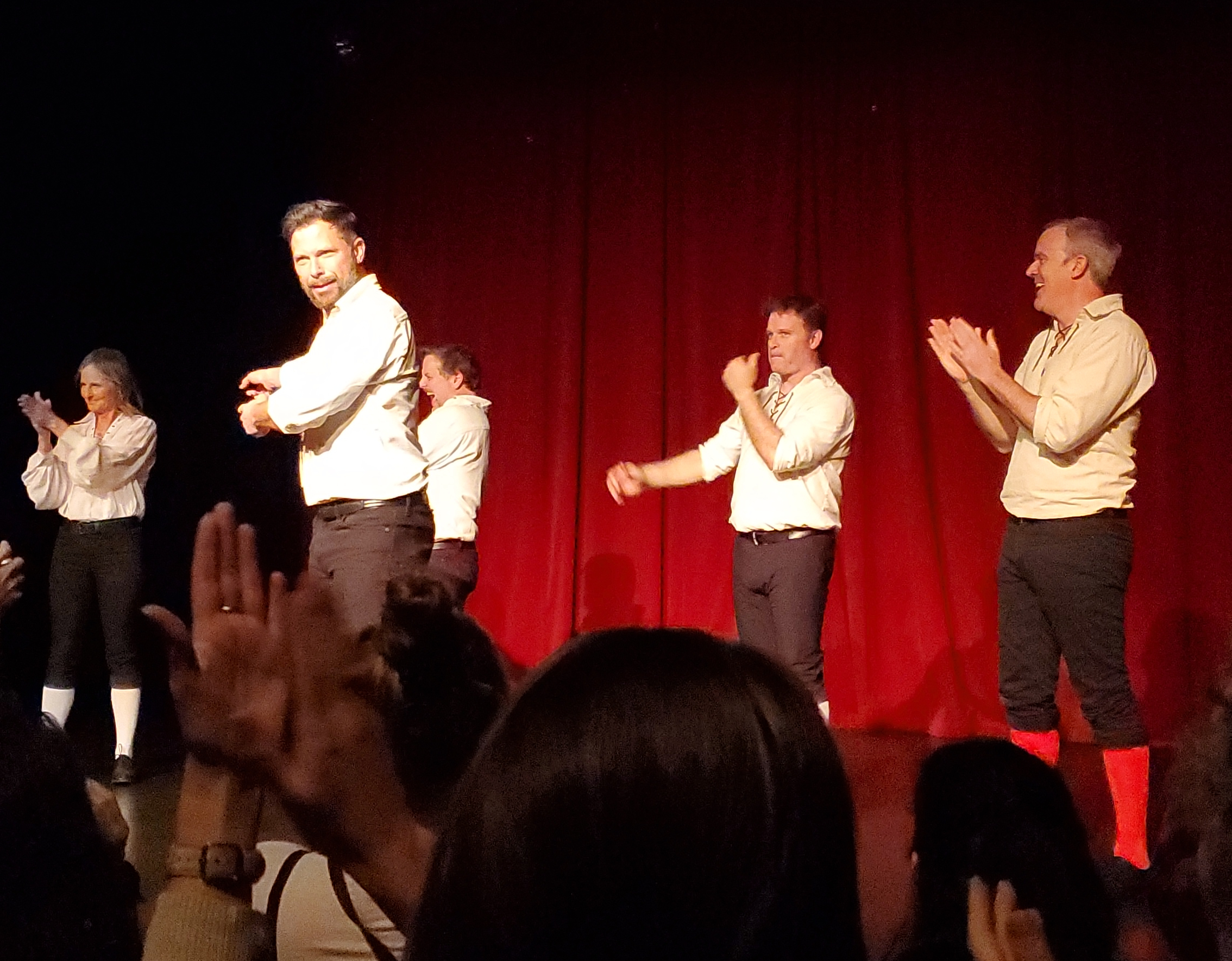
I’m pretty selective with the improv shows I go to–I have been to some real doozies in the past. But Improv Shakespeare is one event that kills, every. single. time.

An amazing stage for an amazing company.
There has never been a bad night of Improv Shakespeare. On even their “worst” night, you’re still crying with laughter the whole way through.
I used to see Improv Shakespeare a lot back when I lived in Chicago, at the iO Theater – their home base. How lucky we all are that they tour!
On 8/9/2025, I saw them again for the first time in a while at the supremely impressive Ford, which boasts 1,200 seats, all outdoors.
I’ve read that in the past there was a company that did a great Midsummer Night’s Dream here, with fairies going all the way back up in the hills.

The view from my seat at Door D, House Right, GG-16.
The Improv Shakespeare troupe never announces their special guests, or even if they’ll have one at all, it’s purely luck of the draw–not that they really need a special guest anyway. I wasn’t expecting one when I sat down, but when six of them walked out, I was squinting. “Huh, that older fellow kind of looks like George from Sein- oh shit that IS Jason Alexander!” Sometimes I forget I live in Los Angeles, where these things just happen.
The Play: Red Stockings
As always, all of the actors wear the exact same outfits, except some wear white stockings and some wear red stockings. When they asked for audience title suggestions, someone sitting up front must’ve just picked the first thing they saw, and shouted out: “RED STOCKINGS!”
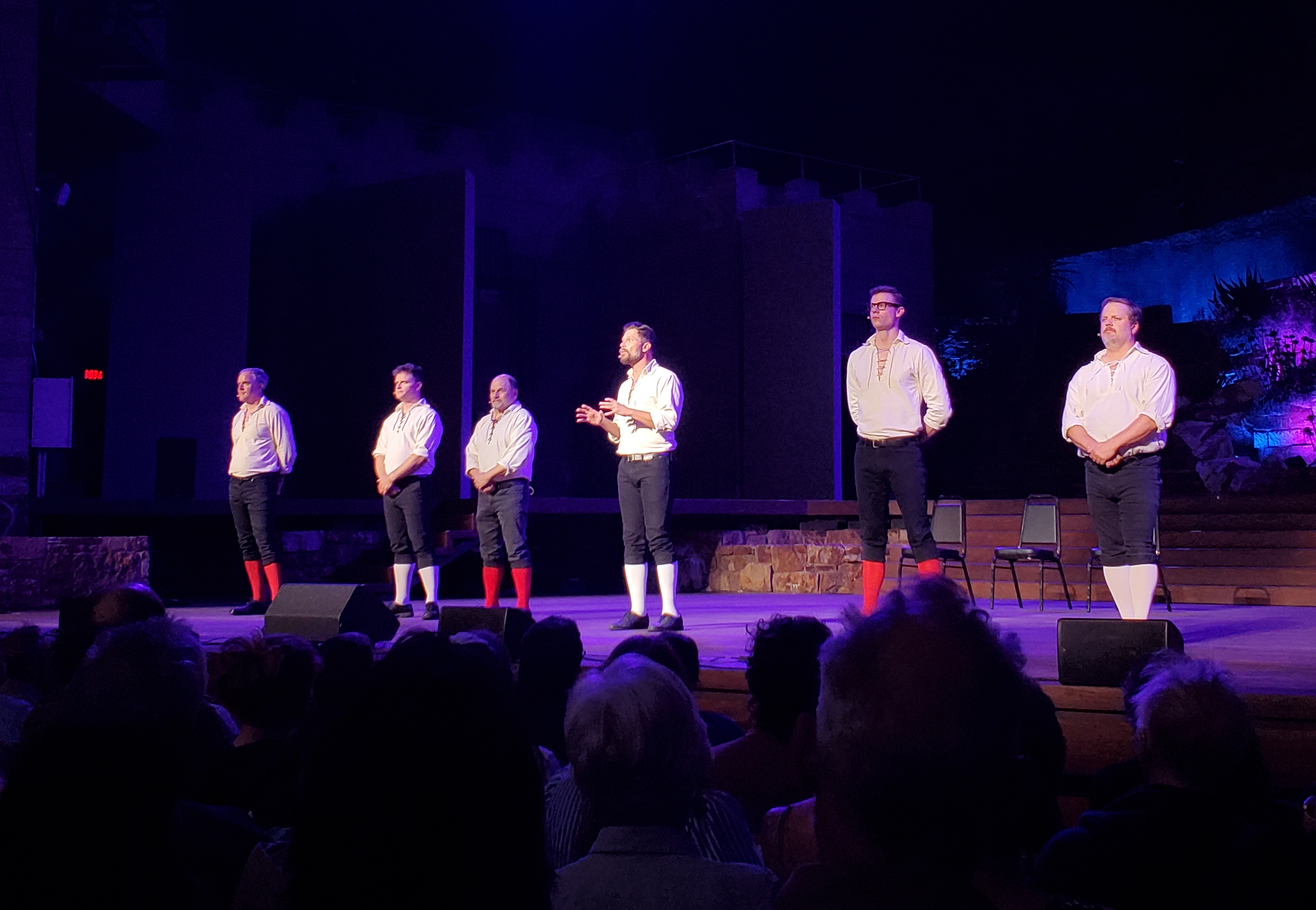
Note said red stockings.
Thus, William Shakespeare’s Red Stockings was born, and the character of Prologue tossed in a couple opening jabs about picking the first thing you see.
Red Stockings took place in Verona, at the all-important Verona Trade Fair (at the Verona Exposition Center, of course). A pair of merchants (Joey Bland, Brendan Dowling) from Padua, which here was known for its backwards customs like drinking sour milk, eating the wrong end of the carrot, drinking water from downstream, and being only mediocre kissers, come to exhibit their custom socks.
The senile old Duke of Verona (Blaine Swen) has set up the Trade Fair to find a husband for his daughter (Randall Harr). His daughter is protected by a stately old guard whose complicated name continues to be forgotten and changed, so let’s call him Truncle Dimple, played by Jason Alexander. Jason Alexander performs the classic Shakespearean character Trumple Deacon with masterful presence and gusto. No one else has EVER played Trickle Dolky with such gravitas as Alexander.
Of course, everyone and their cousin is really after the Duke’s wealth. Even a “mean girls”-esque woman who tries using molded clay to disguise herself as a man to wed the daughter. This led to Blaine Swen leading a chanting song: “I have another question.” “She has another question!” full of rhetorical questions about why she should not be the ruler of Verona.
There is also the matter of the richest noble in the land (played by Joey Bland). Discussions of his wealth continue to grow until not only has he collected a large amount of money, but also gems, jewels, and finally – a clay automaton named Pewter Peter (Harr), who struggles to be a “real boy” – and then, it turns out the noble has a whole army of Pewter Peters. “Boy, we really buried the lede there, didn’t we?” remarks Ross Bryant.
The Duke’s daughter instead falls in love with one of the dirty Paduan sock merchants (Dowling), and they do a dirty, dirty dance. There is all kinds of devilry as everyone tries to steal each others money and influence, and machinations pile up so quickly that you forget the details of each one, precisely as the performers also forget. It’s part of the charm.
Finally, the Trade Fair concludes with a Shark Tank-like performance to see who is most worthy of the daughter’s hand. The Pewter Peter army comes in clutch to defeat the clay-clad woman, and there’s a fair amount of killing here and there. But in the end, the Duke’s daughter and the Paduan sock merchant get their happily-ever-after. After all, he had a lot of socks with funny sayings on them.
The rich noble’s treasury has been stolen (through wire fraud, highlighted as not yet in existence), but when the main Pewter Peter sees the love between the Duke’s daughter and the sock merchant, it fills his soul and he finally becomes a real boy after all.
Thus forever concluded William Shakespeare’s Red Stockings.
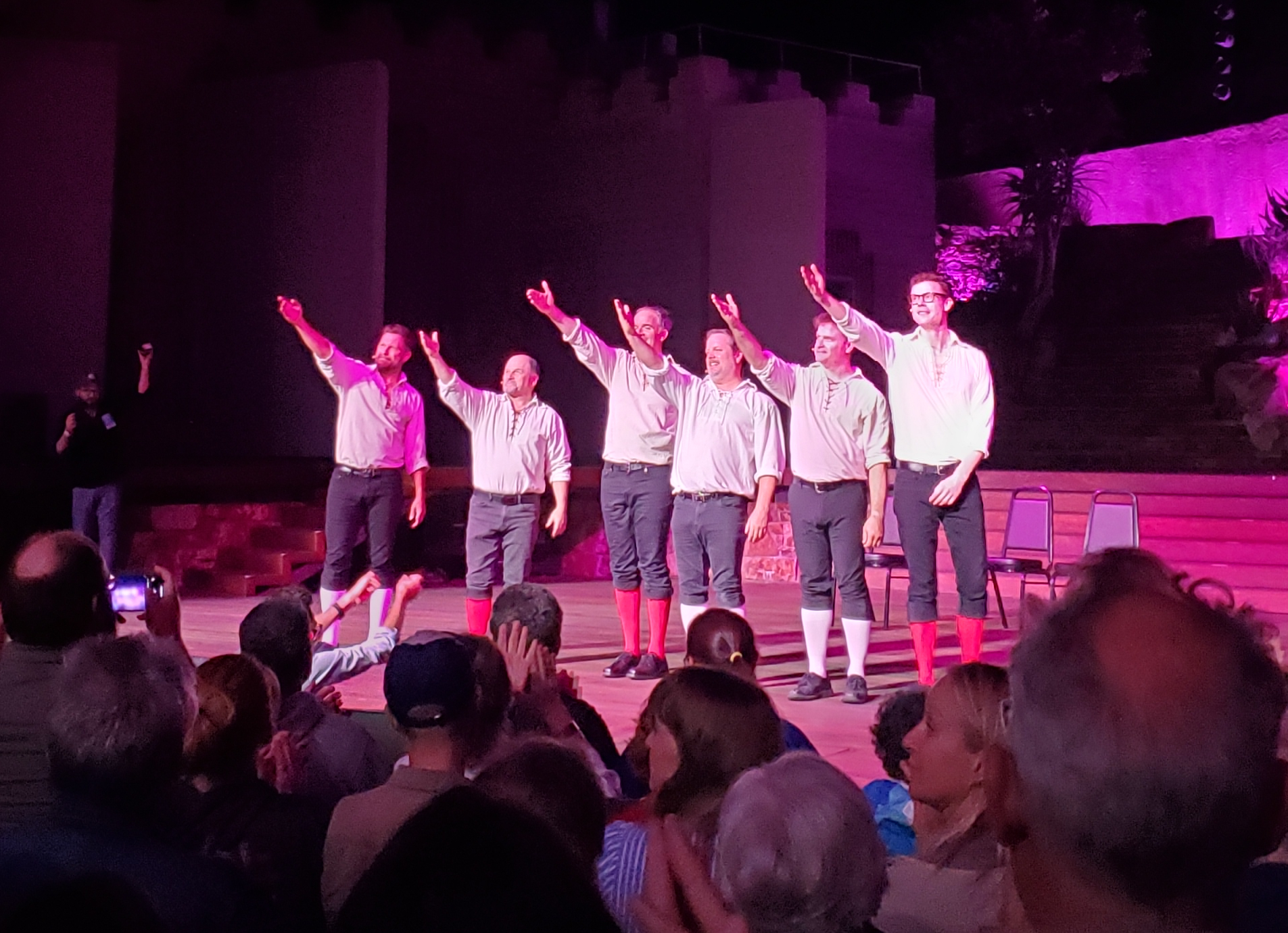
As always, a standing ovation.
I laughed my socks off the entire time. As did the rest of the audience around me.
Formal Analysis
Whenever I see an Improv Shakespeare show, I like to think about the plot afterwards and analyze it as if it were a completely serious work. Many plays do not get saved–Shakespeare himself wrote at least two plays that are forever lost to time. Sometimes all we know about a play is a summary or review that someone else wrote about it, because only that document survived.
Suppose historians uncovered a very old document containing the plot summary of Red Stockings that you just read here. No other context, no lines or source text, but the full story outline. They would use themes, motifs, imagery, probable inspiration sources, genre conventions, comparison to the canon, and historical context to analyze the work as best they could. Here, then, is my formal analysis of Red Stockings.
Red Stockings falls in the genre of festive comedy. It follows Shakespeare’s general template pretty well. There’s a blocking figure with authority over a marriage-ready young woman, a romantic desire that runs counter to that authority, some disguise and social chaos, and a conclusion that pairs lovers and restores order.
One notable aspect is that the number of people who want to court the Duke’s daughter continues to add up, which aligns with Shakespeare’s tendency to mirror parallel plots as a way to comment on them. The conclusion, featuring the Shark Tank contest, is similar to trial and test scenes in The Merchant of Venice, All’s Well that Ends Well, and The Merry Wives of Windsor.
Shakespeare is known to elevate love above commerce and parental arrangement, as evinced in Midsummer Night’s Dream and The Tempest; here too the Duke’s daughter thwarts her father’s desire to marry her off for wealth, subverting it entirely by choosing the lowly sock merchant as her partner. The wealthy noble who loses everything in the wooing process is a reinforcement of this theme. The “red” of Red Stockings could symbolize the warm, sensual lifeblood in the common merchant and function as a hint to his virility and victory.
Pewter Peter and the “real boy” motif is probably the most divergent from Shakespeare’s known canon. However, we can still trace its roots. The most obvious source where the bard could have gotten this is the Pygmalion story from Ovid’s Metamorphoses (Book X). In Ovid’s tale, a Cypriot scholar (Pygmalion) shuns women and vows to remain single, but creates an idealized ivory sculpture of a woman and falls in love with it. After he prays to Venus to make her real, the goddess grants his wish, and the “real woman” later bears Pygmalion a child. As it happens, Ovid’s Metamorphoses was likely Shakespeare’s favorite book, and a major source of inspiration for him after studying it in Latin school. So Pewter Peter is not necessarily some sci-fi golem anachronism, but rather a being with a transformation arc that traces directly back to a substantiated source. One can also draw some parallels with Pewter Peter and Hermione’s statue appearing to come to life in The Winter’s Tale.
What’s more interesting about Pewter Peter is the inversion of the transformation. It is not the creator’s wish that animates Pewter Peter, but rather the observed true love of others. This suggests that love is not just a private transaction or resolution, but a civilizing force that radiates outward–which is a spot-on distillation of what Shakespeare’s festive comedies posit.
It is interesting that clay is referenced two–or perhaps three–times in this play. Pewter Peter is a clay automaton. Swen’s female character uses clay to disguise herself. And, I would argue, the Duke’s senility can also be interpreted as clay, in that the old man’s mind is going soft. Clay is the creation substance of Genesis and the material of Ovidian metamorphosis. Through clay, Red Stockings presents another lens on how identity is literally formed, shaped, or diminished.
The choice of Padua as the home of backwards customs (drinking downstream, eating the wrong end of carrots) is an interesting inversion of Padua’s actual historical reputation as one of Europe’s greatest centers of learning. But it’s not uncommon for Shakespeare to flip or skew perceptions to make a point, especially to impress his political benefactors of the time. Indeed, one of Shakespeare’s most famous villains, Richard III, was probably not all that evil in real life, but when Shakespeare wrote the play under the reign of Queen Elizabeth I–the granddaughter of Henry VII, who defeated Richard–Shakespeare amplified myths from Tudor historians to disparage Richard and thus legitimize the Tudor claim to the throne. We can only surmise at a similarly motivated rationale for disparaging Padua here, and why it was done here but not in The Taming of the Shrew.
Red Stockings would probably have been written in Shakespeare’s middle comedies era, roughly 1596-1601, since the more complex structure would nudge it past his earliest comedies.
Full Cast & Context
The Improvised Shakespeare Company creates a fully improvised Shakespearean “masterpiece” right before your very eyes, based on whatever catches their ears at the beginning when the audience shouts out title suggestions of plays that have never existed. Nothing is planned, rehearsed, or written. All of the dialogue is said for the first and last time, the characters are created as you watch, and as they joke: “if you’re ever wondering where the story is going… so are they!”
“Tonight you are about to witness the world premiere, opening night, of … [TITLE]. By coincidence, you are also about to witness the final showing of [TITLE]!”
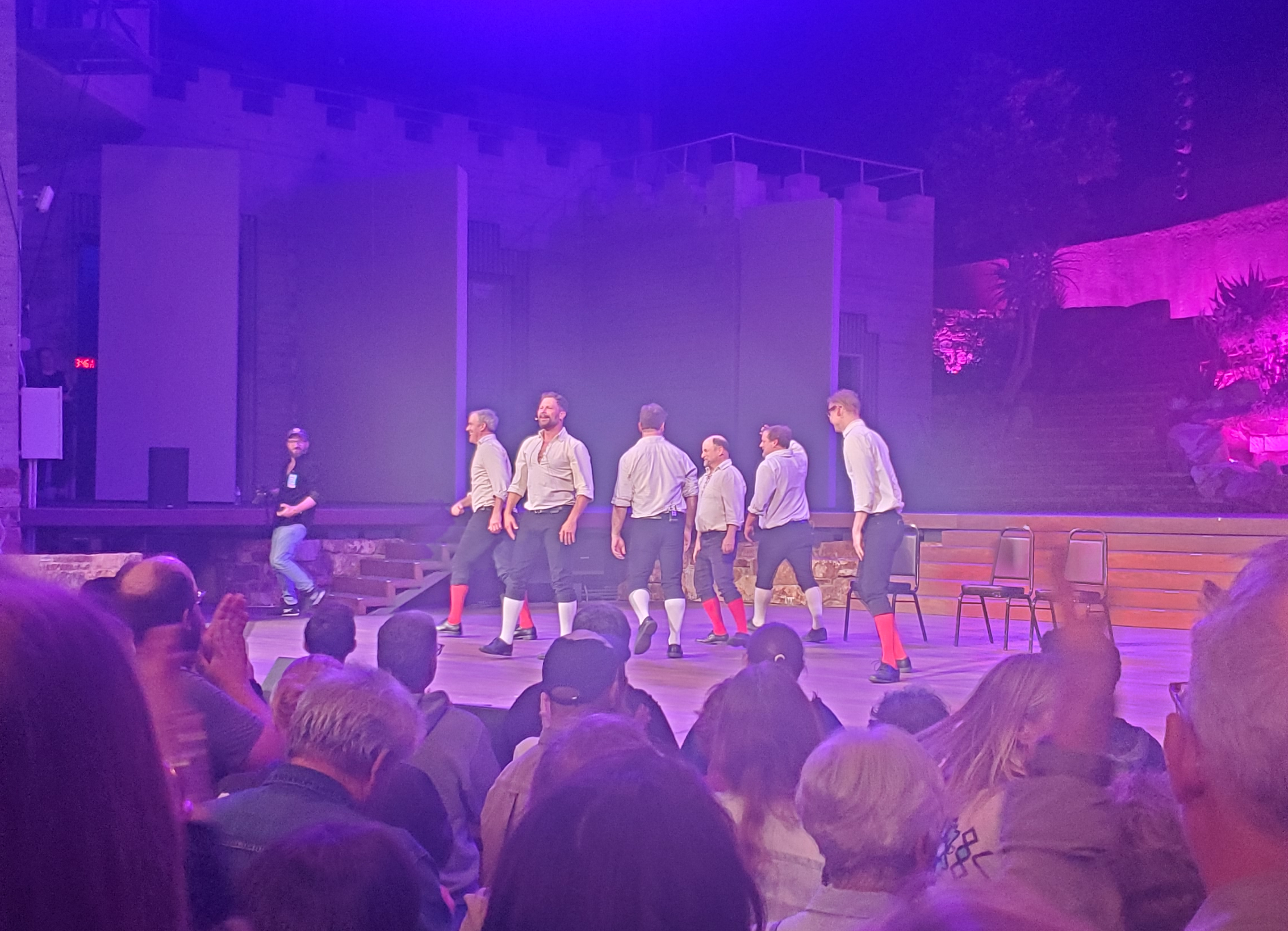
Leaving the stage.
The company began in Chicago in 2005, and regularly tour around the globe, piling on the accolades and awards as they do so.
The Improvised Shakespeare Co. sometimes changes out a member here and there, but tonight was the usual crew that I’m used to seeing:
- Blaine Swen (founder & director, also named the “Best Improviser in Chicago” in 2010)
- Joey Bland (also a two-time Jeopardy champion)
- Ross Bryant (also a writer for Mystery Science Theater 3000)
- Brendan Dowling (also a writer and actor, including an award-winning short)
- Randall Harr (also a performer at a comedy theater in Amsterdam)
- + of course the special celebrity guest star, Jason Alexander
The Ford is an outdoor amphitheater tucked into the Cahuenga Pass in the Hollywood Hills, right along Highway 101 but somehow still feeling hidden once you’re inside. It opened in 1920 as the John Anson Ford Amphitheatre and was built into the hillside with natural acoustics in mind, originally hosting community pageants, folk performances, and civic events.

Approaching the Ford

Inner hallways leading to outdoor seating

Around the exterior
The setting is very LA in an old-school way: oak trees, open air, dusk settling in while a show starts, and cars rushing past far behind, unseen but faintly audible beyond the walls.

The outdoor bar and entrance area, from above
Over the decades, the Ford has gone through closures, renovations, and reinventions, but it’s always leaned toward culturally rich programming. Today it’s operated by LA County and known for hosting world music, dance, theater, Shakespeare, and experimental or cross-cultural performances that don’t quite fit into bigger venues like the Hollywood Bowl.