I went to see the closing night (11/17/2025) of William Shakespeare’s Cymbeline by the Antaeus Theatre Company in Glendale, and I brought along a friend who had never been to a play before. It occurred to me partway through the play that perhaps, juuuuust perhaps, Cymbeline wasn’t the easiest introduction to the world of theater. Shakespeare’s language alone is enough of a hurdle for some people, and of all the plays of his I could have taken her to, I picked the one with approximately a million things to keep track of.
Imagine the first movie you ever see is Inception. You’ll probably have a good time, but you’ll be like, “wow, movies are complicated, huh!” Whoops.
She was understandably a little lost by intermission, but between a little clarification from me and the considerable efforts of the magnificent cast, she followed the rest of it pretty well and really enjoyed herself. And boy, did I ever love this production.
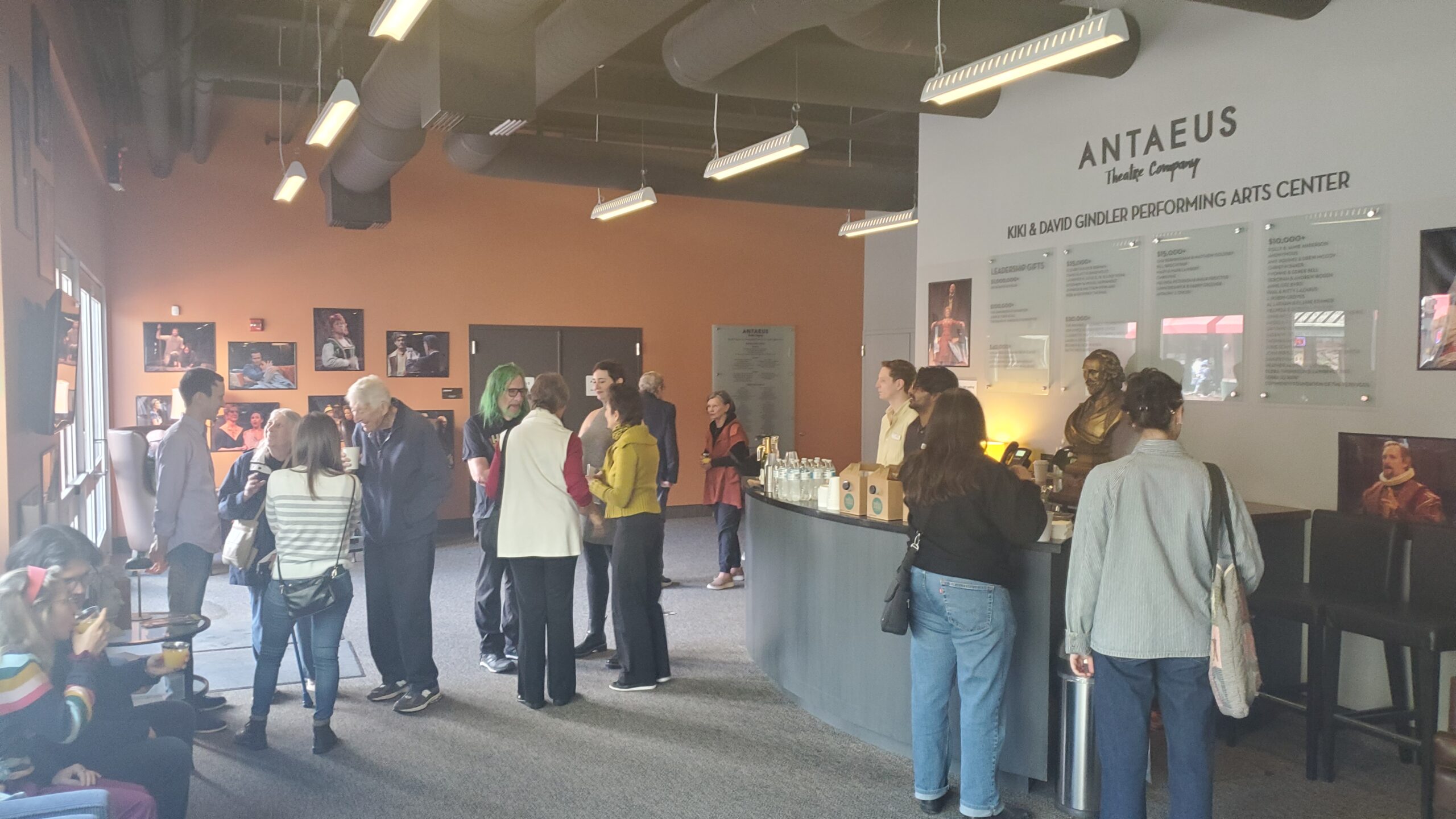
I picked up our tickets and got a cute little themed bag of candy as a season subscriber. I love that Antaeus does these little things to acknowledge its subscribers. I also got to briefly meet the director of the play (and artistic director of Antaeus), Nike Doukas, who was very lovely and welcoming.
Shakespeare in the Wild West
Doukas set her production of Cymbeline in the American West of the 1800s. I’m sometimes a little ambivalent about transplanting Shakespeare to different eras and places, as common as that is. Often I just want to see Shakespeare’s play, and the more that has to be changed to accommodate the new setting, the less interested I am in the whole exercise. But I thought this setting was an excellent fit. Putting a sheriff’s badge on Cymbeline instead of a crown still conveys quite a bit about the guy’s authority, and the whole business of the two young men growing up out in the wilderness works particularly well out West. And none of the lines were changed to awkwardly shoehorn in something about cowboy boots or whatever.
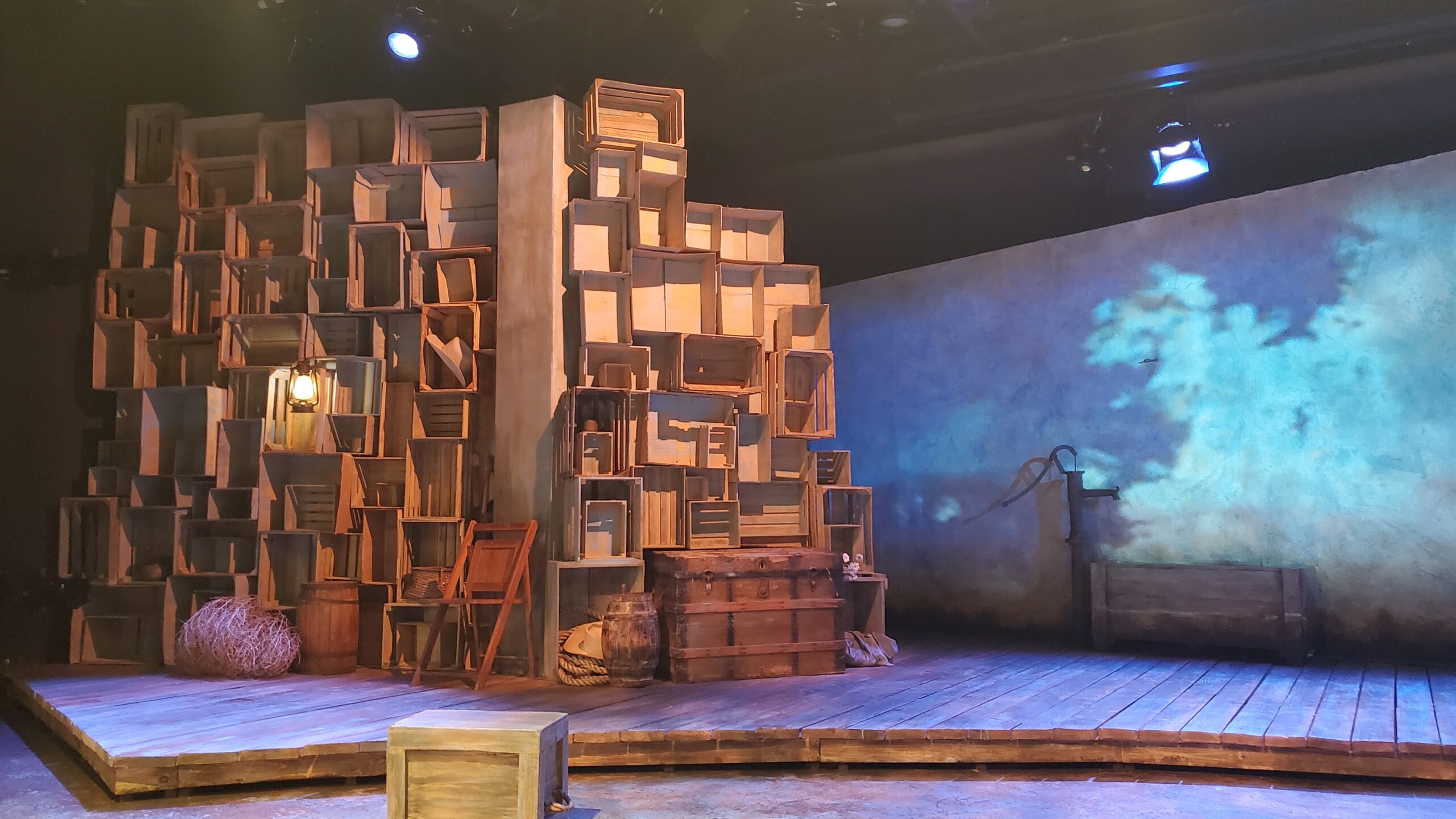
Ann Sheffield’s set was gorgeous. You practically walk onto the set itself when you enter the theater from the side. We were sitting front row center, a couple feet away from everything (though there really isn’t a bad seat in this little theater), and I was particularly impressed with the quality of the materials and all the different textures. There’s a lot of attention to detail here. Between the set, Julie Keen’s costumes and Vickie J. Scott’s lighting, I was quite happy to spend my evening in the Old West.
The Cast
Elinor Gunn was spectacular as Imogen. She’s such a fluid, expressive actress, and I found the sadness in her performance particularly believable. I also loved the change in her appearance when she disguised herself as a boy and went out into the wilderness. Credit where it’s due to the costume and makeup work, of course, but the transformation in Gunn’s acting was every bit as convincing.
Bernard K. Addison was an excellent Cymbeline. Gruff enough for a sheriff, majestic and refined enough for a king. I loved the way he’d get all blustered without ever quite tipping over into a parody of a Shakespearean monarch. He had precisely the kind of sternness I wanted out of the character.
Peter Mendoza as Posthumus brought a tremendous amount of energy to the play. Even in the smaller movements of his face, there was so much going on. He has quite a piercing gaze! He played Posthumus with a passion and conviction that suited the character very well, even when the character’s convictions were spectacularly misguided.
And oh, Gerard Joseph as Iachimo. What a guy! He was all kinds of slippery and sleazy and yet so charming, in exactly the proportions one wants from Iachimo. You could see the calculation in the way he ingratiated himself with people. He could actually get a couple of audible gasps out of the audience, and I loved watching him work.
Randolph Thompson, meanwhile, made a wonderfully self-important Cloten. His fast-talking, energetic delivery was so well suited to the part.
I very nearly thought Eve Gordon was two separate actresses at first. She played both the Queen and Belaria (Belarius in the original text), and the difference in bearing between the two characters was enormous. She was every bit the royal figure as the Queen, and quite folksy and fun as Belaria. Again, some excellent makeup & costuming here, but Gordon herself did a remarkable job differentiating the two.
JD Cullum played Lucius, Cornelius, the First Lord and Philario, and was also our guitar-playing storyteller for the evening. I loved the ease with which he’d switch from one person to the next, changing his voice and posture. My friend even figured out what doubling was (one actor playing multiple roles) in the course of watching Cullum do it–I guess I had forgotten to explain some common theater things first too. He was particularly important to the structure of this production, with the musical interludes helping to connect the scenes. John Ballinger composed the original music for the show.
Teodora Avramovic and Anja Racić as Guiderius and Arviragus, Cymbeline’s long-lost sons, nearly stole the second half of the play for me. The two of them were so gal-darn funny together. They had a rambunctious, very believable sibling chemistry, and I particularly enjoyed the energy they brought to the scenes out in the wilderness.
I also really liked Desirée Mee Jung as Pisania (Pisanio in Shakespeare’s text). So much of the drama in this role rests on what to do with a letter and whose instructions to obey. I could really see the conflict in her performance as the faithful servant found herself caught between her obligations to Posthumus and her concern for Imogen.
And while I’m giving out compliments, John McElveney’s headless corpse prop was pretty dang good too. Convincing enough for its dramatic purpose without being especially gory, and just a little funny without ruining the scene.
Adapting Cymbeline
I have to give Nike Doukas a lot of credit for her handling of the text itself. The Western setting required relatively little change to the actual story, but there was considerable editing for length. The battle, for instance, was extremely condensed, with most of the action conveyed verbally. I thought this was a particularly sensible place to save some time, given how much still has to happen after the fighting is over.
It’s an awfully ambitious plot for any theater to put on. We have a secret marriage, an exile, a wager on a woman’s fidelity, a rather nasty stepmother, a disguise, a sleeping potion, a headless body, two missing royal children and a war with Rome (or the outlaws or whatever in this production). And then Shakespeare has to bring all these people together at the end and explain to each of them what the others have been doing for the last several acts. The fact that my friend, on her very first experience of live theater, could follow that final scene says quite a bit about how well the story was told here.
Now, as something of a Shakespeare purist, I would’ve loved to see the full play, including the appearance of Posthumus’s dead family and the descent of Jupiter on an eagle. I mean, how often do you get the opportunity to see that on stage? And an eagle would’ve been perfect for an American western retelling, right? But I’d much rather see this version of Cymbeline than not get to see Cymbeline at all. And I can’t think of much I’d have changed about this particular adaptation. The cuts made sense, the story was clear, and the actors were excellent across the board.
My friend and I went out for a drink at the Oak and Vine after the show, as I always like to do when I’m in Glendale because it’s such a good wine spot with excellent bartenders. Then we went to another bar where, entirely by coincidence, the cast was celebrating the end of the run. I bought a few of them a round of shots and we ended up spending a good part of the evening talking Shakespeare and theater. What a lovely way to end closing night!
I’m pretty well sold on Antaeus Theatre Company at this point.
Full Cast & Context
The cast included:
- Bernard K. Addison: Cymbeline
- Teodora Avramovic: Guiderius / Second Lord
- JD Cullum: Lucius / Cornelius / First Lord / Philario
- Eve Gordon: Queen / Belaria
- Elinor Gunn: Imogen
- Gerard Joseph: Iachimo
- Desirée Mee Jung: Pisania
- Peter Mendoza: Posthumus
- Anja Racić: Arviragus / Frenchie
- Randolph Thompson: Cloten
The production team included:
- Nike Doukas: Director
- Ann Sheffield: Set Designer
- Julie Keen: Costume Designer
- Vickie J. Scott: Lighting Designer
- John Ballinger: Composer / Musical Director / Sound Designer
- John McElveney: Props Designer
- Nick Santiago: Projections Designer
- Elijah Frankle: Associate Lighting Designer
- Maya Aragon: Assistant Set Designer
- Olivia Shu: Assistant Set Designer
- Jenn O’Brien: Assistant Director
- Claire Fogle: Production Stage Manager
- Jessica Osorio: Assistant Stage Manager
- Frank Ishman: Artwork
William Shakespeare likely wrote Cymbeline around 1609-1610. It was first published in the First Folio of 1623, in which it was grouped with the tragedies. Modern scholarship often groups it with Shakespeare’s late romances, including Pericles, The Winter’s Tale and The Tempest, despite the very different genres represented by the individual plots within Cymbeline.
Shakespeare took much of the British royal and military history from Raphael Holinshed’s Chronicles. The story of the wager on Imogen’s fidelity, meanwhile, has a literary antecedent in the ninth tale of the second day of Giovanni Boccaccio’s Decameron, a story also circulated in other versions. The Folger Shakespeare Library’s essay on the play discusses these sources and the rather unusual combination of historical periods and literary genres in the text.
Antaeus Theatre Company began in 1991 as a project of Center Theatre Group and opened its permanent home, the Kiki & David Gindler Performing Arts Center, in Downtown Glendale in March 2017. Its focus on classical theater and ensemble acting is particularly well suited to plays of this sort. The company’s 2025 production of Cymbeline ran from October 12 through November 17. Antaeus Theatre Company takes its name from Antaeus, a giant in Greek mythology and the son of Poseidon and Gaia, who drew his strength from contact with the earth.