I saw Poe: Pulse & Pendulum on the night of Sunday, April 5th. Such a terrific title; I am always in attendance for alliterative art. And wow, was this experience an interesting one, put on by the Theatre Obscura LA company.
You’ll forgive my tongue-in-cheek featured image for this post; no, it’s not an error, that’s an all-black photo I took of nothing but darkness. That’s because this whole play (actually two plays) was performed around the audience while we were all completely blindfolded. Yes, really, the whole time.
You’ve never seen a play like this–and I haven’t seen it either.
The first act would feature a dramatic reading of Edgar Allan Poe’s The Pit & The Pendulum; the second act would feature a dramatic reading of the same author’s The Tell-Tale Heart. Immersive elements would include sound, smell, and even touch.
This unique theatrical event was held at The Count’s Den, an ornate alternative venue in Downtown Los Angeles owned by the Immersive Arts Collective charity foundation. I should mention up front that for a short time I served as an honorary director at the IAC helping with their marketing and website efforts, and am friends with the owner; I have been to a dozen or so events at The Count’s Den over the years, including a few vampire dinners and a horror escape room. I will do my best to not let my small amount of history with the IAC color my impressions of this event, one way or the other.
All that aside, let’s get into the night.
Arrival
The Count’s Den is just a couple blocks from my apartment, so it was a short and pleasant walk. Otherwise, it’s not far from bus lines and perhaps a ten minute walk from the Pico stop on the E & A train lines.
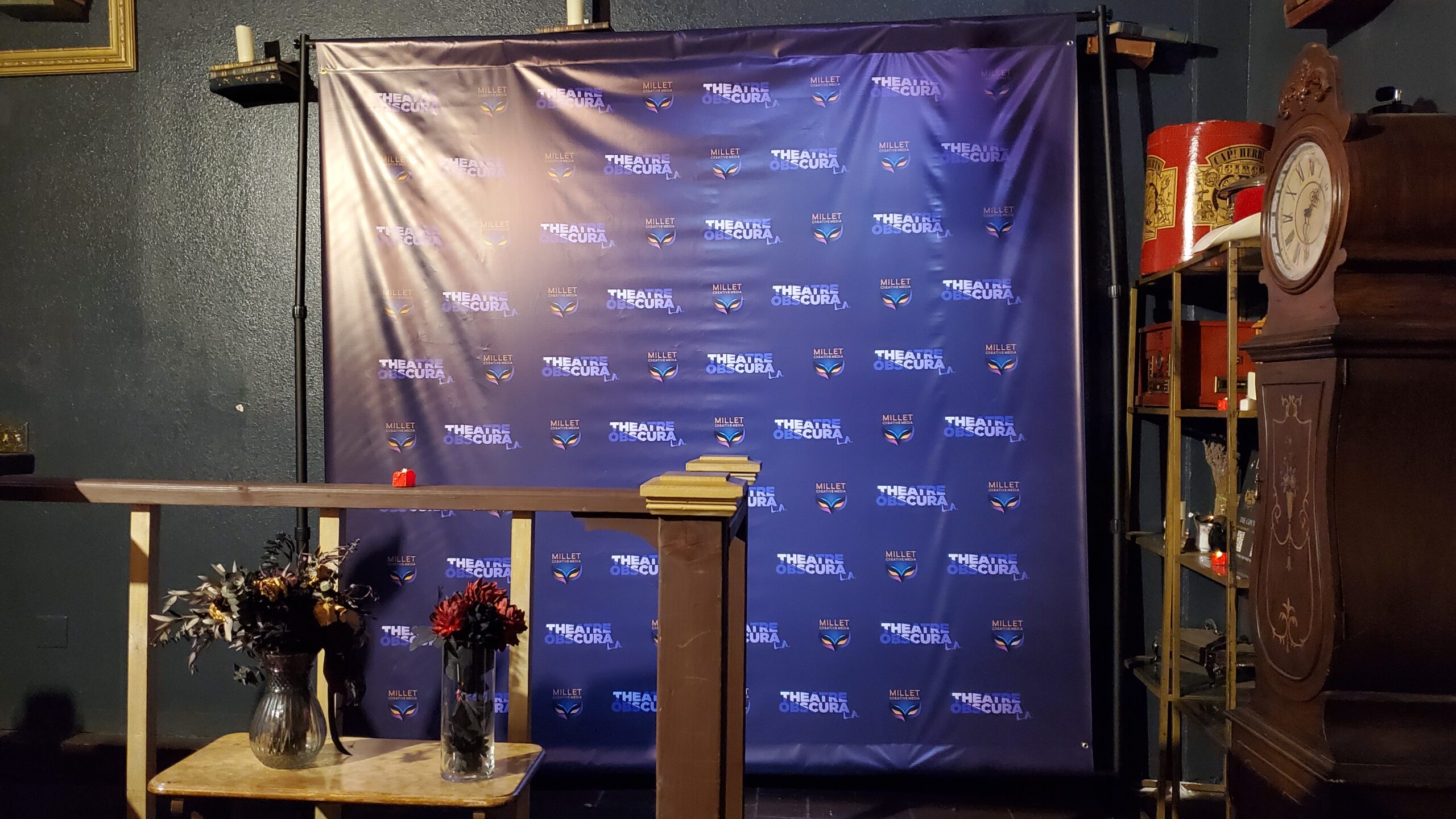
The entry room of the Count’s Den featured a Theatre Obscura backdrop and a small bar. Usually the bar is in the back, but for whatever reason it was moved up here tonight. There was a special Poe-themed cocktail which I had to try–delightful. I was also provided with a brand new blindfold, fresh out of the bag, as we all would be.
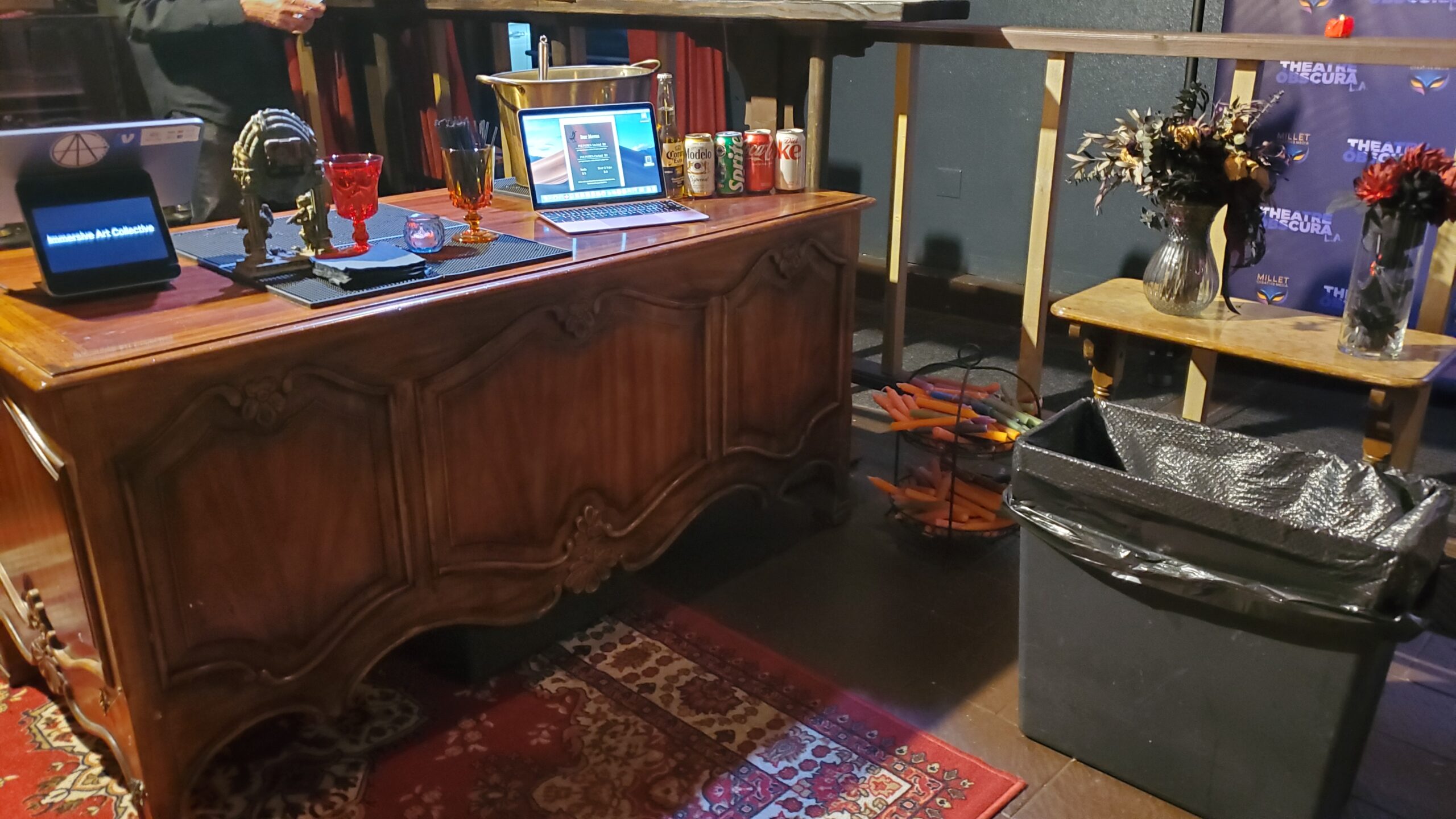
I was the first one there, so I made conversation with the two people working the front, Paul Millet (who I believe is the director of this whole venture) and Erika Jenko (who was the official front of house person). When others began to arrive, I entered into the main space of the Den to see how it would be arranged tonight.
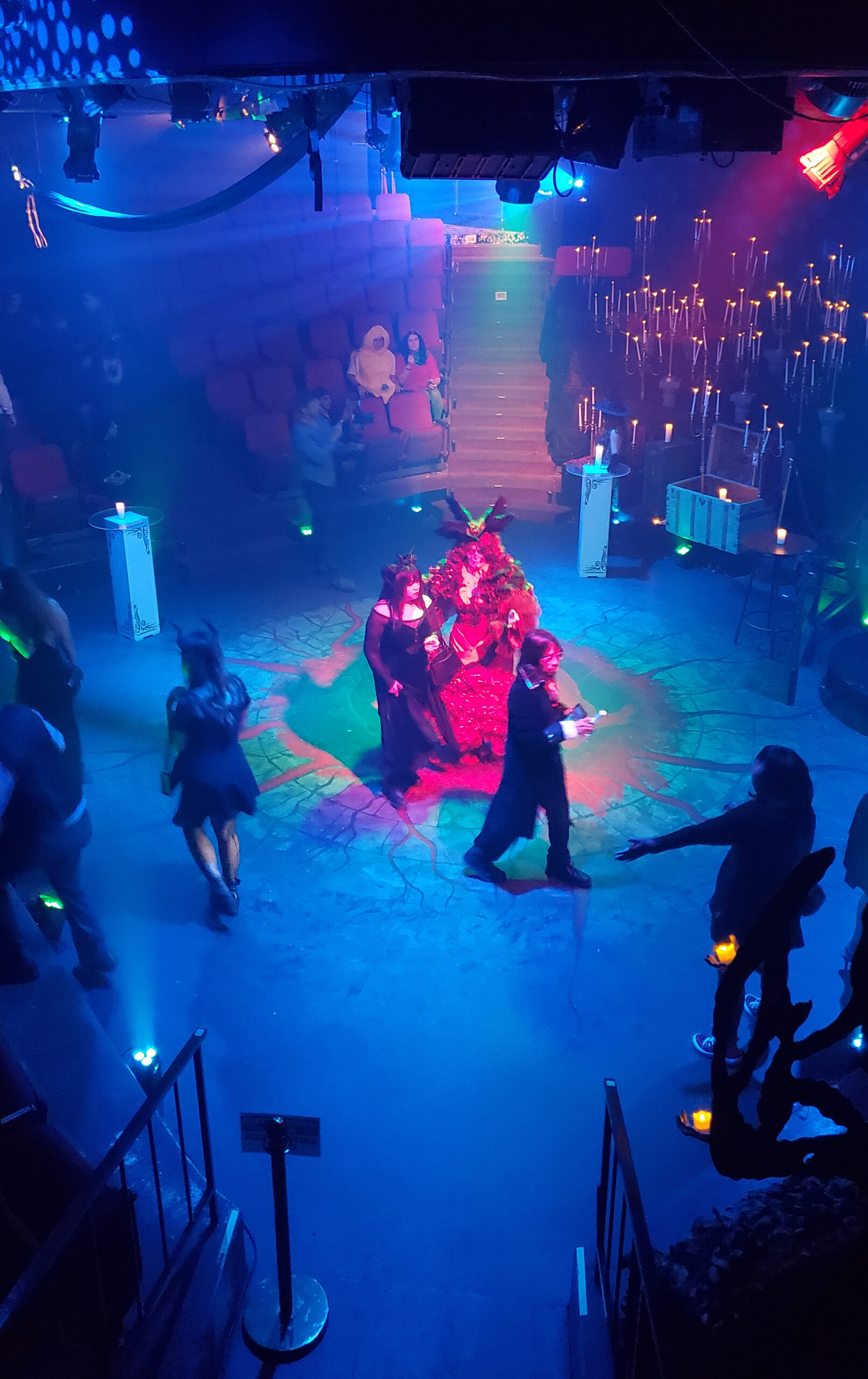
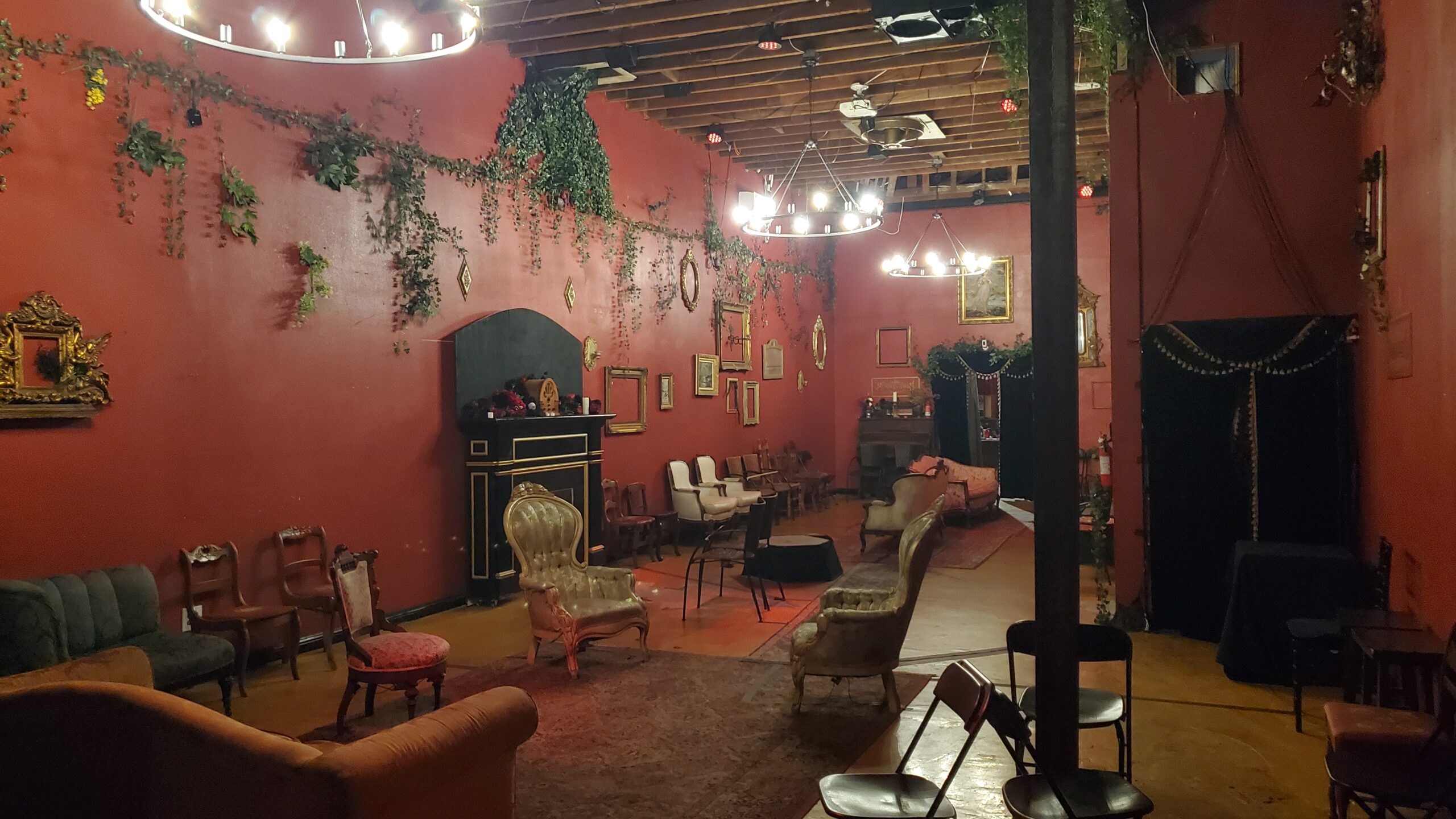
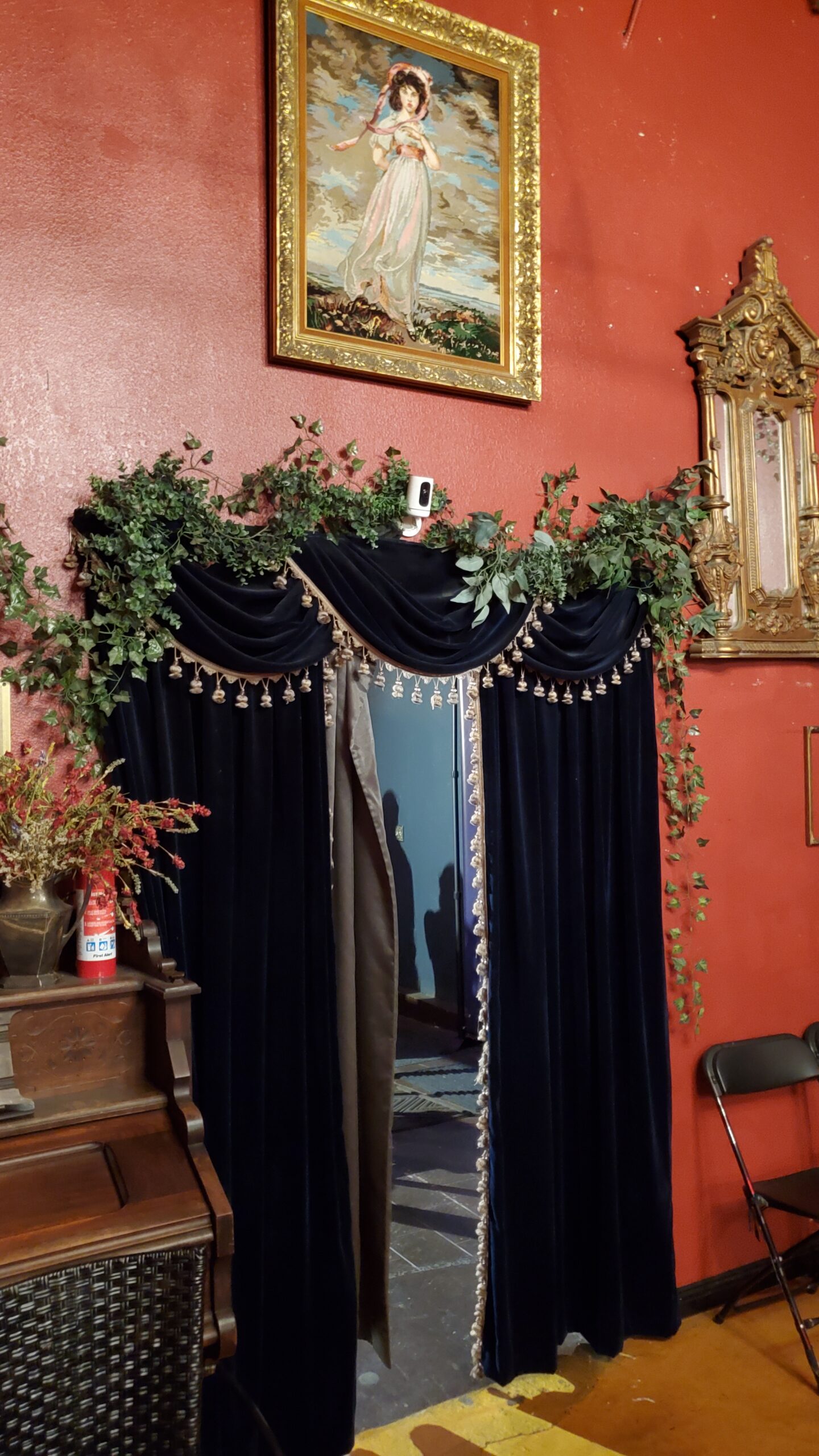
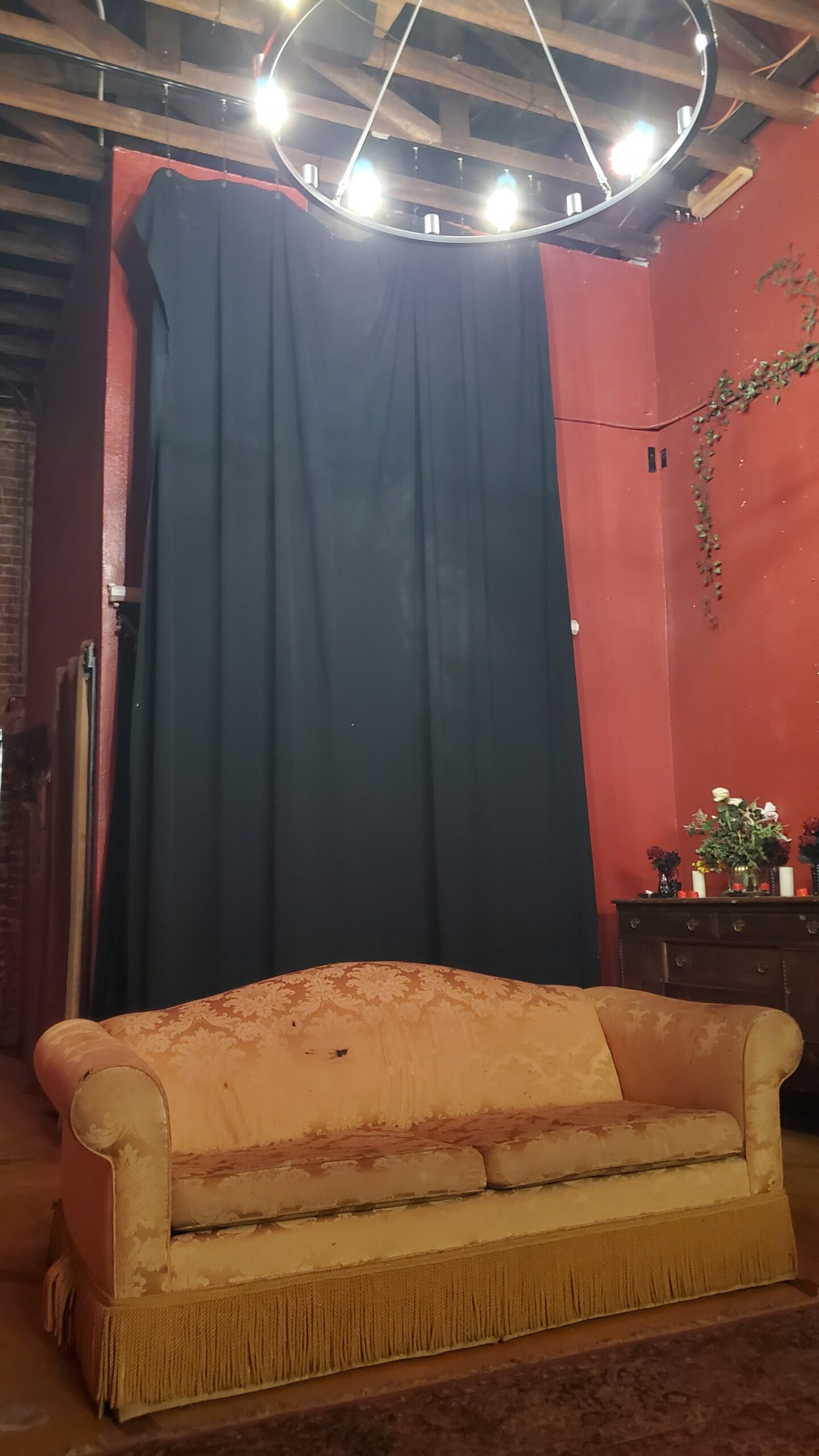
The space is always interesting. There are hidden rooms off to the side, a second floor that seems genuinely spooky, an outdoor back patio, and a side corridor-like set of rooms with a secret entrance along the wall of the main room (though I won’t spoil where).
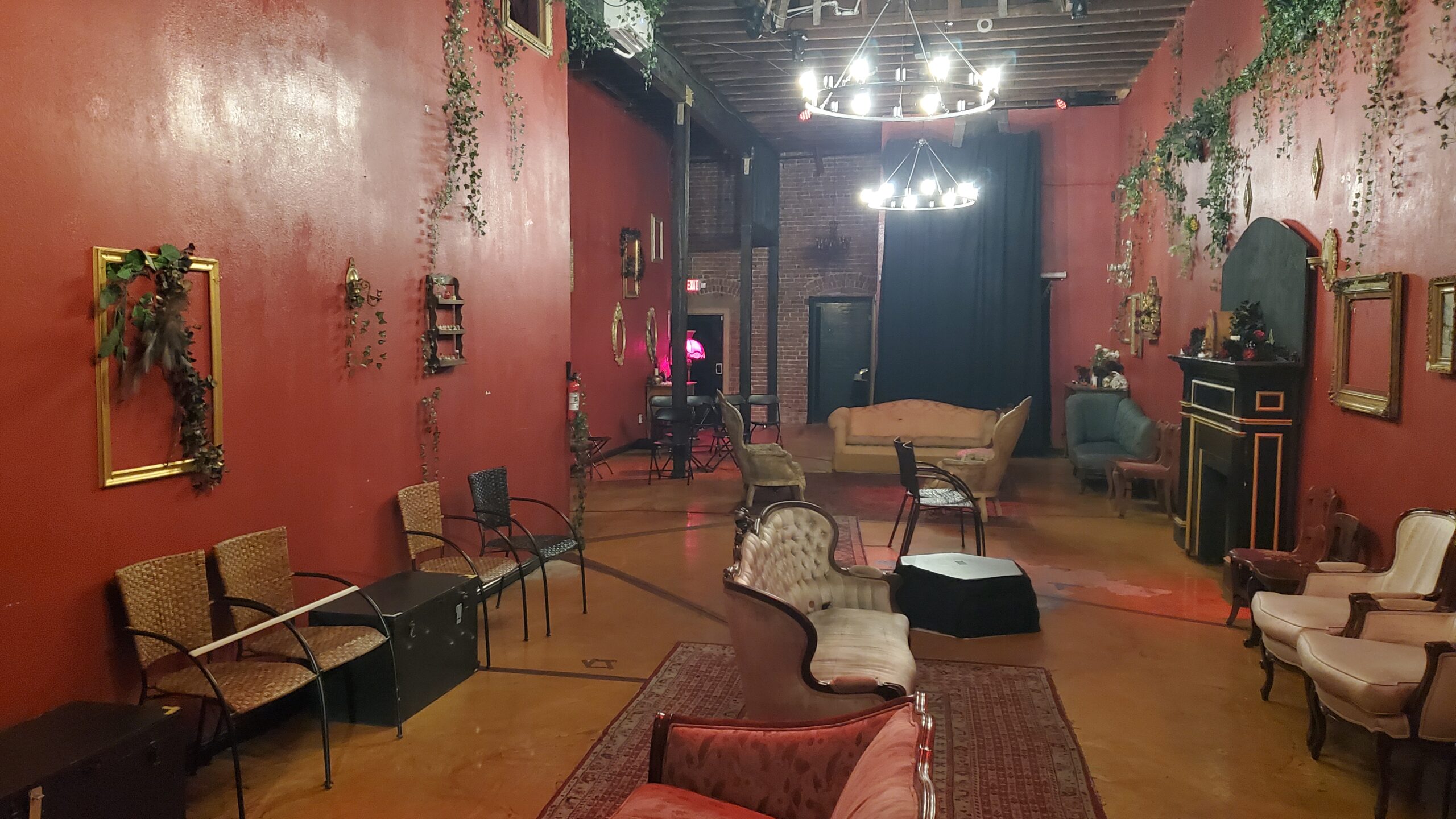
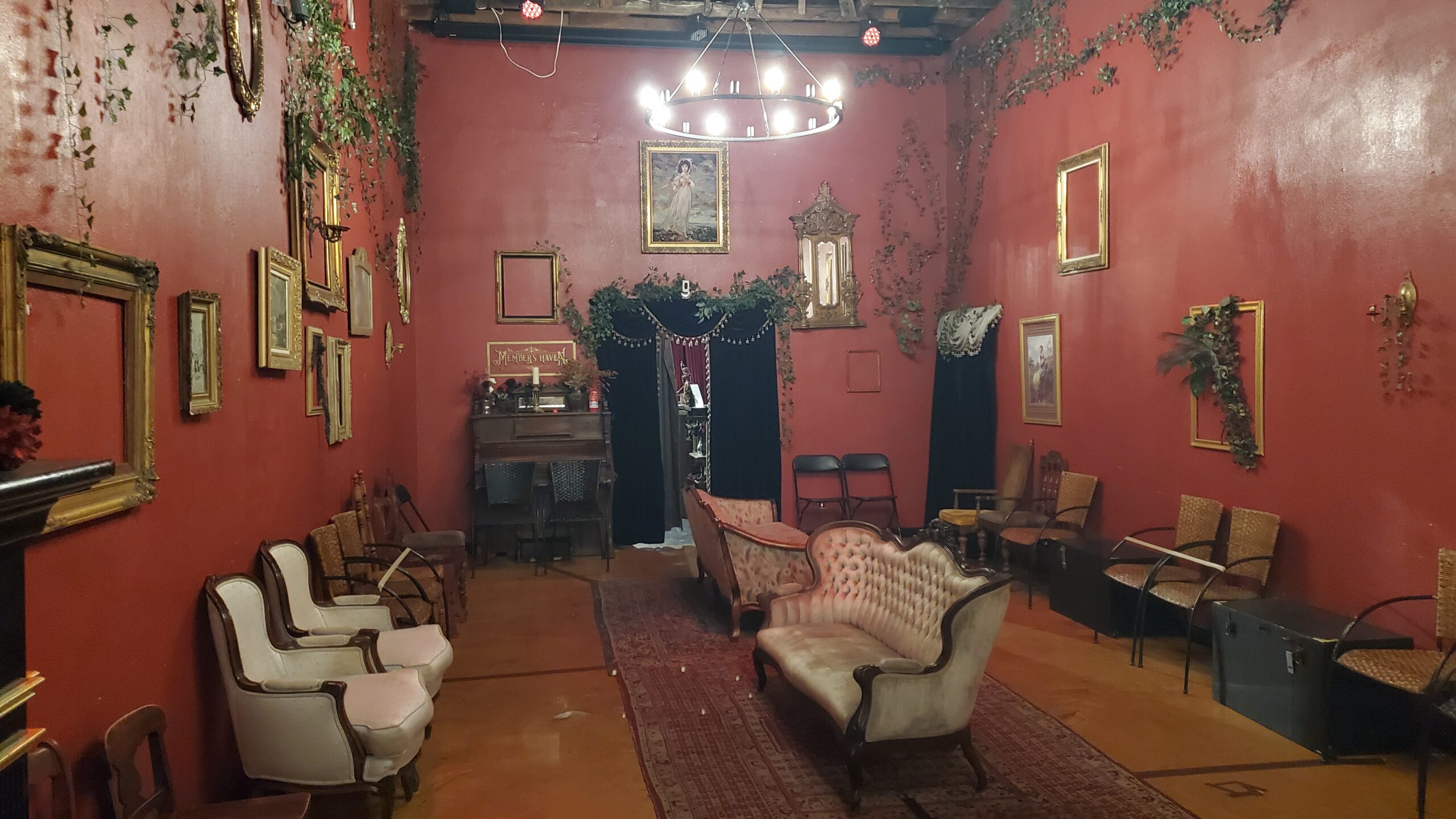
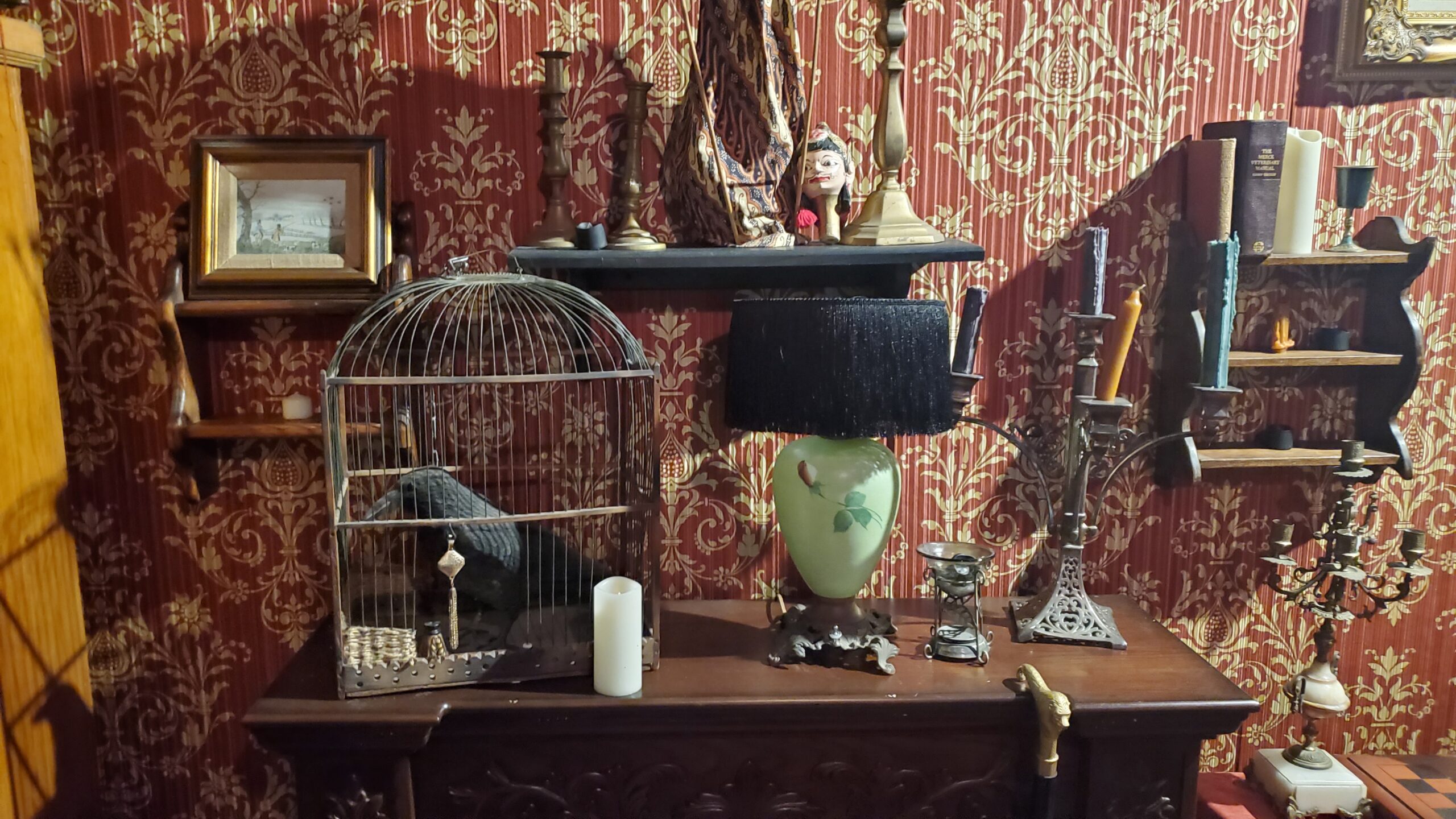
The walls are red and covered with picture frames, mostly empty, some with especially strange takes on expressions of art–see for yourself:
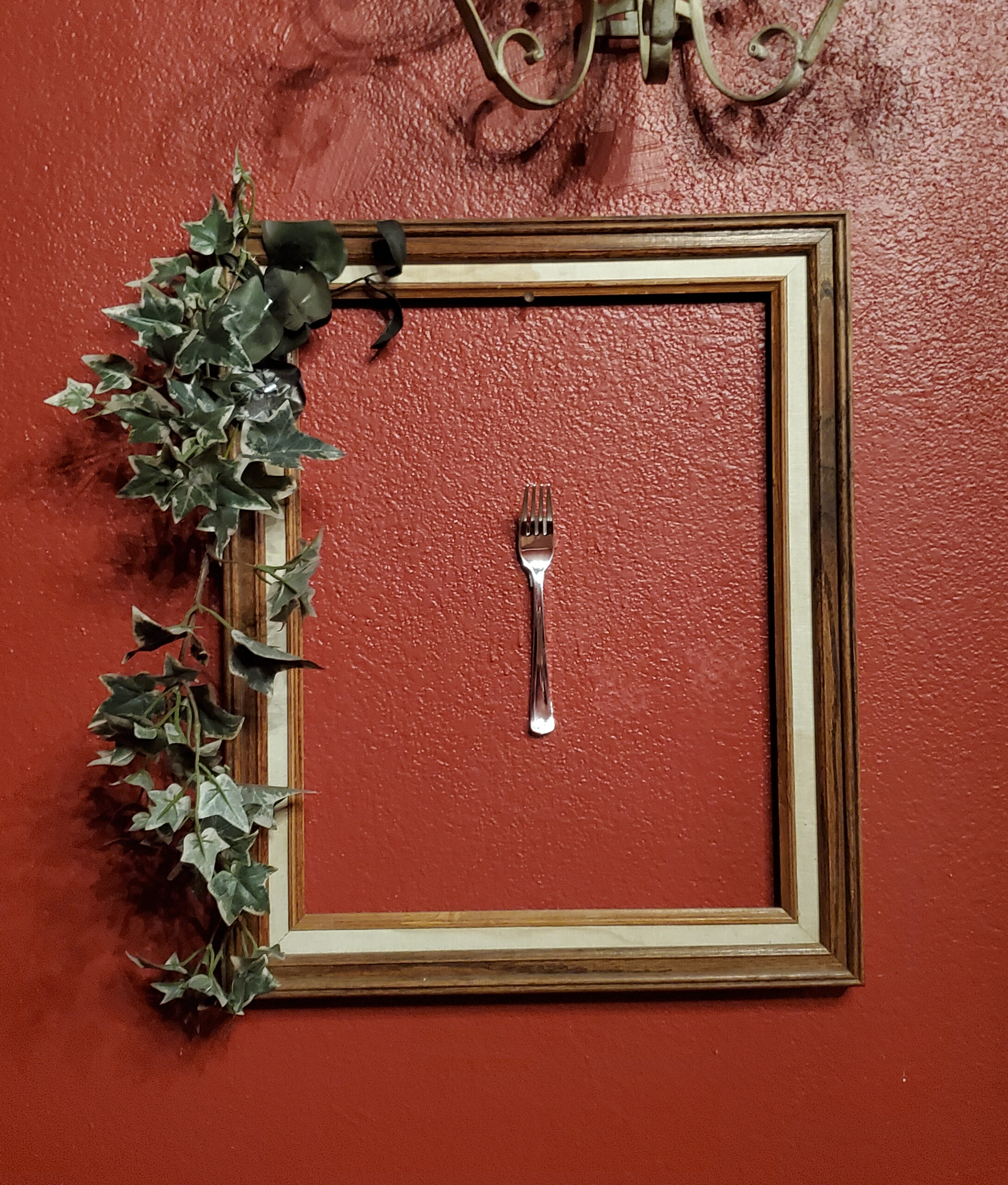
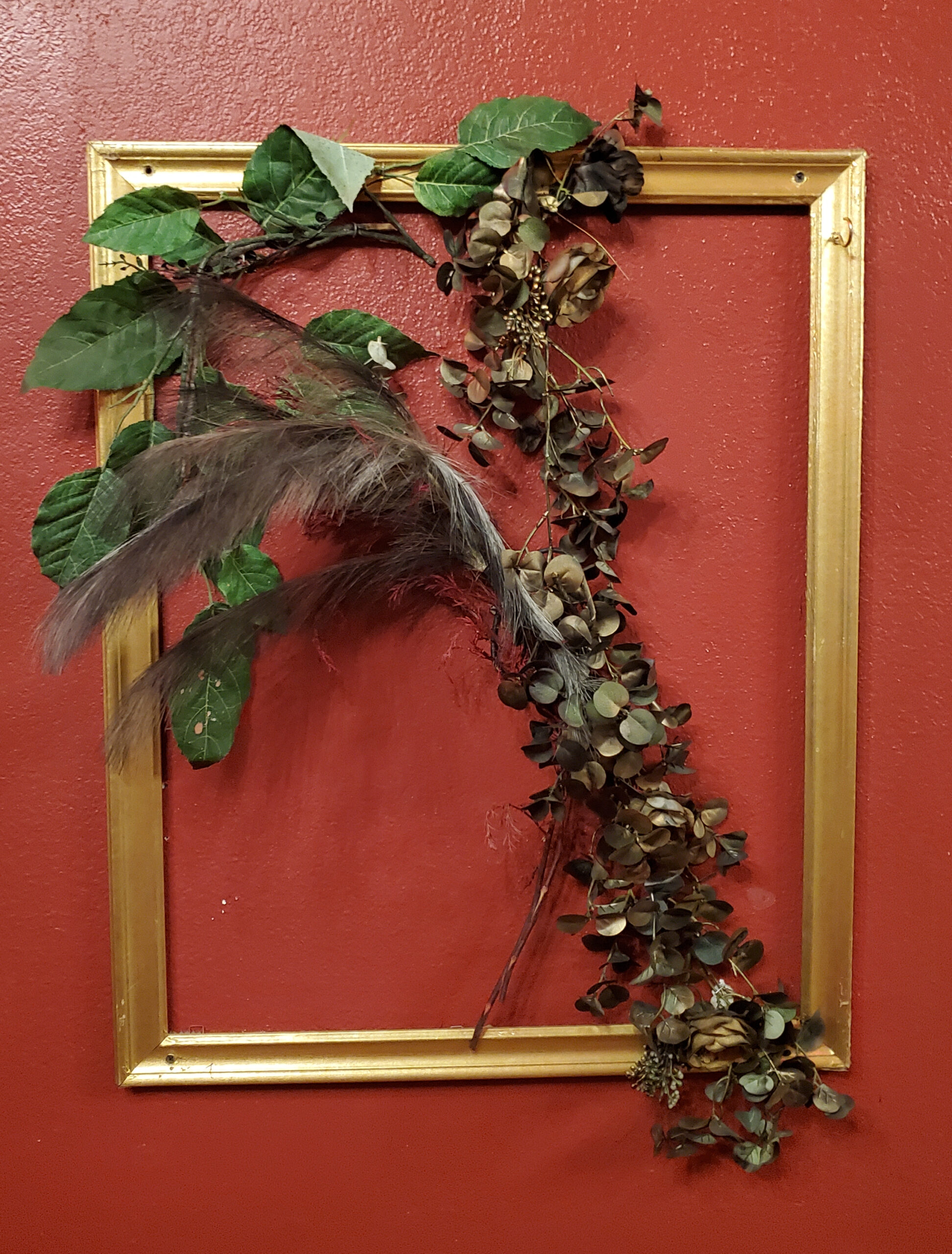
Tonight, only this one long main room was accessible to the audience. The chairs were scattered throughout the center of the space so the actors would be able to walk around us easily.
There were some chairs reserved for guests who preferred a more hands-off, no-touch experience, which was a nice consideration. I chose a big full-experience chair.
Other audience members trickled in, and soon the lights dimmed and a voice over the speakers told us it was time to don our blindfolds.
The Performance

The first act was Poe’s The Pit & The Pendulum. If you’re not familiar with the story, there aren’t really any other characters besides the one person who is mysteriously trapped in a dark and horrific chamber. I suppose you could count the hungry rats as characters, but they don’t have any lines.
So the first act was all a reading by one actress (Melissa Lugo, I believe), who put a sense of abject horror into her voice and somehow only escalated it the entire time.
A blindfolded play’s closest relative may be a radio play. They don’t make a lot of radio plays anymore, but if you can remember back to the 1940s, before television caught on, they used to be big business. You could argue that podcasts or audiobooks are a more modern equivalent, but I’d beg to differ–neither of those mediums stress the same amount of vocal performance as a radio play.
In a radio play, the only lever an actor has to play with is the voice. No physical gravitas, no blocking and staging, no expression work unless those expressions are audible in vocal timbre. So a good vocal actor learns to put more emotion and feeling into their voice than a conventional theater actor would. A conventional theater actor may be more worried about projection, making sure their voice reaches the rows in the back, and to take it even further, an actor for film gets to act the most subtly of all, knowing that even the faintest facial twitch will be perceptible in close-up on a large screen.
The difference here is that aside from only voice, the Theatre Obscura actors get to work with space and motion. I don’t know if I’d call it “blocking” without the visual aspect, since nothing is being “blocked,” but actors get to move fast or slow, control if their footsteps are audible or not, and change positions in the room, sometimes as they talk so you can follow them, sometimes after a period of silence so they seem to pop up somewhere new.
Lugo’s largely-solo endeavor of reading The Pit & The Pendulum was expertly done, using an expressive voice, the full space, and changing rates of motion to keep you on the edge of your seat the entire way through. You were certainly never bored.
During the reading, you would be sharply fanned with air as the sharp pendulum swung ever-closer. Sharp noises would jolt you from your comfort as shocking things happened in the story. And when the rats ran around, you felt something around your ankles, softly but rapidly moving around them.
The whole thing was fantastic!
When it was over, the voice came back on the speaker and instructed us all to remove the blindfolds. The actress had disappeared before we could get them off.
During the short intermission, I stretched my legs and made some more conversation.
The second act started the same way, and soon our blindfolds were back on and a new character was leading us into his world. In The Tell-Tale Heart, we have an unreliable narrator who slowly descends into guilt-fueled paranoia after murdering an old man, after murdering his wife before. This latter part (the wife) was an addition to Poe’s plot; details and backstory were added to the script to build in more of a dramatic history and fill in some of the blanks around motivation.
Multiple characters (the narrator, the two police officers, the old man) added a lot to this one. Conversations took place roving all over, with sound effects and background noises aiding spatial perception.
The story even called for flashbacks, which was done through background audio changes and sudden shifts in speaking space, as well as simple story context. I think this was handled very well, although I think they could stand to differentiate it even a little more if possible. I don’t know that everyone got it right away, although it did snap into place for me after just a couple moments.
There was no real touching in this act, but there were a couple intense moments where voices–ostensibly the voices that the narrator was hearing in his potentially paranoid schizophrenic state–suddenly whispered in your ear, which was a shocking and chilling effect. “He knows, he knows!”
As the narrator’s mind closed in around him, the rain effects intensified, and noises seemed to crash and explode, until finally he was pleading, screaming, confessing his terrible deeds. I was fully enraptured in the story. Great performances by the two cops and the old man; incredible vocal performance by the narrator, who had to do a lot and succeeded very well.
This time, when we took our blindfolds off, all of the actors were standing in the middle of the room, to bow and receive applause. It was almost jarring looking at them for the first time, not knowing who was who, connecting faces to voices. What a strange feeling.
While the actors performed spectacularly and the sound effects were very good, the show did have a couple areas it could improve, in my opinion. They had made a point to say that we could be touched by the actors, but there was only one moment in the entire play that I was touched, and it was during the first act, just by the “rats,” and it was sort of underwhelming. It felt like some sort of stuffed plushie was being wiggled between my ankles, which wasn’t too bad or anything, but then nothing else happened. Act 2 featured no touching at all. Some close-to-the-ear whispers, but no touching.
They also said that smell would be involved, that we might be exposed to different scents. However, there were no scent-based effects in the entire play. If any were used, they were so faint that they were wholly imperceptible, and I have a pretty good sense of smell.
As a smaller note, I would’ve loved if the actors would’ve each had a moment at the end to speak in the voices they used during the play, so we could truly connect voice to face to role.
And I wish I could see a short behind-the-scenes of what they were doing the whole time as they were going in between us, acting around us. I would’ve loved to have seen what it looked like from an outside perspective. Of course, maybe this would ruin the magic; you never really want to know how the sausage is made.
Still, was it worth it? Yes, unambiguously and undoubtedly. I thought this was such a fun experience and the visual constraints amplified the psychological drama that Poe is known for to an insane degree. I’m not about to go and see a blindfolded show every week, it would be gimmicky at that point, but I would see more of these shows on occasion. I hope I get the chance to do just that.
Full Cast & Context
The cast included:
- Joe Camareno
- Eric Keitel
- Richard Large
- Melissa Lugo
- Andrew Thacher
- Andrew Villarreal
The Pit & The Pendulum was adapted and directed by Paul Millet.
The Tell-Tale Heart was adapted by Paul Millet and directed by Gabrieal Griego.
Both stories are by Edgar Allan Poe.
Sound design was by Joseph Slawinski; front of house was handled by Erika Jenko.
Edgar Allan Poe was a 19th-century American writer best known for gothic horror and psychological dread. He had a generally rough life, moved around a lot, and died under still-mysterious circumstances in 1849. A lot of what we think of as “dark literature” traces back to his influence.
The Pit & the Pendulum (1842) is one of Poe’s most physical, tactile horror stories. A man is imprisoned during the Spanish Inquisition and subjected to a series of psychological horror torture setups, the most famous being the swinging blade slowly descending towards him as he’s tied tightly below.
The Tell-Tale Heart (1843) is another famous story, tighter and more psychological. It is narrated by someone insisting they are sane (never a good sign) while describing how and why they murdered an old man (admittedly an even worse sign). It builds around guilt and paranoia, less about external danger and more about the mind turning in on itself.
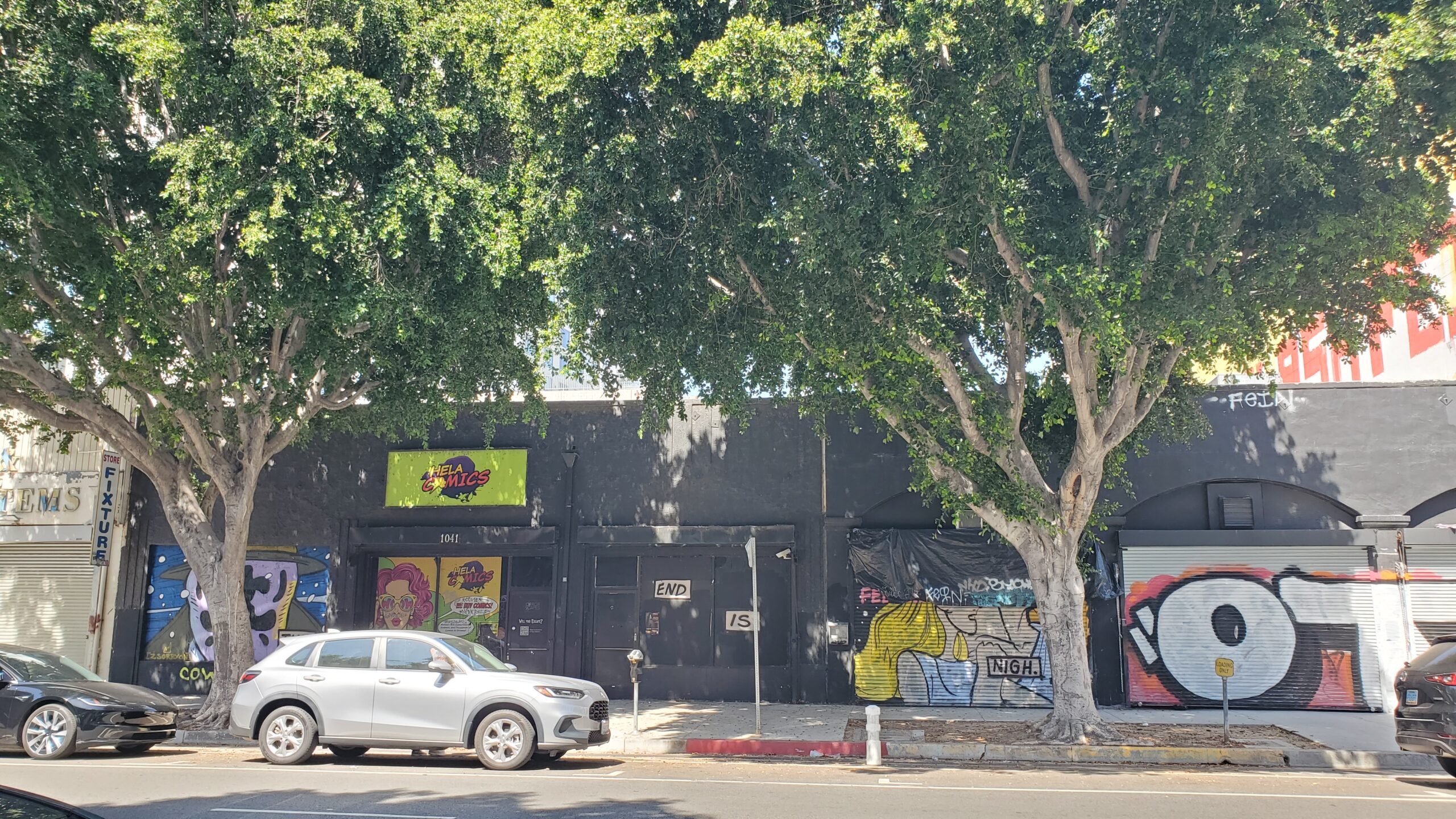
The Count’s Den is a small, moody venue in DTLA that leans into gothic and immersive vibes. Known for alternative parties, creative concerts, and dinners with a vampire coven, it blurs theater, nightlife, and art installation.
The Immersive Arts Collective (IAC) is a nonprofit focused on supporting immersive and experiential artists in LA. They do funding and advocacy for work that falls outside traditional formats. They also support inspiring children in the arts.
Theatre Obscura LA is a newer LA-based company; not much is written about them yet. But I’m certainly looking forward to the next creative idea they put forward.