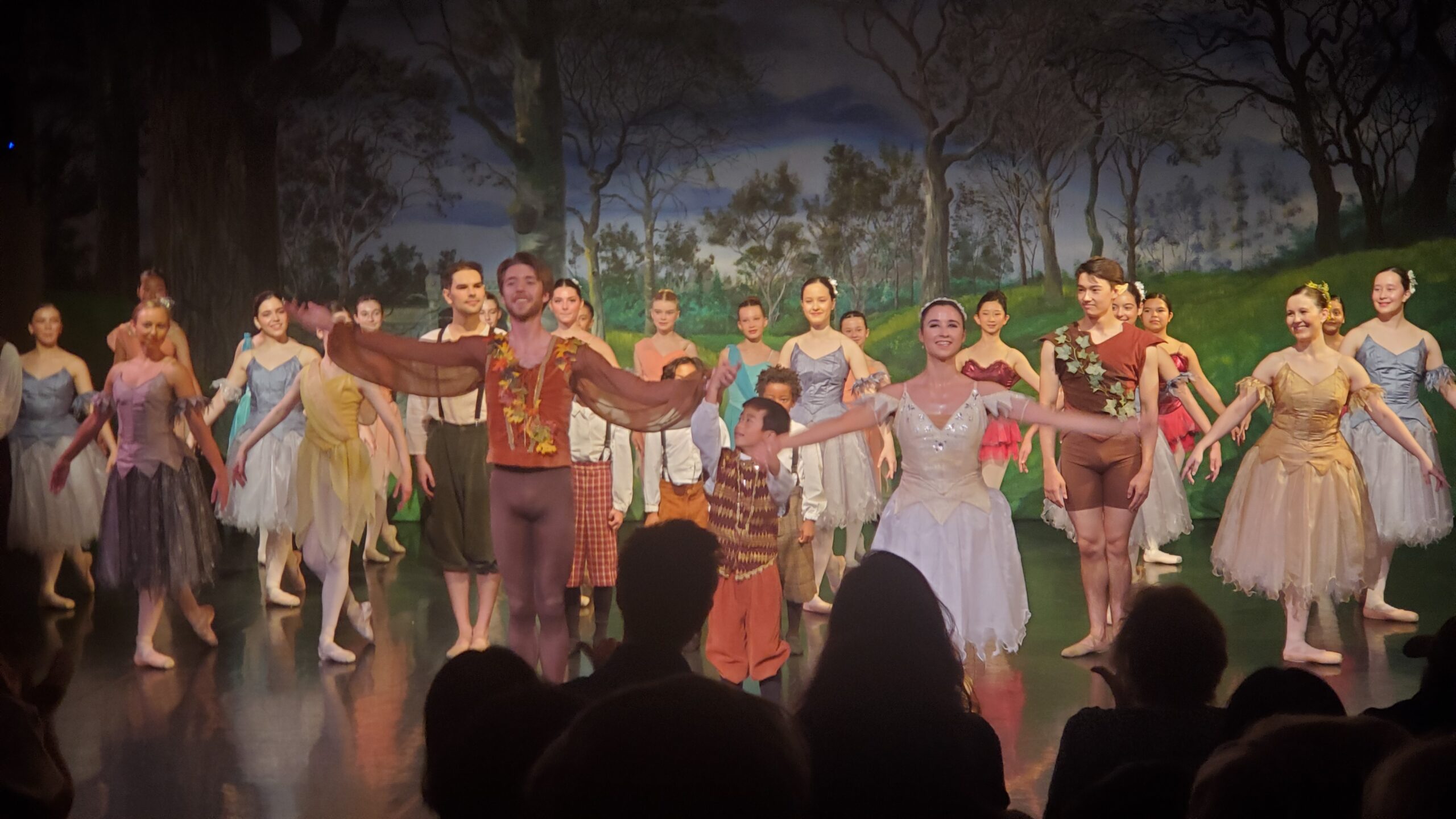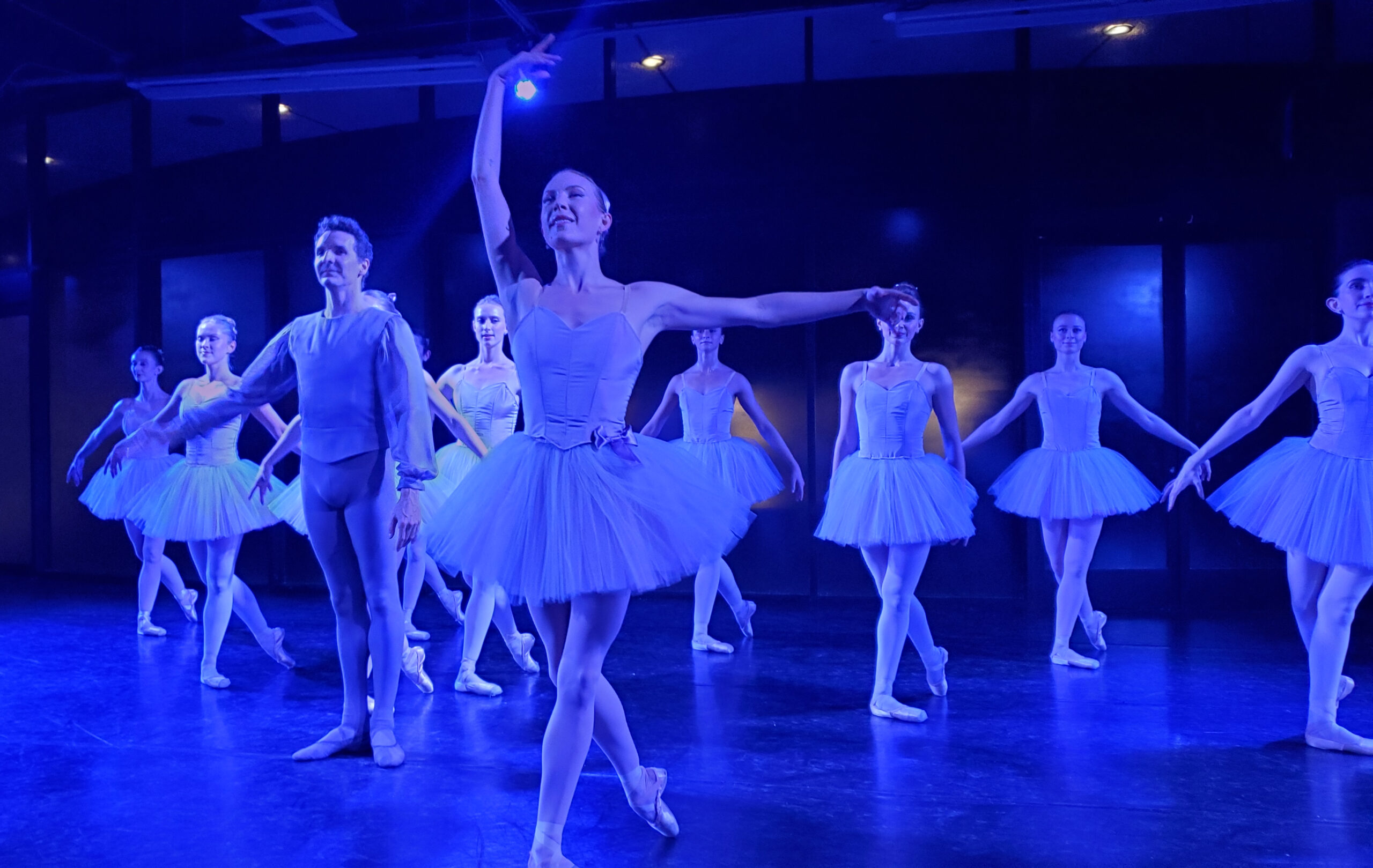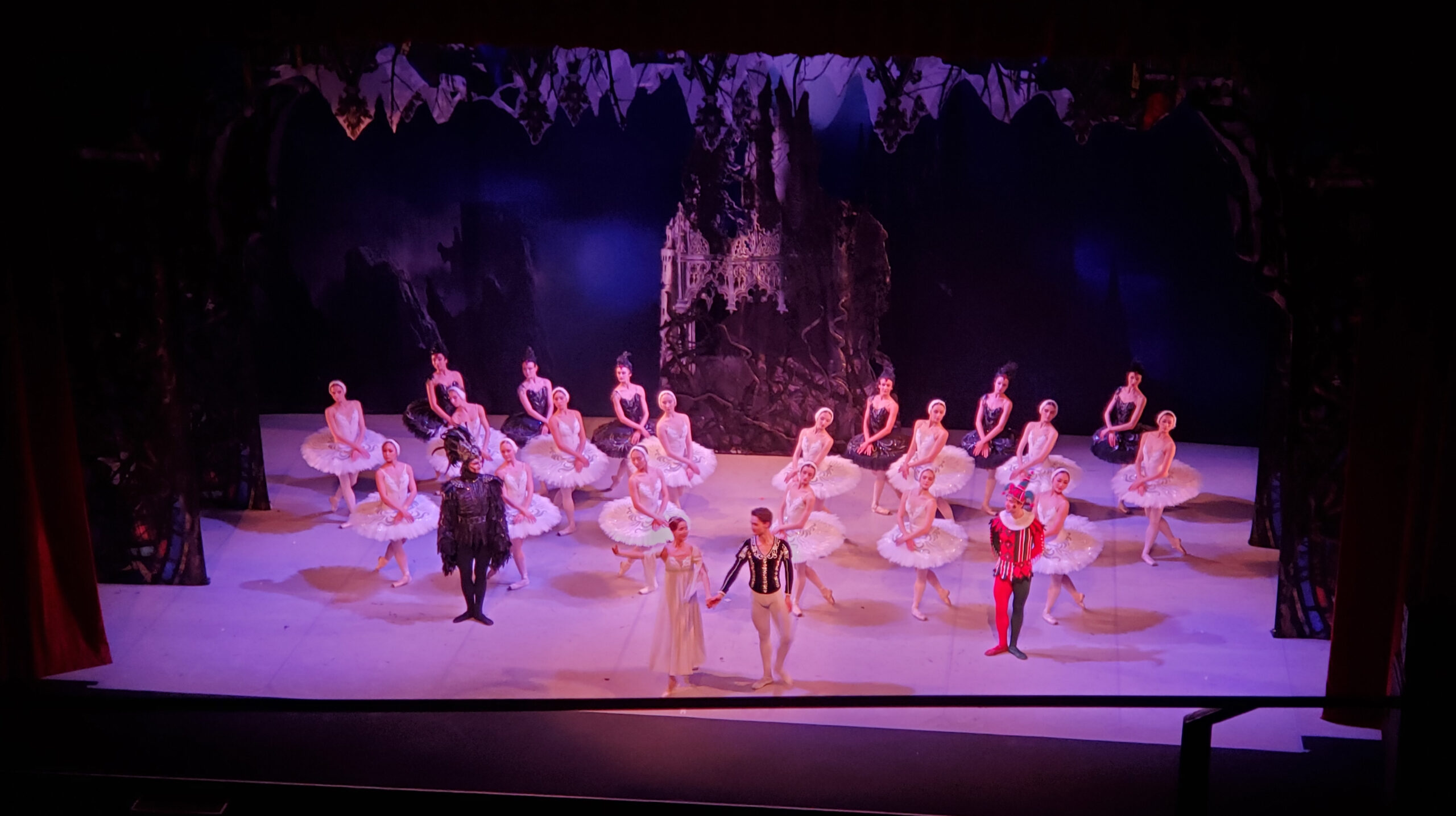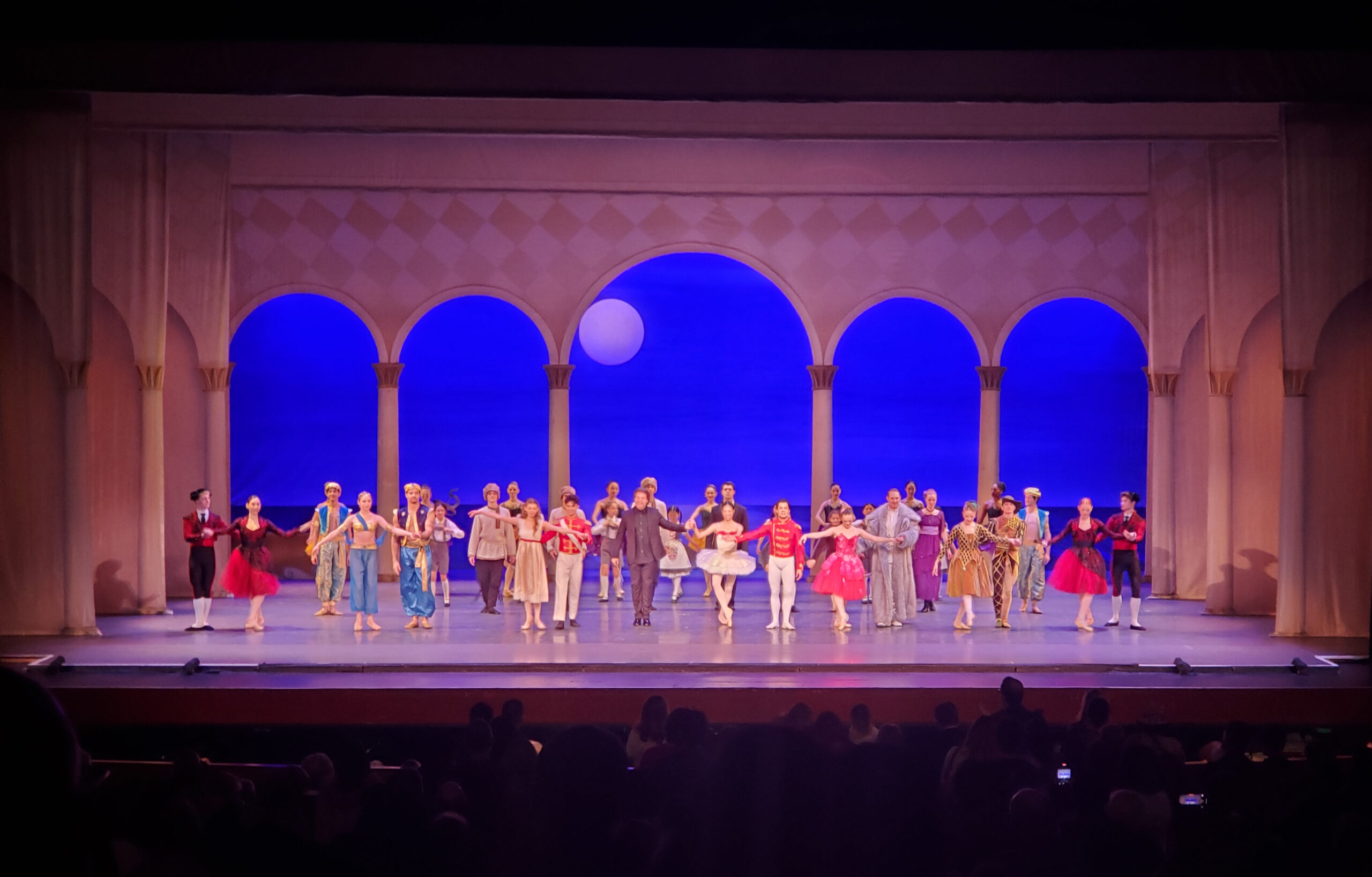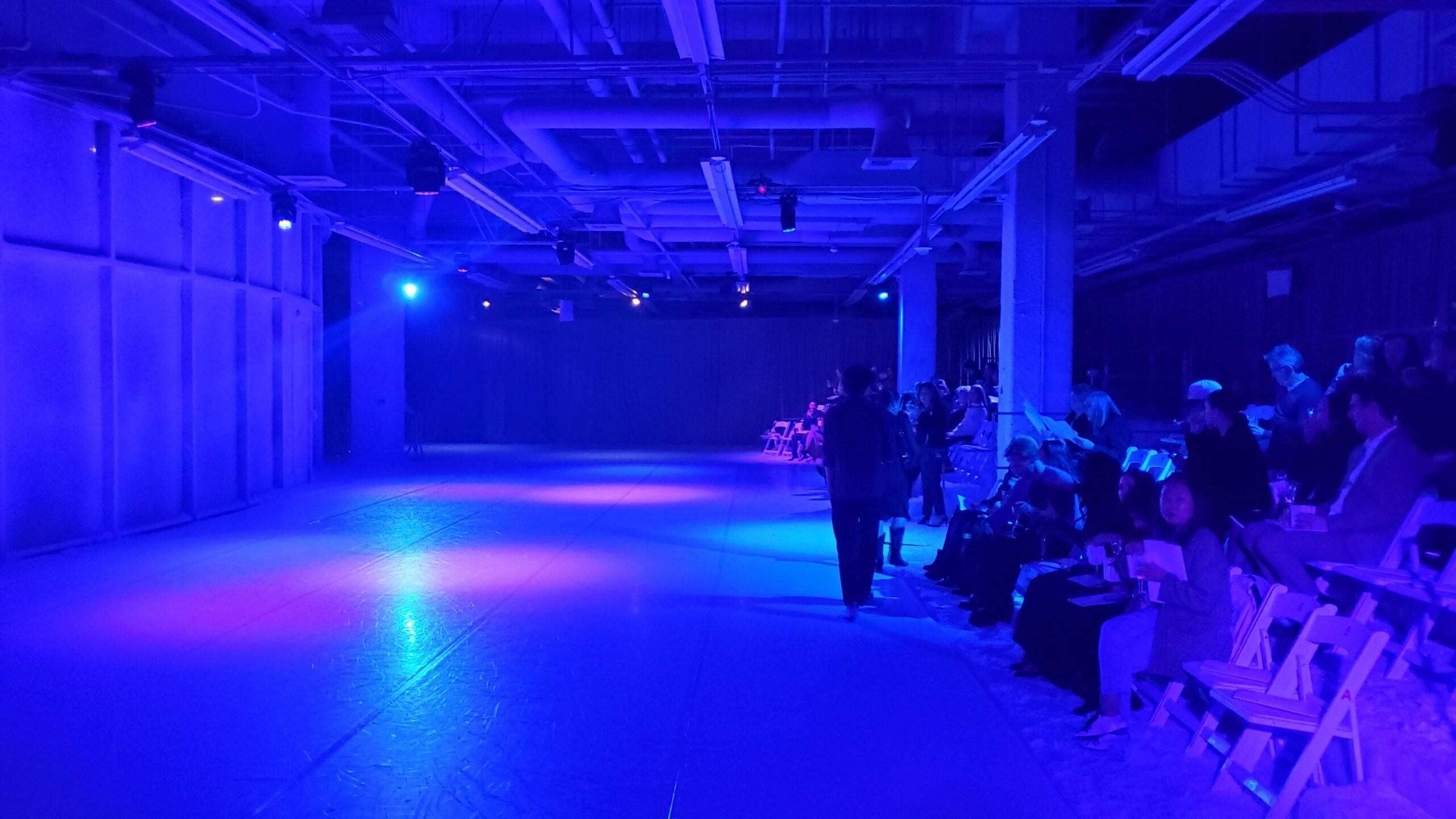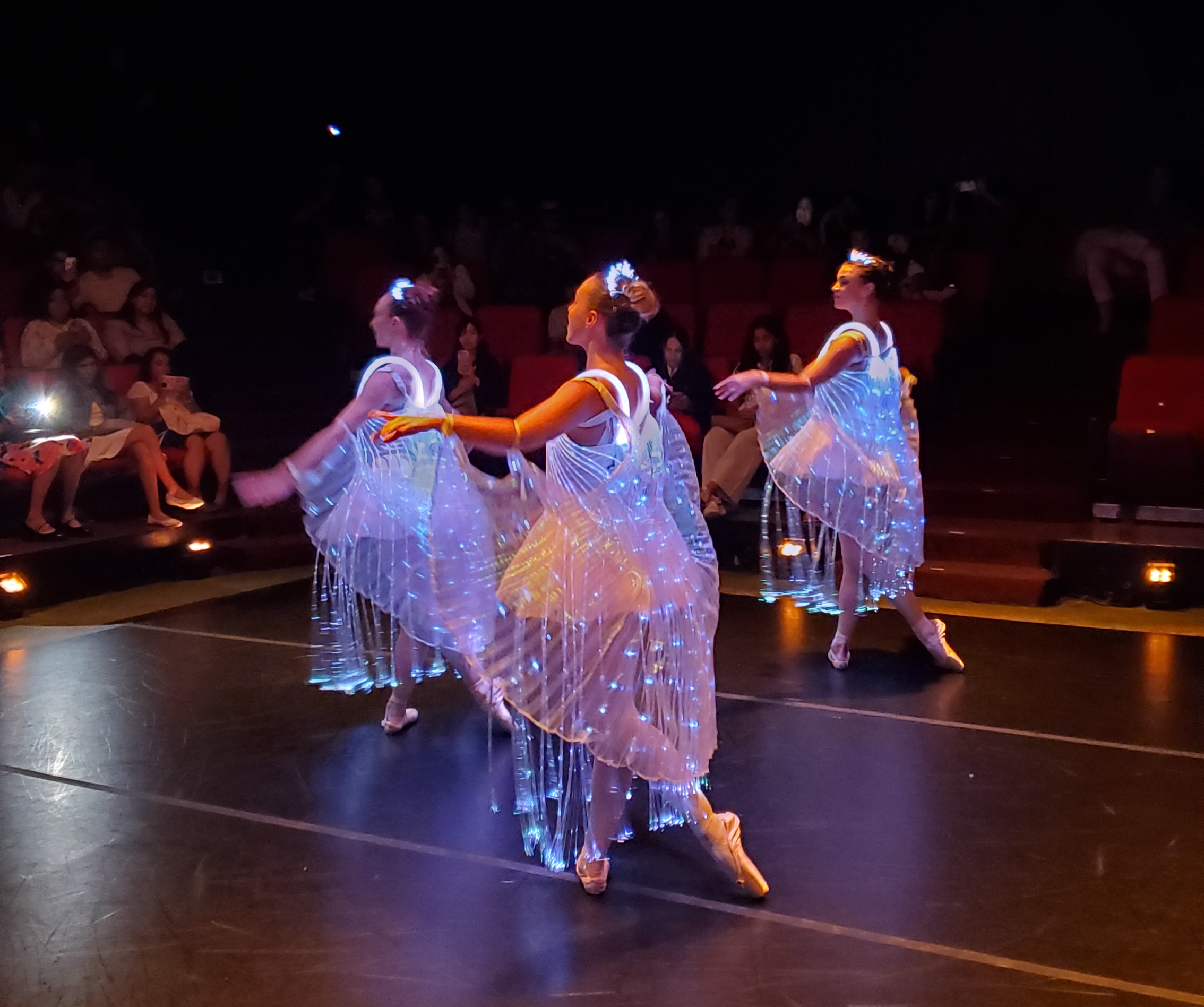
The Los Angeles Ballet company (LAB) has been going strong for over 20 years. To celebrate, they hosted an anniversary triple billing of Rubies, Frank Bridge Variations, and Wavelength–by LAB artistic director Melissa Barak, a world premiere. This show was a fantastic demonstration of variety and skill.
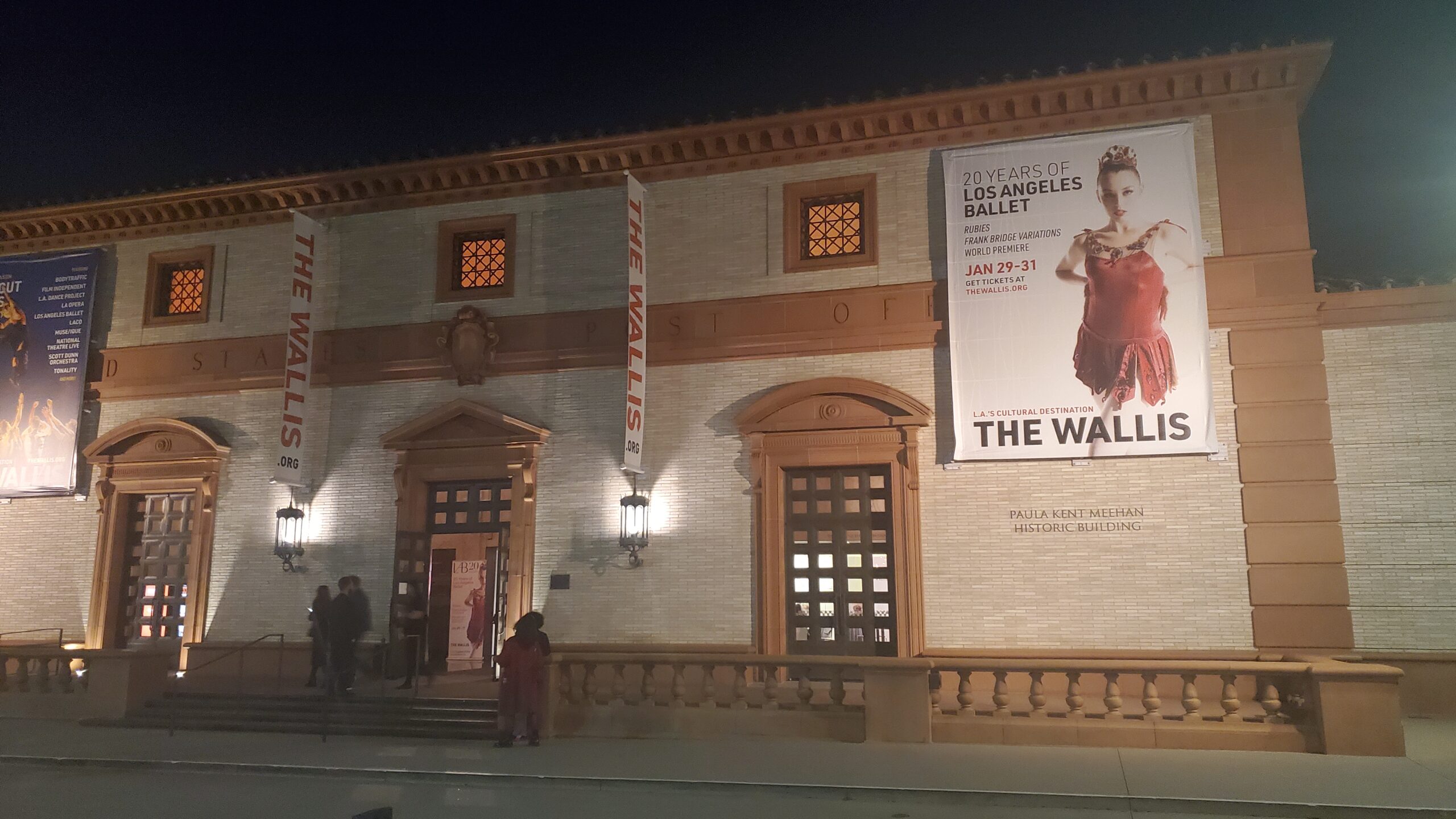
The special occasion was celebrated at a suitably special venue: the Wallis Annenberg Center for the Performing Arts, which is a distinguished and formal location in Beverly Hills.
Arrival
No expense was spared, from the gigantic banner outside the building:
to the posters inside:
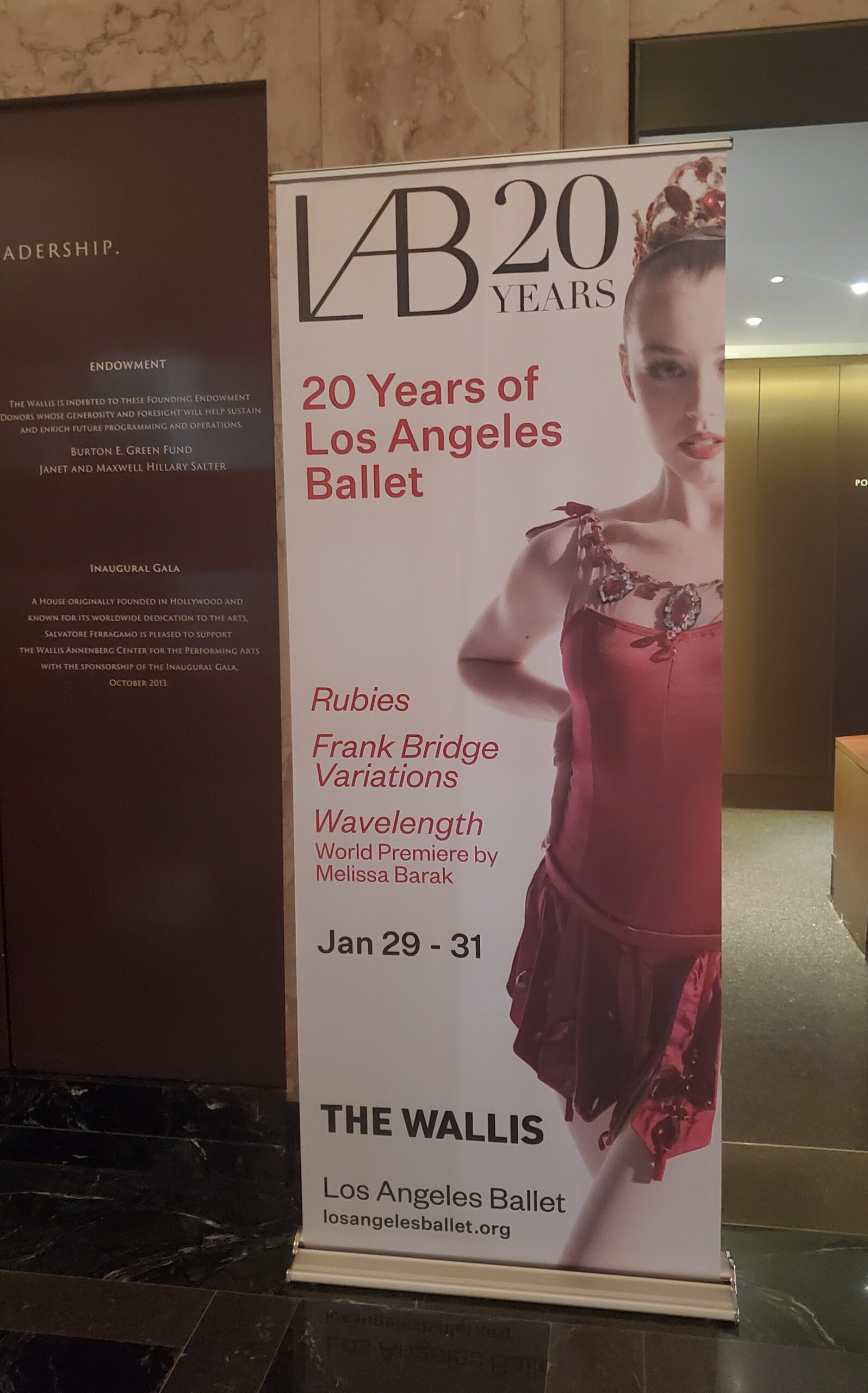
I believe the ballerina featured on all these posters is Aviva Gelfer-Mundl.
The Wallis is always a pleasure to visit. The interior architecture is grand, the bars are convenient and fast, and the Bram Goldsmith Theater itself is very nice.
The only downside I’ve noticed is that there always seems to be a long line for the women’s restrooms. I’ve seen it stretch around corners, while the line to the men’s is nonexistent. Plan ahead if this will impact you.
I did take this opportunity to finally get a photo in front of the Wallis backdrop.
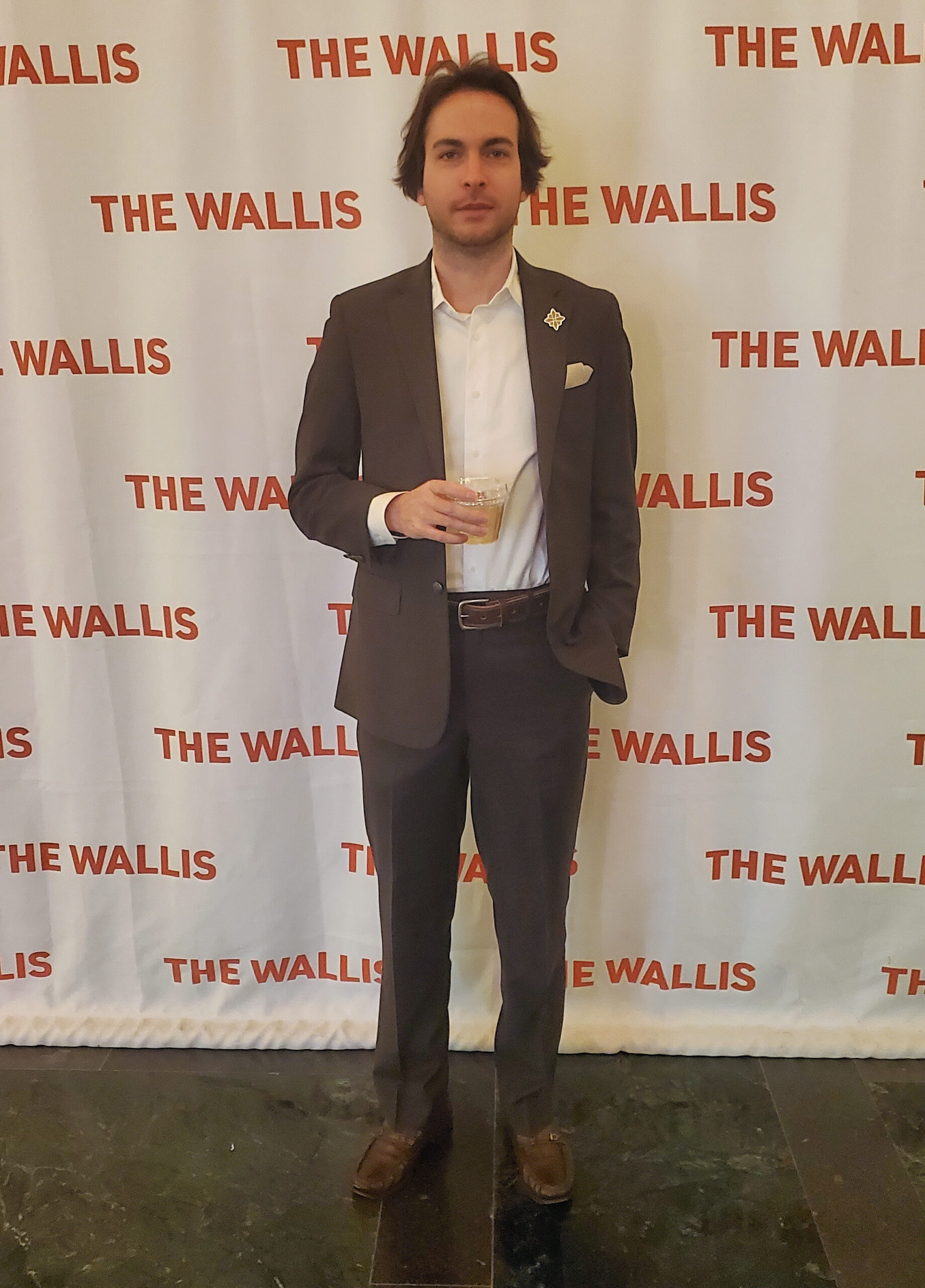
An upside of the Wallis is that you can bring your drink inside the theater. After getting a glass of wine, I made my way to my seat.
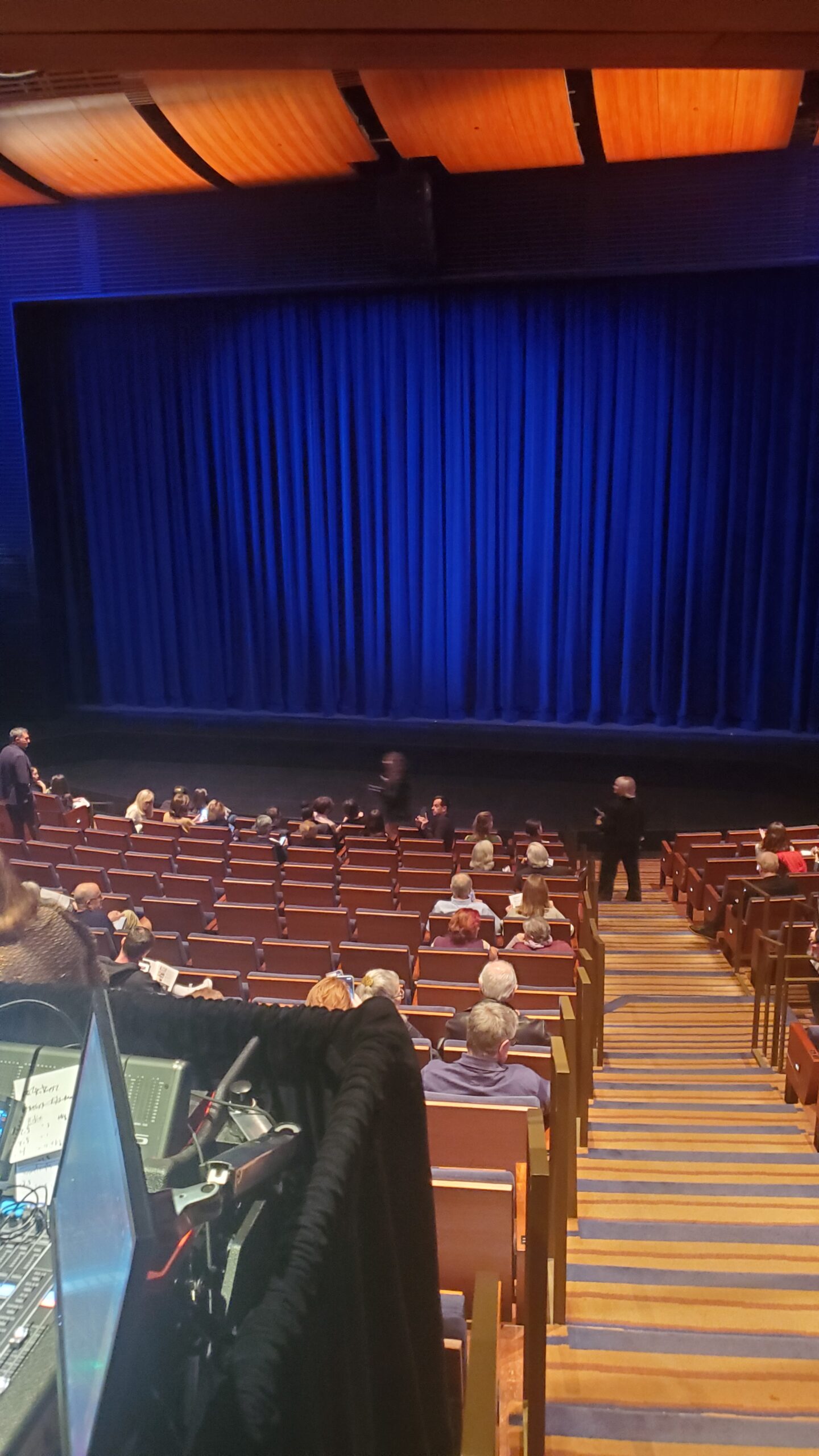
I think just about any seat in the Wallis will give you a good view. I bought my ticket early, so I had a great view from the fourth row:
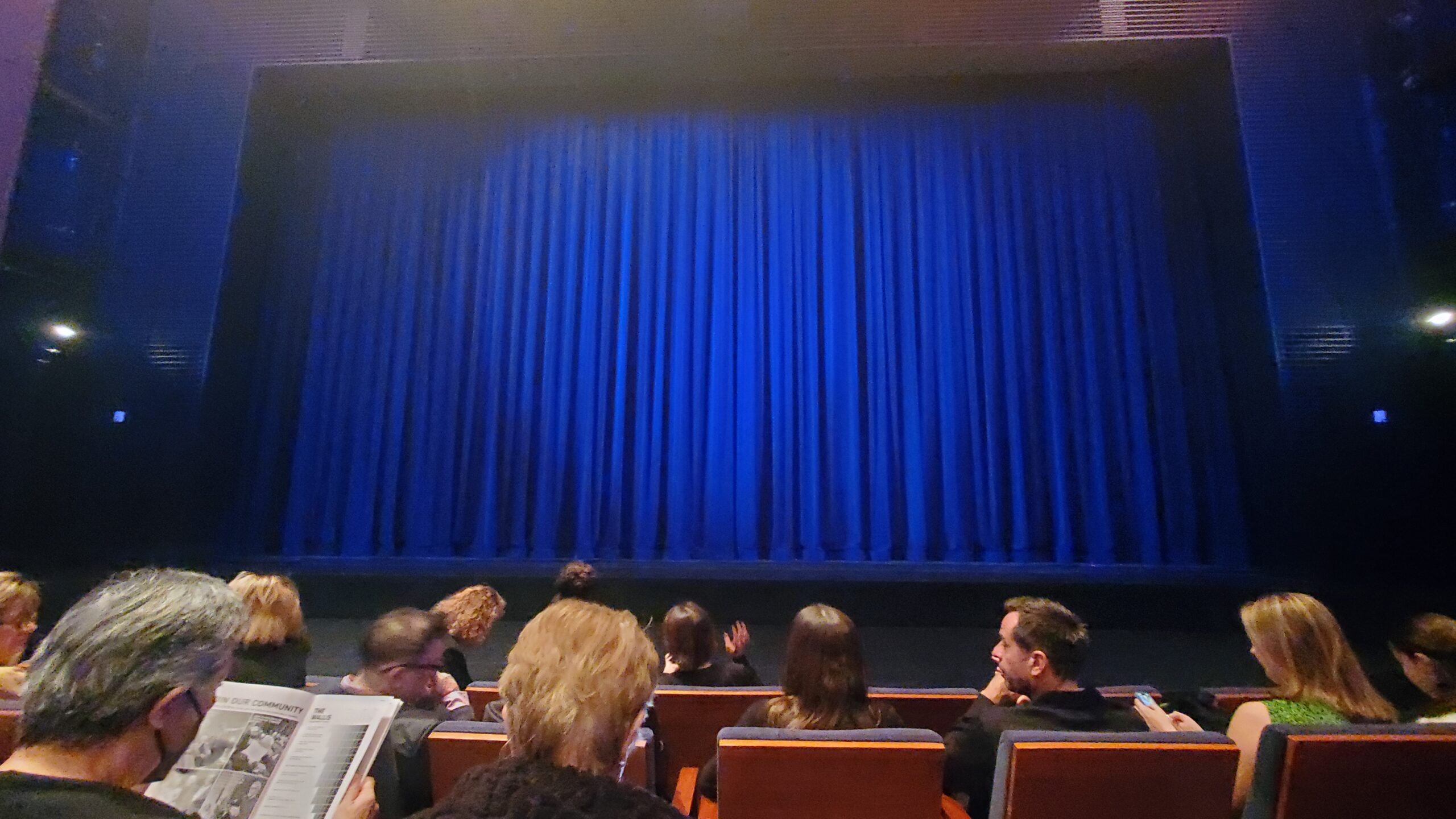
Center Orchestra PL1, Row D, Seat 105
I snapped a quick photo of the audience space behind me, as well, to give you the full view of the main and balcony seating.
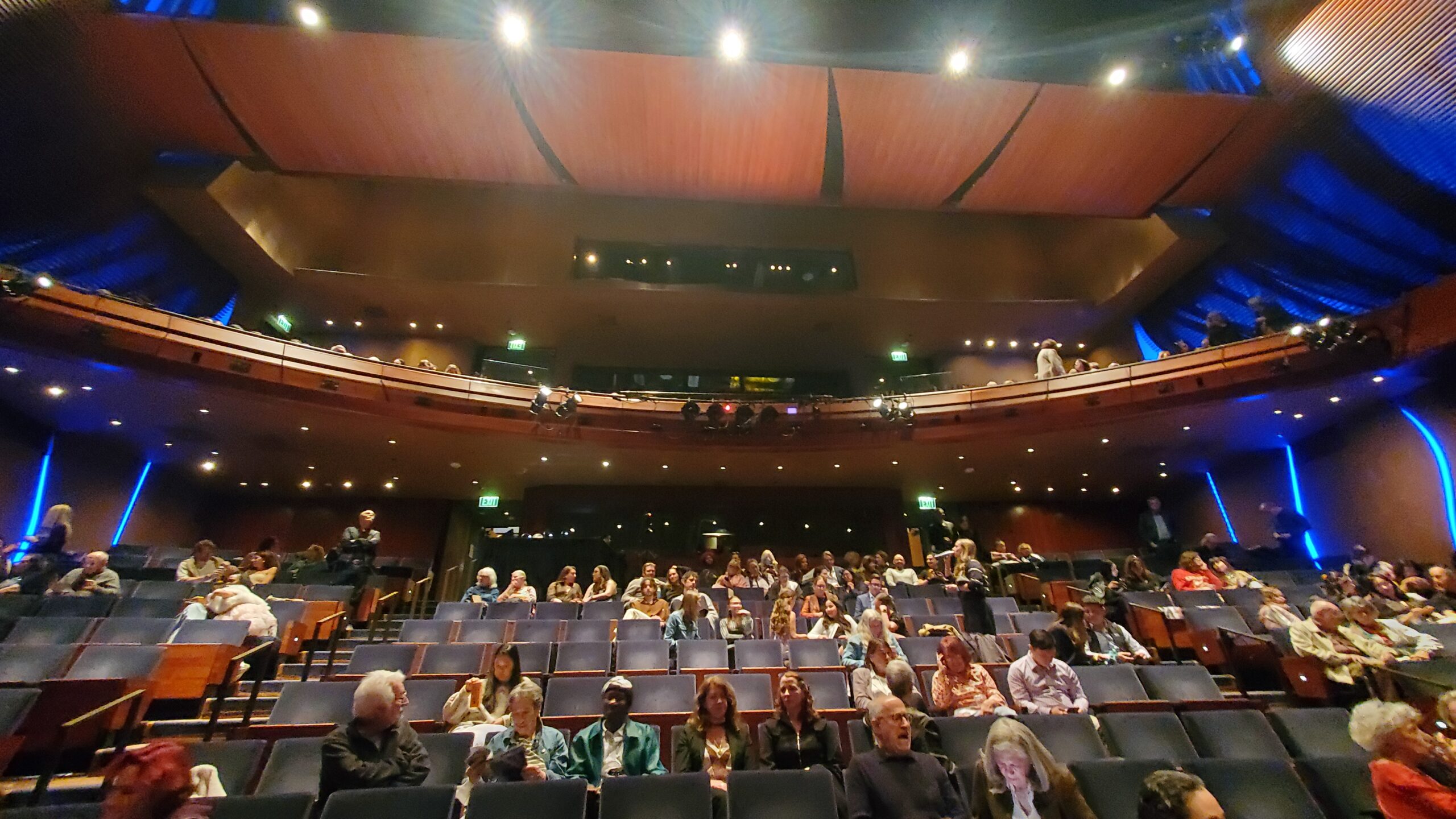
Settling into the comfortable seat, I waited as the audience filtered in, and soon the lights dimmed and the performances began.
The Performances
Melissa Barak walked onto the stage along with one of the people who run the Wallis, and they welcomed the crowd and briefly reflected on the last two decades of ballet in LA, and discussed the performances to come, signifying the past, present, and future of the company.
It was great to see Barak on stage introducing the show herself; I felt immediately more connected with the company than I did at the more traditional Nutcracker by LAB a month earlier.
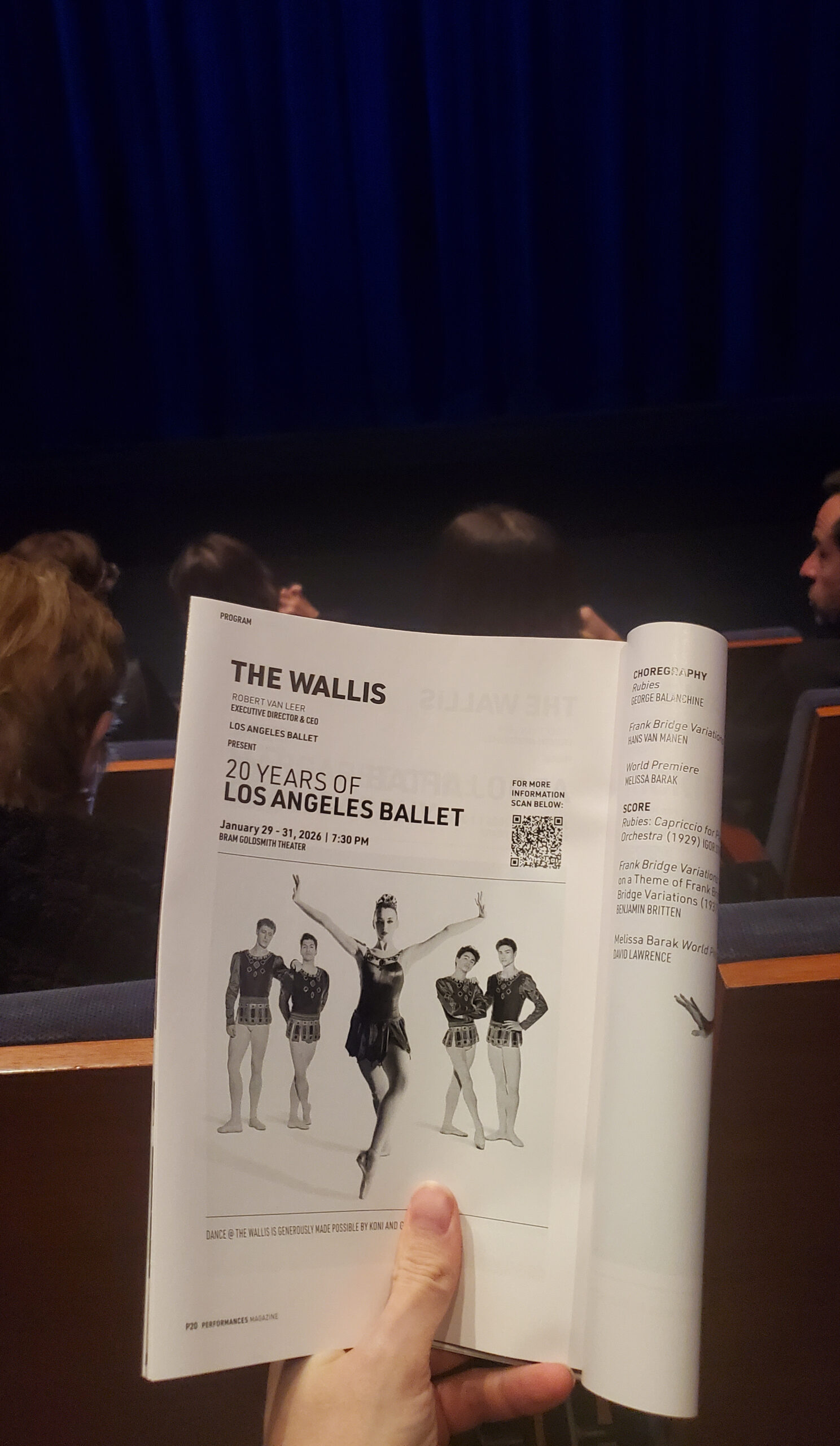
Act 1: Rubies
Rubies is the middle movement of George Balanchine’s Jewels, and was shown here tonight on its own. It can be described as a little bit brash, a little bit daring, and a little bit angular, traditionally with a lot of hip and torso work and plenty of speed. Barak revealed that she herself performed in LAB’s production of Rubies 20 years ago.
LAB’s performance tonight was finely polished, at first presenting itself more traditional, with decorated red costumes against a lit backdrop of solid sky blue. Out of an initial classical feel came more modern and interesting movements, notably the tilting hips. There was a constant back-and-forth flirtation usually led by the women against an undercurrent of a bustling city. In some small way I was reminded of the busy urban vibe from Guys & Dolls, if only in general atmosphere.
The standout performance here–and perhaps the singular standout performance of the night, for me–was the lead role of “Tall Girl” performed by Julianne Kinasiewicz. It’s difficult to describe without beginning with simply: “wow!” Kinasiewicz was precise, joyful, and energetic, with a confidence both in movement and in expression that made her the focal point of attention any time she was moving on stage. At times leading an ensemble, at other times dancing with four male performers, and even on stage on her own, Kinasiewicz was thrilling to watch.
The leading couple (Kate Inoue & Marcos Ramirez) was also a delight to see, and lent a more traditional feel against the Tall Girl’s modern flair. More elegant and romantic than flirtatious, they seemed to spend much of their time in the air, and yet grounded the act in a familiar language.
Rubies was set to Igor Stravinsky’s Capriccio for Piano and Orchestra. Unfortunately the music tonight was pre-recorded, not live–perhaps the only minor disappointment of the night.
LAB’s Rubies was grand, showy, and aggressive, and the energy was high going into the second act (after a quick 15 minute intermission).
Act 2: Frank Bridge Variations
The lights darkened with the second act, and with them, so too did the mood.
Hans van Manen’s Frank Bridge Variations pairs Benjamin Britten’s large, spacious score with lots of wide open space on stage. Frank Bridge was Britten’s teacher, and Britten could parody, deconstruct, and memorialize his work all at once. Meanwhile, choreographer van Manen thought deeply about shapes, groupings, and transitions, as opposed to big dynamic buildups to climactic events.
The most striking thing about LAB’s Frank Bridge Variations was the backdrop. An inventive use of moiré patterns became an unforgettable real life visual effect.
A moiré pattern is an interference pattern that most of us are familiar with from normal life. Imagine taking the fine mesh screen from your window screen or screen door, and putting another fine mesh screen on top of it, and slowly rotating and shifting the top mesh over the bottom. Your brain interprets this as an “optical illusion”-like third pattern that seems to float above and between the screens all at once, with new dark lines and waves.

LAB had at least two screens like this behind the dancers for Frank Bridge Variations, and at first it was so visually oppressive that it threatened to give me a headache. From whispers I heard in the audience, I don’t think I was alone. As the dancing began, it gave the impression that the ballerinas were all in front of a moving field of three-dimensional television static, and trying to place their exact positions and relations on stage was visually difficult as your eyes focused and refocused repeatedly.
It was a fascinating novel experience, but I was still thankful when, after a few minutes, they lifted the screens most of the way up, mercifully giving my eyes a break. I don’t want to sound like it was all that painfully unpleasant or anything; my main note on this section is that it was hard to concentrate on the dancers with this effect behind them, so some of the performance nuance may have been lost, especially early on.
The dancers switched to dark red or green/gold leotards, and the motions were so much more inward, deep, and emotional. While at times there were grand movements, much of the choreography was reduced to locomotion, which here served as a textural counterbalance against the jazzy Rubies.
This piece was more about restraint and constraint, with the visual effect reinforcing the mood of the performance and literally providing visual boundaries when hanging above the ballet. Still, the pressure found releases, especially in some small, subtle, witty moments in shared glances between dancers, and walks off of the stage that felt like deadpan humor.
It would be hard to call this section my favorite, as a viewer, but like any dark point in a story, it’s necessary for the overall work to feel whole.
After another bow, the lights went up and there was another 15 minute intermission–this time feeling like a breath of fresh air.
Act 3: Wavelength
After two acts that were so different in nature, I was eagerly awaiting the third and final act: Wavelength, a new creation by LAB artistic director Melissa Barak herself, set to music by David Lawrence. This was the world premiere and, according to Barak herself, meant to represent the future of LAB. What could the future have in store?
The score started and was instantly more lively than Frank Bridge Variations was. It felt more contemporary, with little clicks–perhaps spoons, or something more mechanical?–reminiscent of clocks and timekeeping. Meanwhile the music itself wasn’t rigid against the beat, but rather smooth and flowing, with a foreign feeling that I’m not expert enough to geographically place, but perhaps somewhere abstract in the Middle East.
The outfits were a variety of solid colors, with men in yellow or purple, and women in red or blue. Men had tank tops and patterned leggings, while women had patterned tops and either skirts (red) or tights (blue). While the patterns were all cut from the same overall theme, no two were exactly alike. The mood was bright and fresh.
The background here was a simple lit solid color, but it would slowly change from blue, to a gradient, to purple, then another gradient, shifting through colors, and at times (so it seemed) shifting slower or faster, though never distractingly so.
Against that simple staging was a performance that was so fast, vivid, and enjoyable that I think my jaw had dropped midway through. There were always multiple things going on across the stage–when there was a couple or a single person up front to one side, someone else would be repeating simple motions across the stage in the back, as if on conveyer belt, repeated by someone half the stage distance behind them moving at the same pace, enter to exit, constantly entertaining without overwhelming or overshadowing.
There were wonderful movements involving dragging and tossing, which demonstrated precise coordination while still feeling like ballet, not just contemporary acrobatics. I kept thinking how smooth it all was, and how much planning and thought clearly went into the theatrical mis en scène, especially impressive when there are no props or sets to speak of.
My favorite part of the staging, which was wonderfully repeated with variations multiple times, was when the ensemble would appear in a group and then, coordinated with a dramatic moment in the music, they would all duck and collapse to the floor, flat, while just two or three principals would be revealed among them, still standing, in some dramatic, striking pose, often lifted. They would hold this for just a moment before reconvening and continuing the dance. It was like waves parting to suddenly form a beautiful Renaissance painting, a living sculpture acted out on stage. I was blown away.
There was another dramatic posing moment where the whole group was arranged as if emerging from the back of the stage, on the right, all looking forward and outward diagonally with one person (Kinasiewicz again) lifted, reaching out, as if all united in some struggle or desire. It was fascinating compositional staging.
It wasn’t just the big moments, though, but all the little ones too. The performers were constantly smiling, and with genuine smiles, not the polite performance smile worn when executing a demanding move. More than dancing, it gave the impression that you were watching friends interacting, or a community coming together. One of my favorite moments was when two male performers (I believe it was Jacob Soltero and Marcos Ramirez) interacted, dancing off of each other for a moment in friendly greeting before returning to female performers. While each act featured great male performances, the male-male dynamic is something I’ve seen less often and was a delight here.
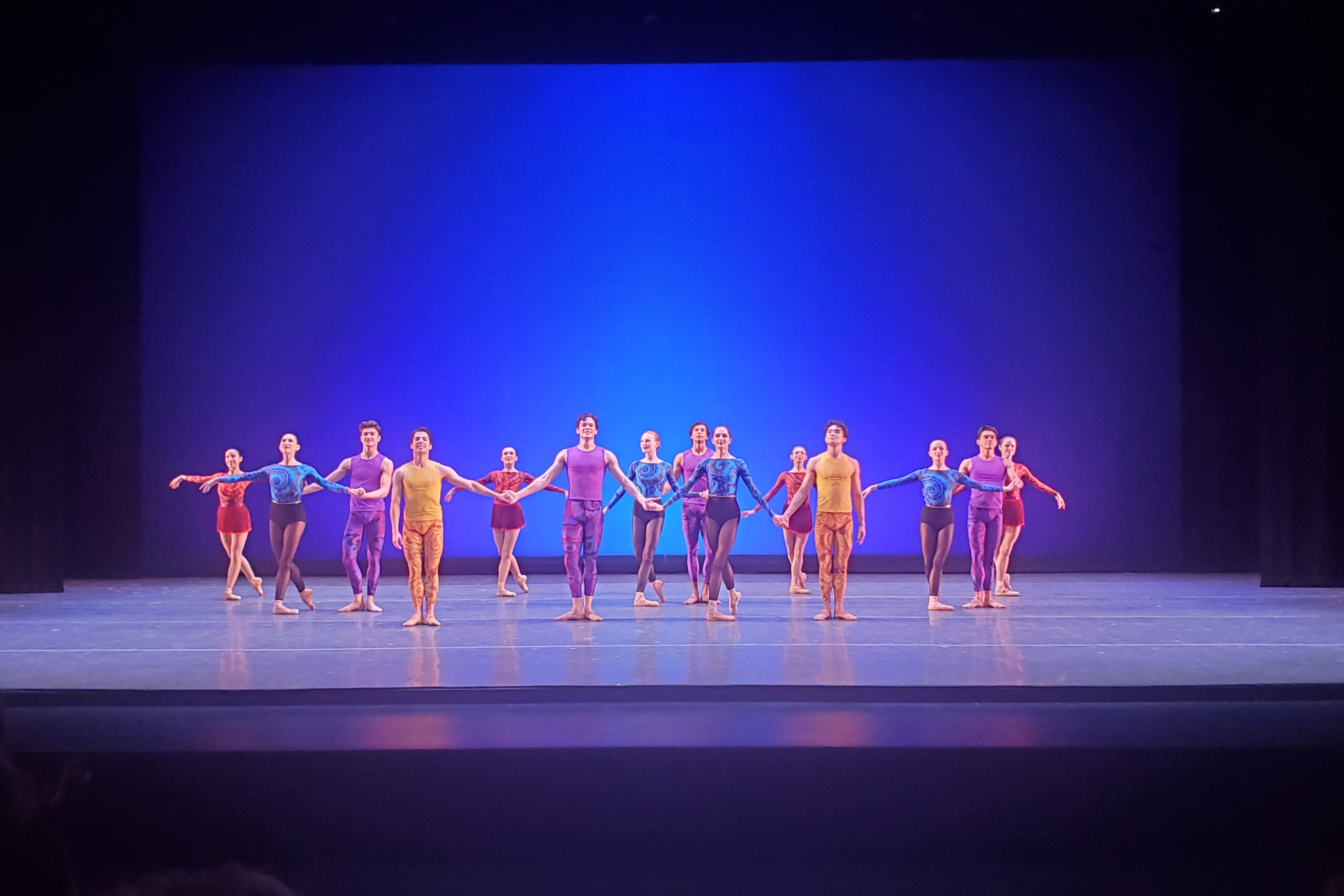
Wavelength was an athletic expression of social joy and a visual feast for the eyes. It ended with drama and finality and was rewarded with an immediate standing ovation from the audience.
Thoughts on All Three
In the introduction, Barak had mentioned that these three pieces were supposed to represent the past, present, and future of Los Angeles Ballet. I think this makes sense when looking at Rubies as past (the most classically influenced of the three, and an “origin story” produced again twenty years later) and when looking at Wavelength as future (which I’ll expand on later).
Far be it from me to disagree, but I would instead offer up another interpretation of the three acts: a dialectical interrogation of LAB’s present, in relation to Los Angeles as a whole.
We start with the thesis of Rubies, which, yes, is older (1960s) but hardly Tchaikovsky- or Italian-Renaissance-old. Instead, I think Rubies symbolizes the common perception of ballet. The outfits are more traditional and formal, the movements are a little jazzy but still feel classic, and the overall place is an establishing benchmark: yes, this is ballet.
We move on to the antithesis: Frank Bridge Variations, which questions, what is ballet, what is movement, what is it to watch a performance at all? The visual effects worked together with the slower and more emotive performances to break the dance down to pure motion, the atoms of ballet. Can this art form survive in the modern world?
The synthesis of Wavelength says, definitively, yes it can, and here’s how. Wavelength mixes the movement and tradition of Rubies with the emotion and intelligence of Frank Bridge Variations, and produces something new: a community of joy. Rather than princes and swans or tortured abstraction, LAB is saying the future of ballet is social at heart, with smoothly flowing ensembles that lift everyone up. It’s a recalibration, and in a sense, a very fitting one for Los Angeles–to say that true human networks and relationships are what we should be emphasizing in the coming era.

If this is what LAB’s future holds, I can’t wait to see it.
Full Cast & Context
Since the only online program available for this show is for the 31st (and I went on 1/30), I’m not confident that this is the exact lineup of the night I saw, but it should be largely correct. Please let me know if you’re aware of any erroneous inclusions or performers overlooked.
- Abigail Gross
- Aviva Gelfer-Mundl
- Brigitte Edwards
- Bryce Broedell
- Cassidy Cocke
- Chloe Oronoz
- Cleo Tanej
- Evan Gorbell
- Felipe Zapiola
- Jacob Soltero
- John Dekle
- Julianne Kinasiewicz
- Kate Inoue
- Lilly Fife
- Lilly Leech
- Marco Biella
- Marcos Ramirez
- Natalia Burns
- Nick Sedano
- Paige Wilkey
- Poppy Coleman
- Rony Baseman
- Sarah-Ashley Chicola
- Taylor Hugens
- Theo Swank
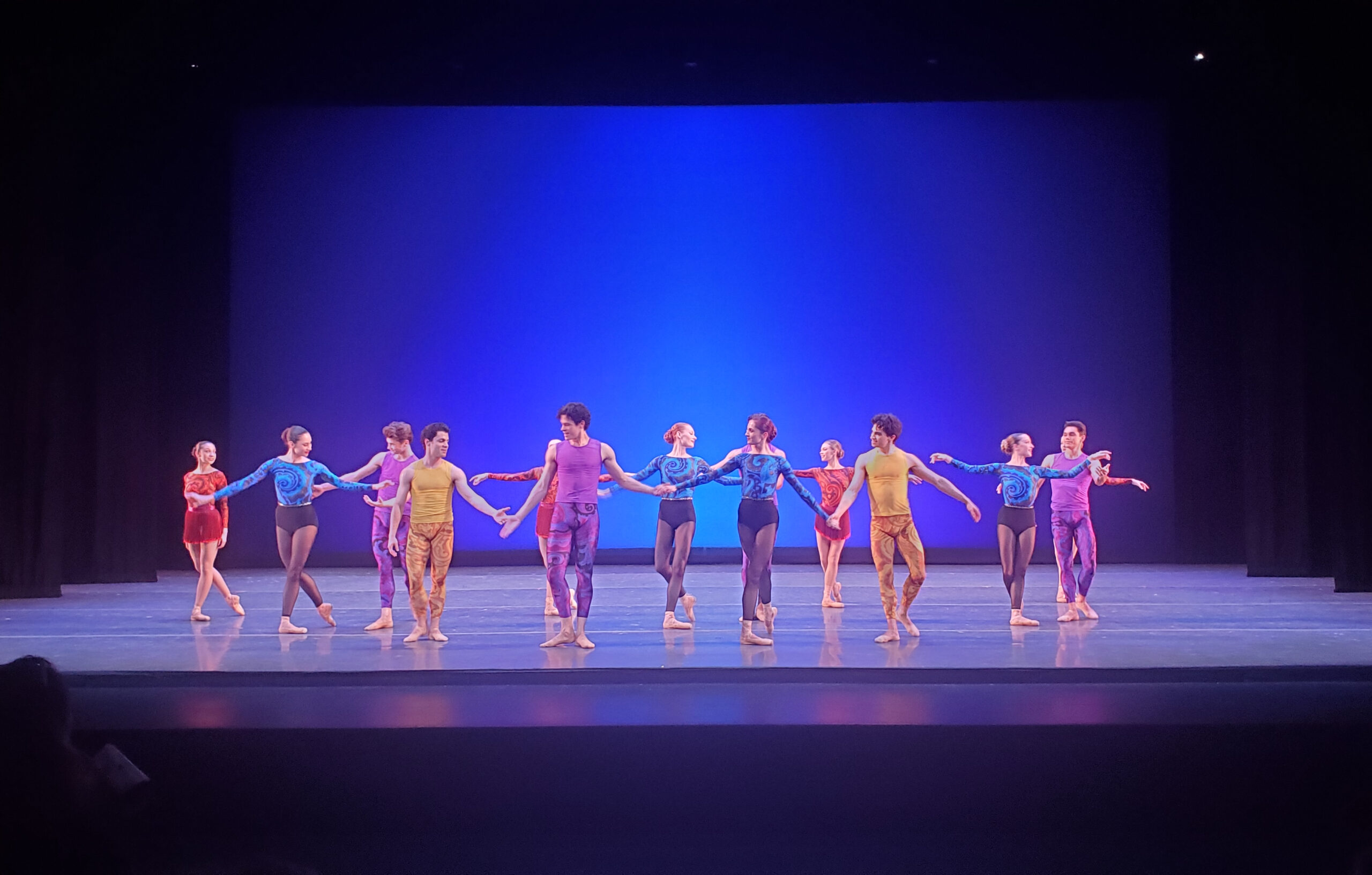
The LAB creative team:
- Melissa Barak: Artistic Director
- Nathan Scheuer: Lighting Design
- Keso Dekker: Scenic & Costume Design
- Chloée O’Hayon-Crosby: Costume Design
Jewels is George Balanchine’s three-part, plotless evening-length ballet, and Rubies is the sharp, jazzy middle section. The full triptych also includes Emeralds (lyrical and soft) and Diamonds (big and imperial). Rubies is set to Stravinsky’s Capriccio for Piano and Orchestra and often feels very American. It’s less fairy tale, more cocktail hour en pointe.
George Balanchine was born in 1904 in St. Petersburg and trained at the Imperial Ballet School before emigrating west. He co-founded New York City Ballet and basically reshaped 20th-century ballet around speed, musicality, and abstraction. His style is so distinct that “Balanchine dancer” is a full descriptor.
Igor Stravinsky was one of the defining composers of the last century. Early on he gave us The Firebird, Petrushka, and The Rite of Spring, then pivoted into neoclassicism, then later into serialism. He collaborated often with Balanchine, and their partnership shaped modern ballet’s sound.
Frank Bridge Variations is a sleek, abstract ballet by Hans van Manen set to Benjamin Britten’s Variations on a Theme of Frank Bridge. It’s tight, architectural, and not sentimental at all. It premiered in 2005 and fits comfortably in van Manen’s modernist aesthetic.
Frank Bridge was an English composer and violist born in 1879. His early work is very late-Romantic English style, though he modernized over time. He’s probably most remembered today because his student Benjamin Britten wrote the Variations on a Theme of Frank Bridge in his honor.
Benjamin Britten (1913–1976) was one of Britain’s major 20th-century composers. He wrote operas like Peter Grimes and Billy Budd, and tons of choral music and beyond.
Hans van Manen is a Dutch choreographer born in 1932, often described as a master of minimalism in ballet. His works are usually heavily stripped down: no clutter, just dancers in clean costumes with a strong musical structure. His work is intense, very European, very precise.
David Lawrence is a Los Angeles-based musician, composer, and arranger who works across orchestral, jazz, and film enterprises. He’s written for symphony, chamber ensembles, and screen–in other words, he’s very versatile.
The Wallis Annenberg Center for the Performing Arts opened in 2013 in Beverly Hills, partially housed in the restored 1933 Beverly Hills Post Office building. It’s named for Wallis Annenberg, the media heiress and philanthropist behind the Annenberg Foundation. The complex mixes the old Spanish Revival architecture with a sleek new theater space below, and is more intimate than the other Music Center venues.
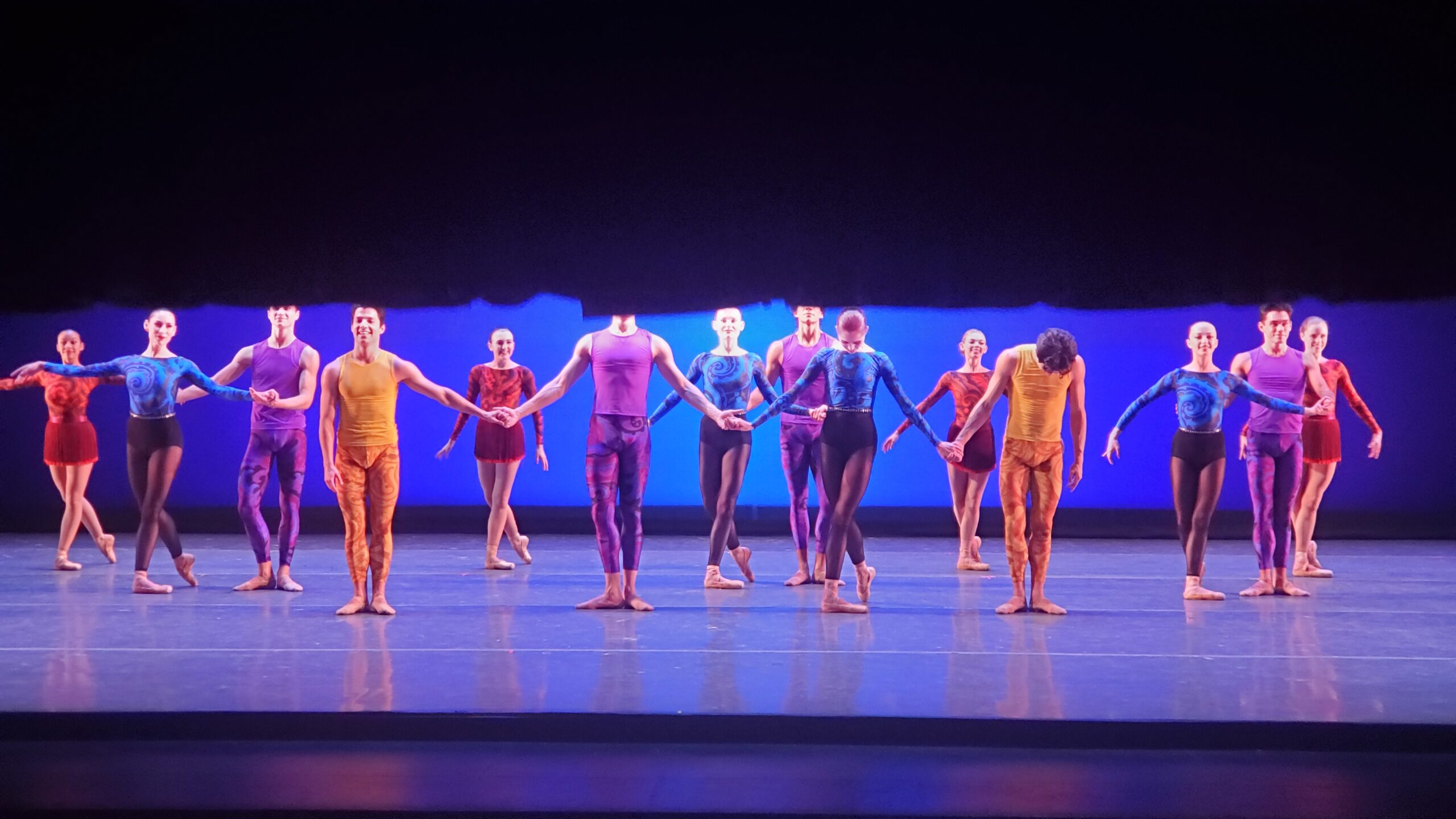
The final curtain.
Los Angeles Ballet was originally founded in 2006 by husband-and-wife team Thordal Christensen and Colleen Neary, both with Balanchine backgrounds. The company tends to mix classical story ballets (The Nutcracker, Swan Lake) with Balanchine works and contemporary pieces. Their style tends to run clean and musical rather than flashy or experimental. It’s not yet a massive institution like New York City Ballet, but it’s carved out a steady place in the LA scene and built a loyal audience over the last couple decades.