When it comes to Medieval history, I’m a huge enthusiast. So when I found out that there was a brand new opera (put on by LA Opera, no less) about the life of Hildegard von Bingen, a real, significant historical figure, I needed to see it. And I was lucky enough to get a ticket to attend the opening night of the world premiere showing (11/5/2025), the first time this has ever been performed for a true audience.
Although I enjoyed the production, it was not what I was expecting in multiple aspects. And although it has skilled performers, I suspect it will face difficulties reaching popularity. Let’s jump in to my experience.
Arriving
The Wallis Annenberg Center for the Performing Arts is an impressive space in an impressive zip code. The building is every bit as impressive as you would expect.
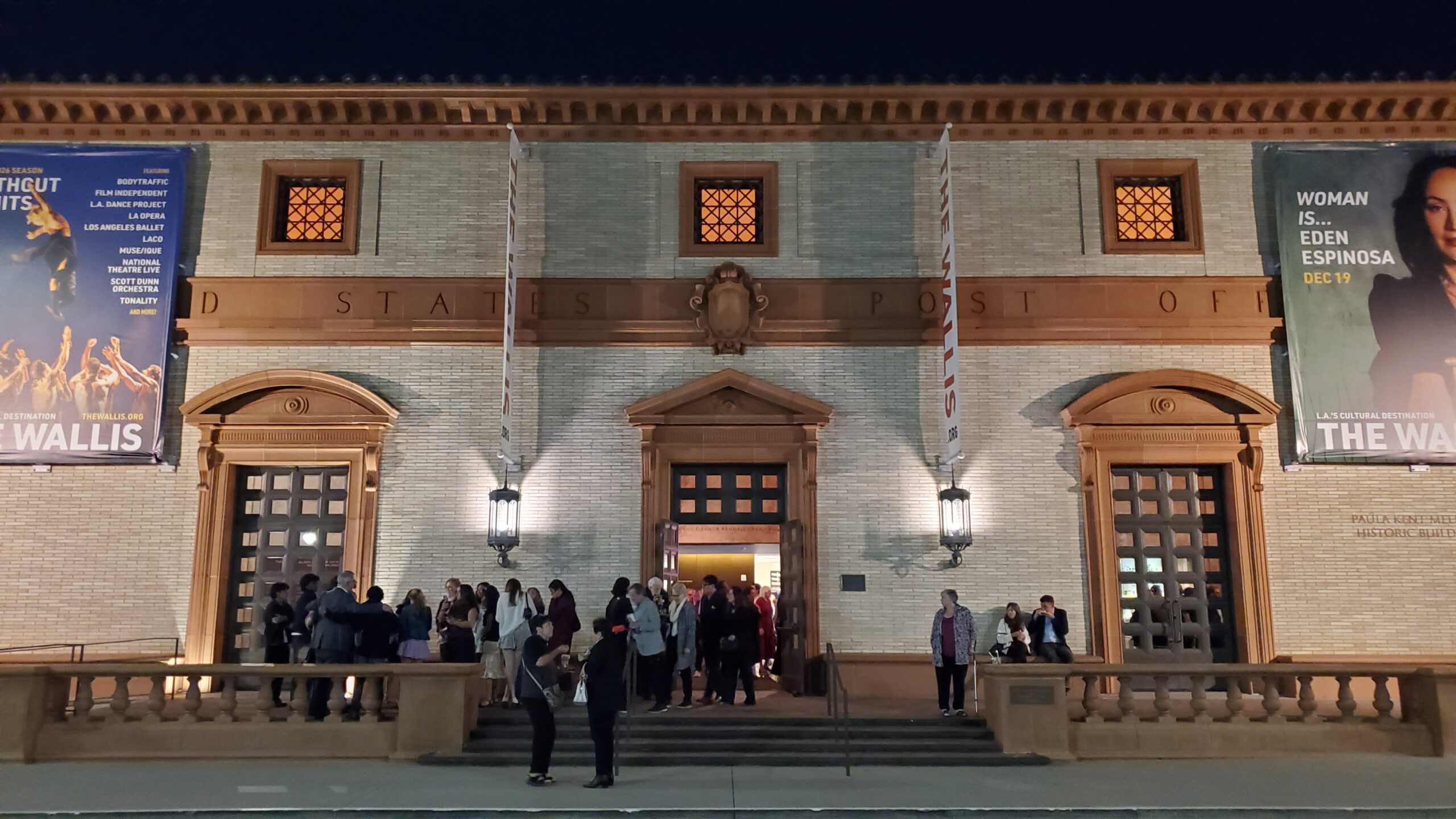
I arrived in plenty of time to enjoy some socializing beforehand, and to get acquainted with the location a little better. This is not a place one dresses casually to. In fact, I’d consider this Beverly Hills venue more formal than the downtown LA Dorothy Chandler Pavilion (LAO’s primary residence).
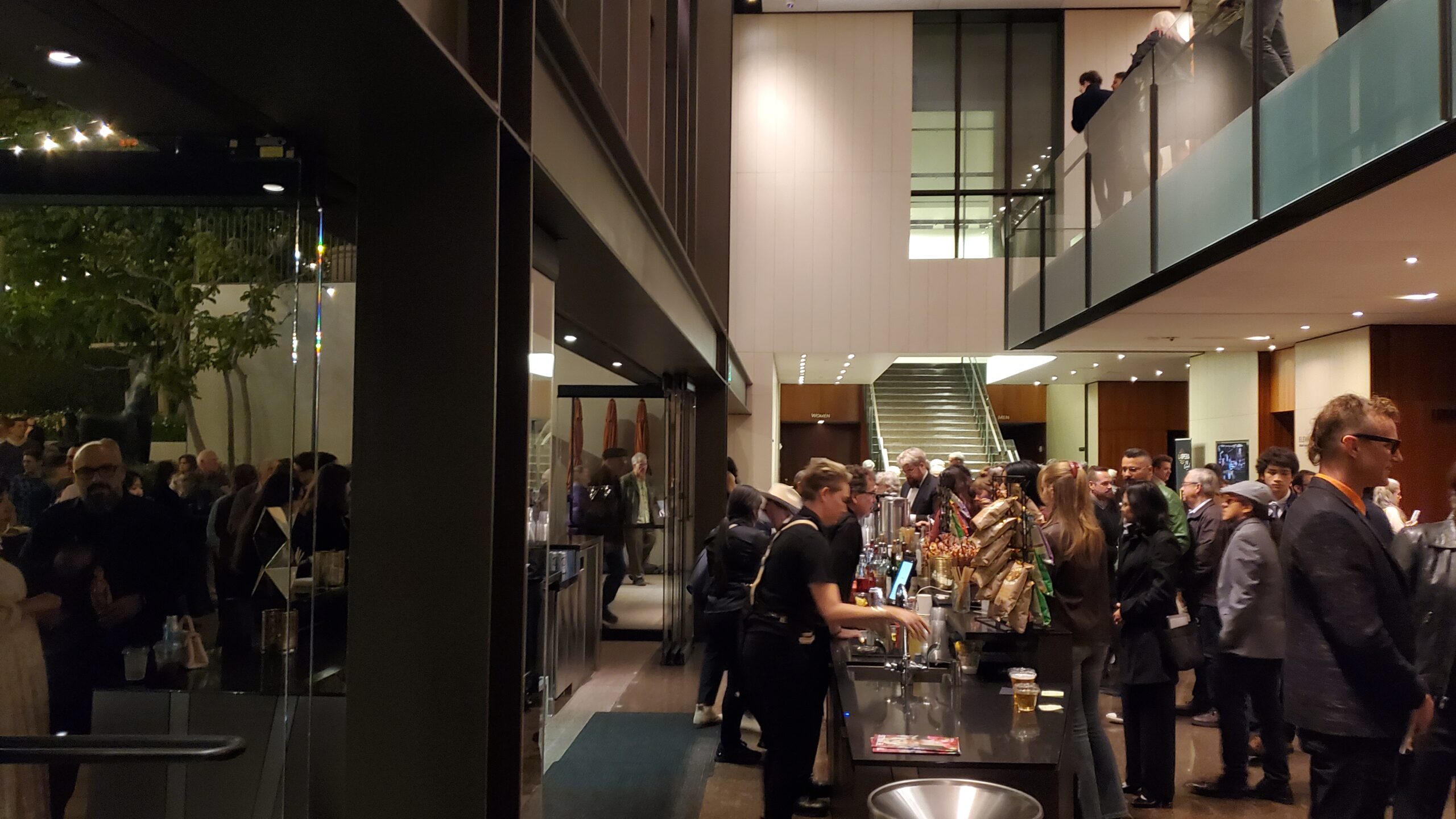
There’s a bar and concession room in front, along with hallways with event-specific tables and decorations. The restroom situation for men is ok, but for women it’s extremely limited–there is always a very long line to the ladies’ room.
The theater is a level below, so you walk down a hallway and then down a grand staircase with beautiful art around you, into a lower space in the back with a balcony level and a large windowed side, overlooking a charming patio. There are more bars down here.
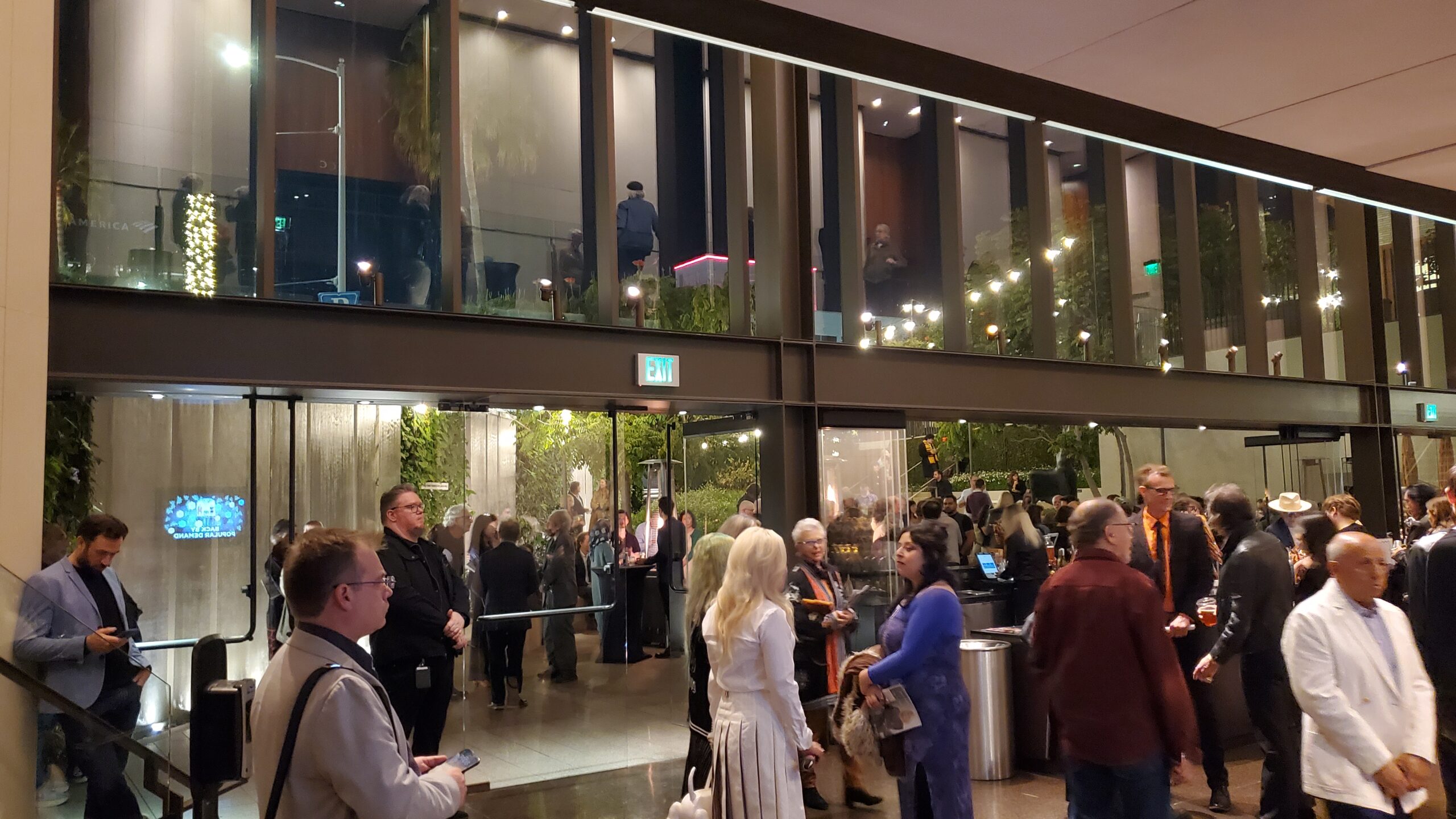
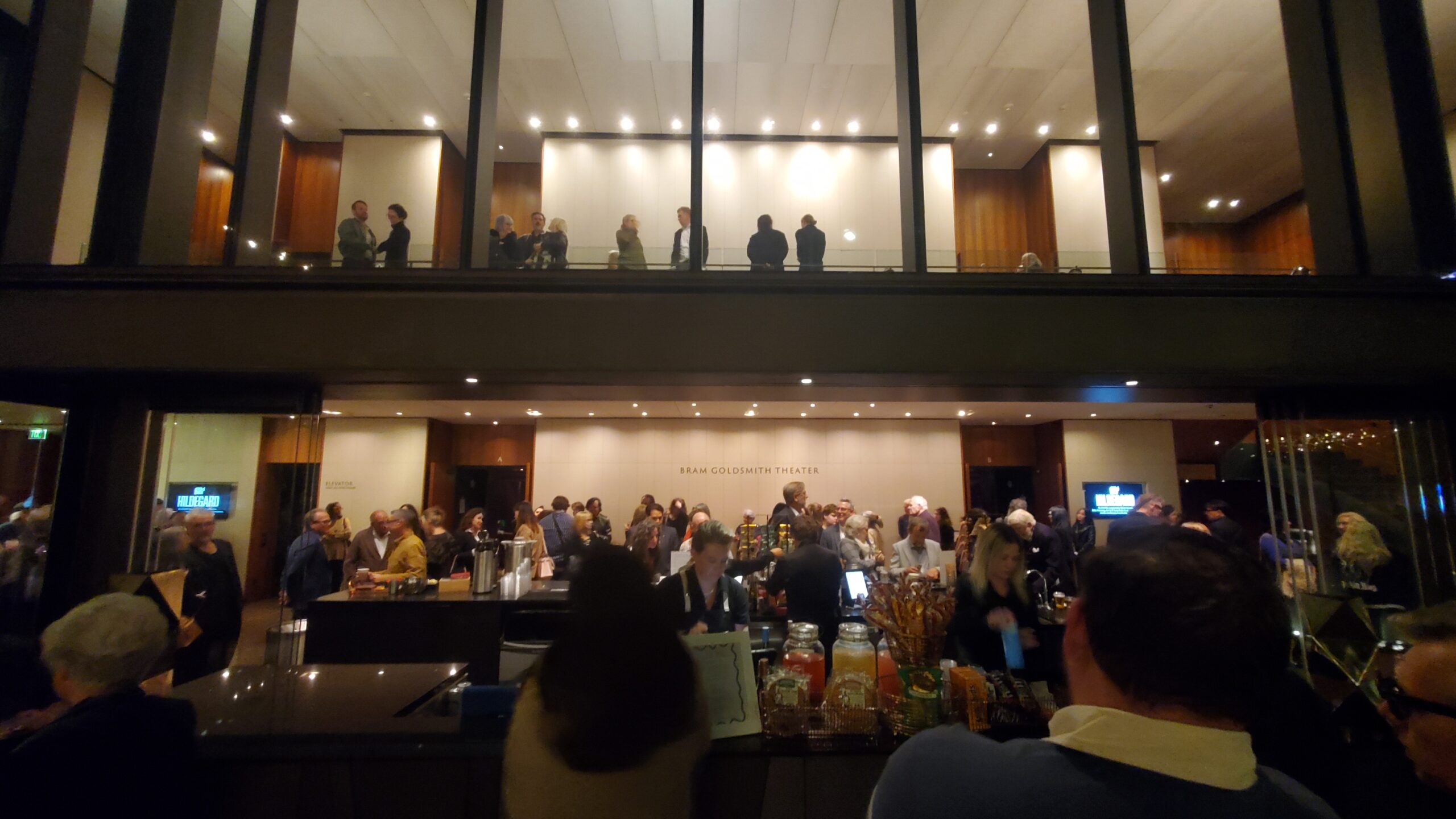

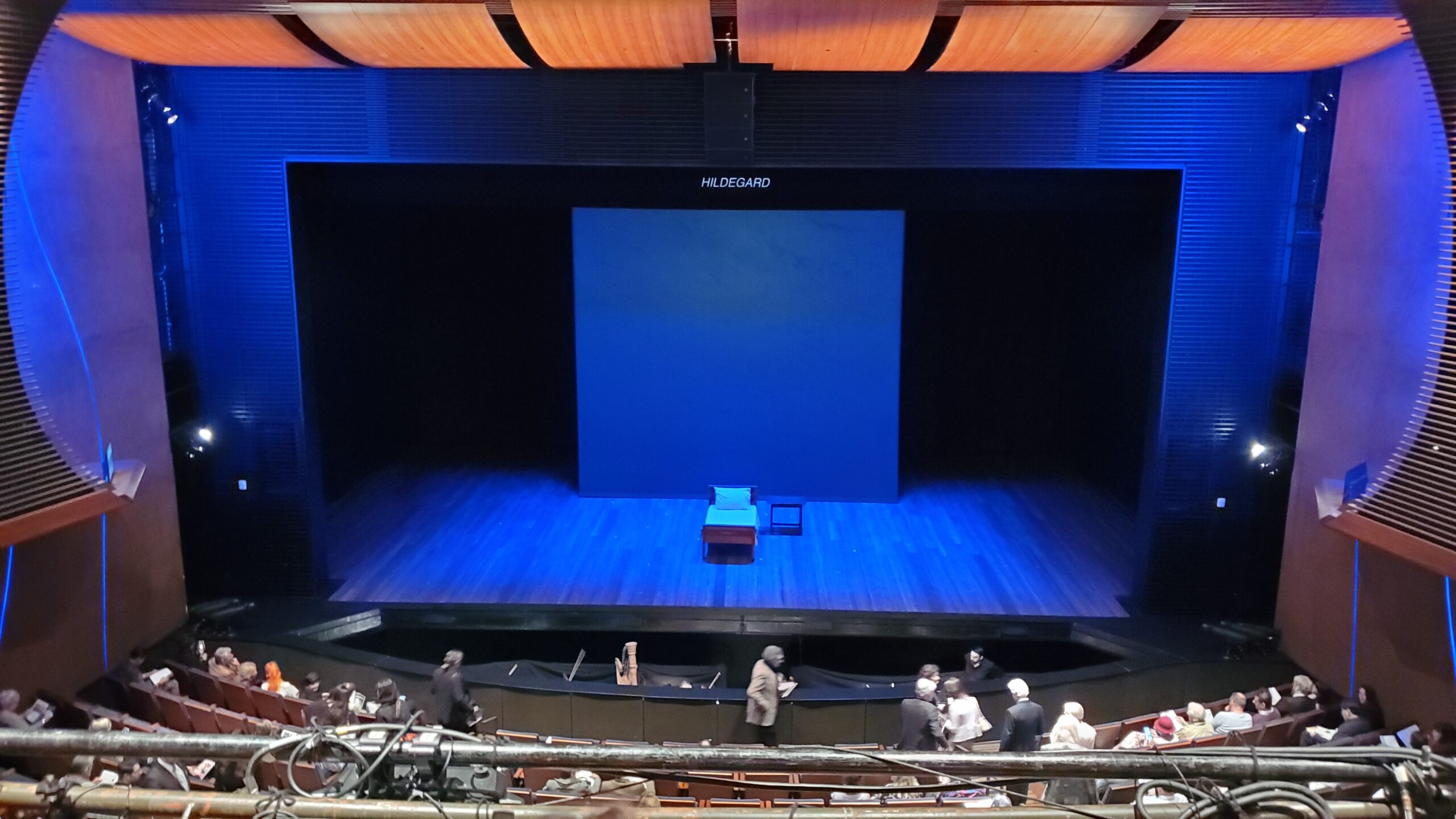
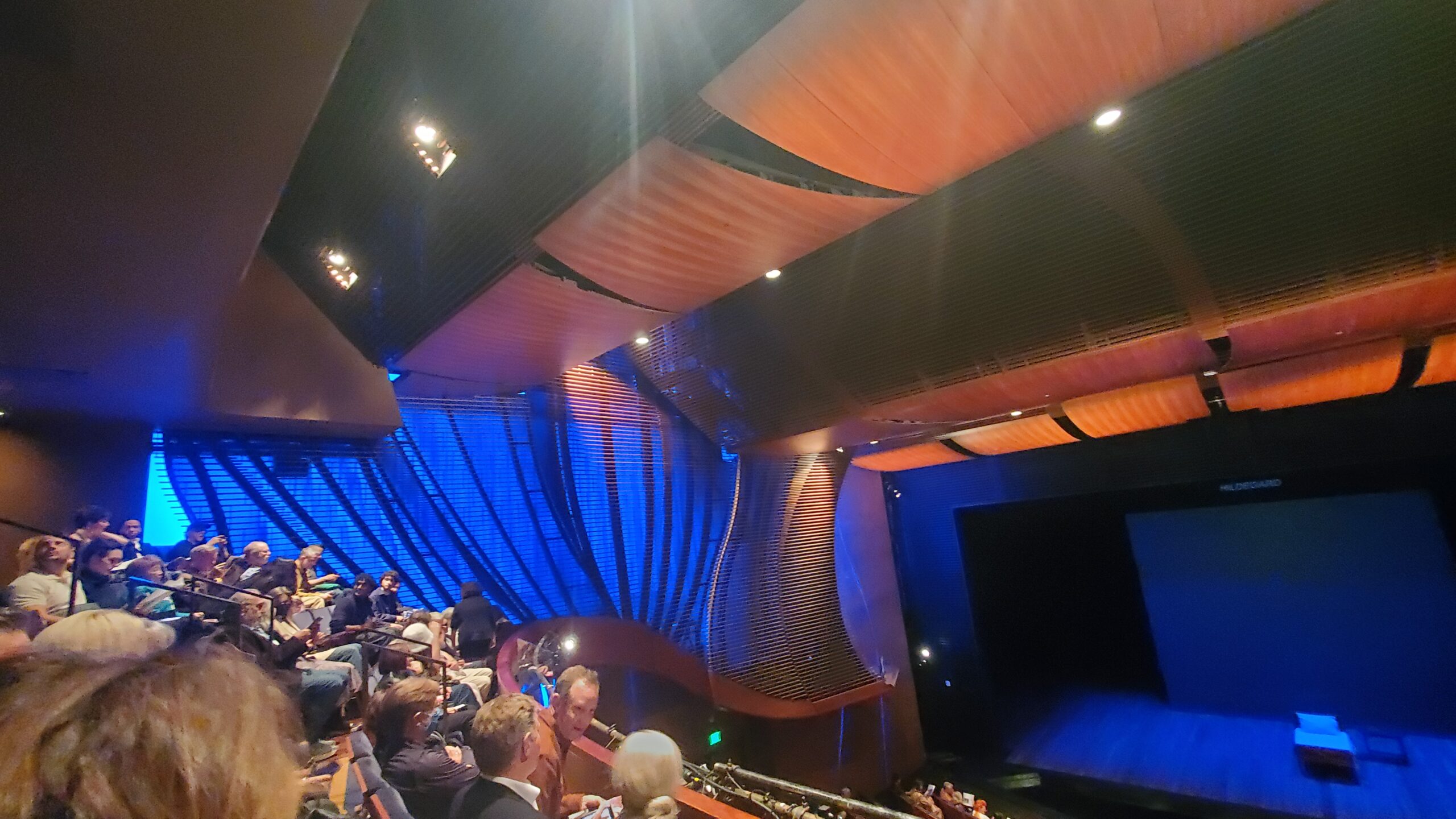
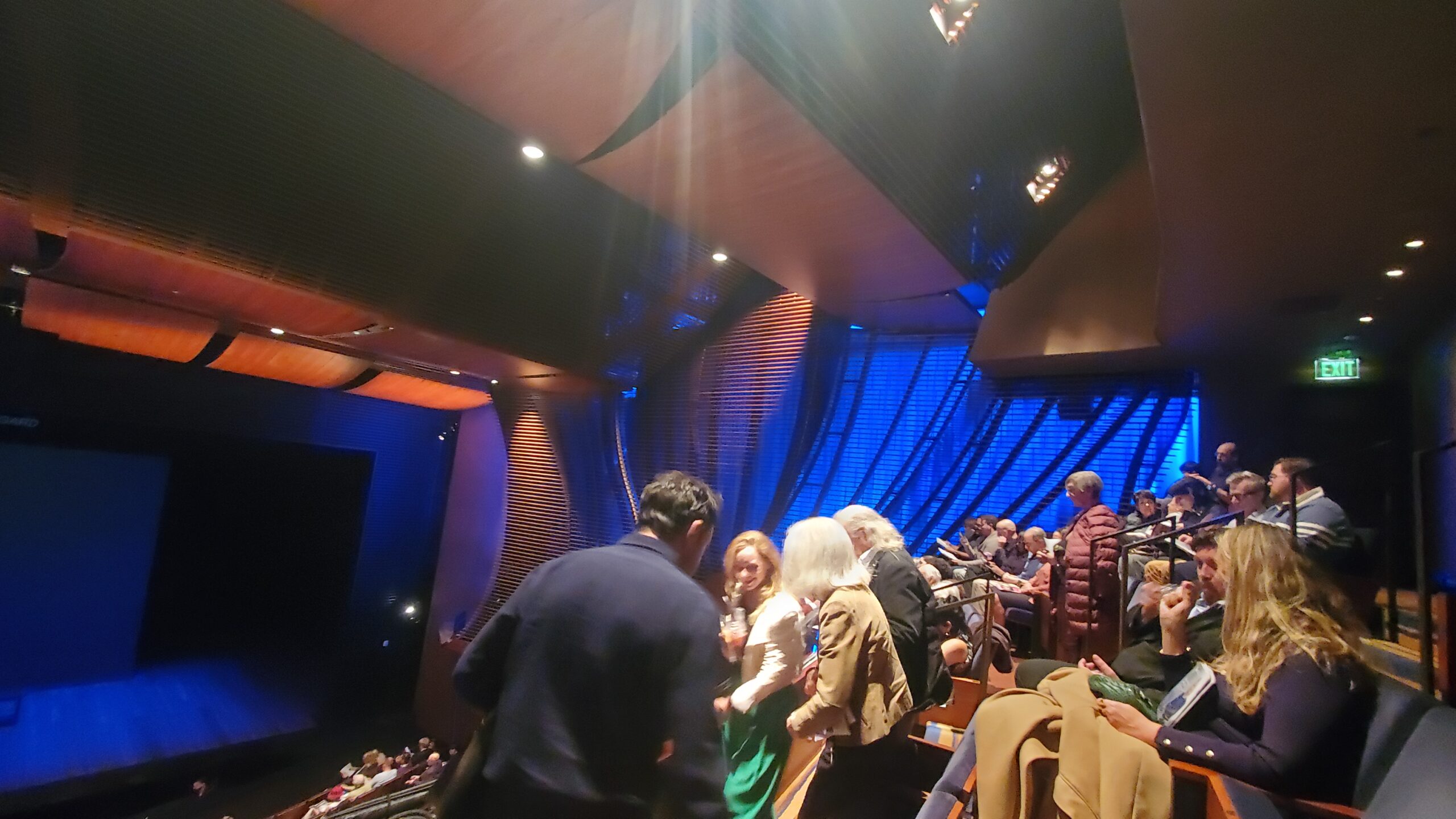
After mingling, I took my seat in the balcony. The theater is not too big, not too small, and the balcony doesn’t feel too far away. The woodwork and interior architecture inside the space is very pleasant; the dark blues and rich brown wood tones create a remarkably pleasing effect to the eye.
Here’s my view from the mezzanine section, door C, row BB seat 206.
Looking left and right for a complete idea of the balcony seating.
I settled in and Hildegard promptly began.
Hildegard: The Opera
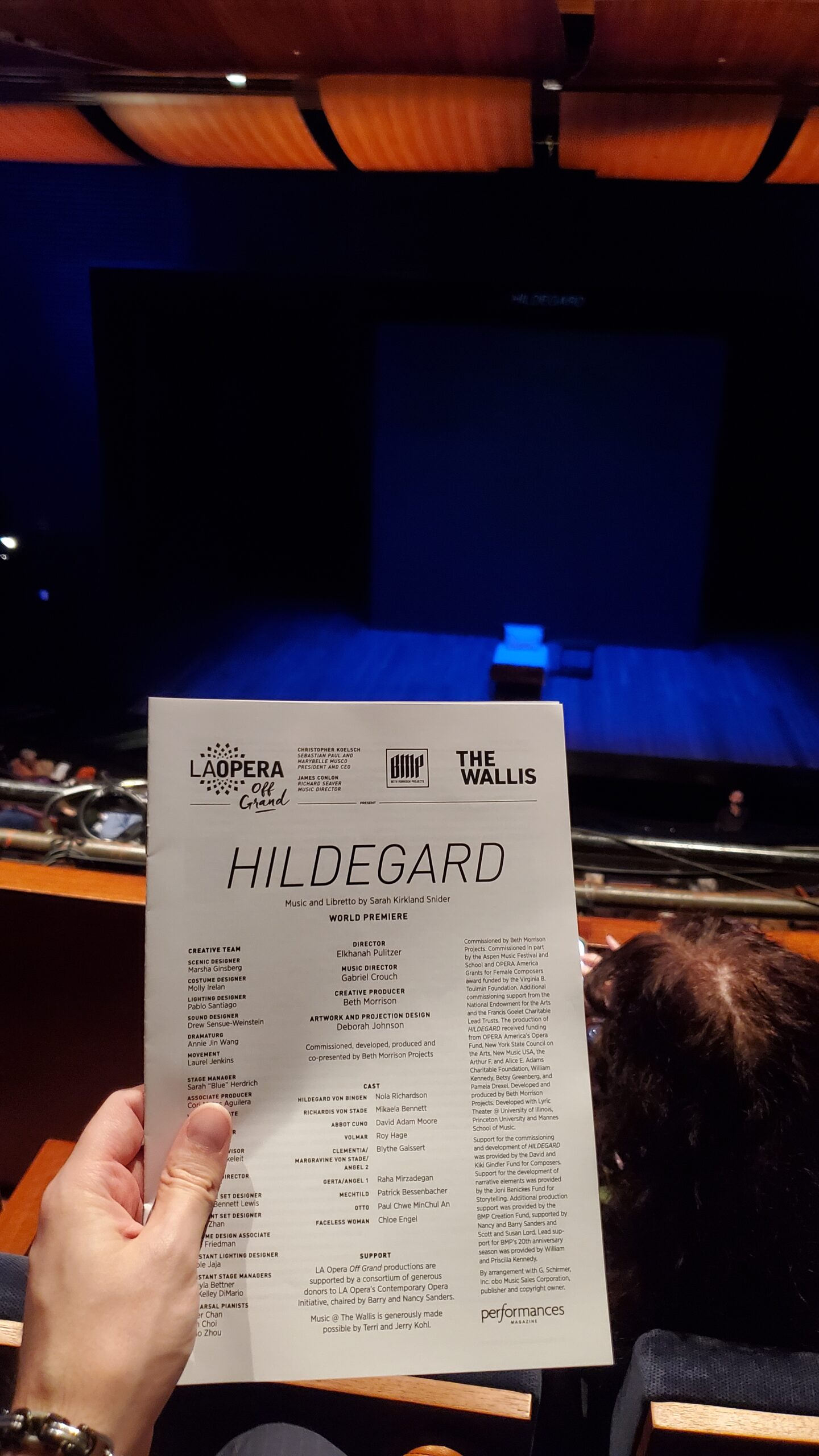
The lights dimmed. We are introduced to our lead, Hildegard von Bingen, played by soprano Nola Richardson.
The real Hildegard of Bingen lived from 1098-1179 CE. She was a Benedictine abbess, mystic, herbalist, and composer, sometimes called the first known female composer in the entire Western tradition of music. Her music comes from a time before modern notes, melodies, and polyphony. She also wrote theological treatises and medical works, and was known for starting her own monasteries and seeing “visions from God” that were certified true all the way up to the Pope. She was not only sainted, but made a Doctor of the Church, an even higher and considerably more exclusive honor. 800 years before what we think of as “feminism” began, Hildegard was an incredibly talented and remarkable person who made a significant impact in the world around her, and there is much to draw from in her life.
Indeed, Hildegard was a “Renaissance man” centuries before the Renaissance began–perhaps the phrase should be replaced with “Medieval woman.” A very different connotation than one usually gives to that phrase, and perhaps a worthwhile subversion.
Hildegard in this opera is experiencing her visions, shown by small light shows and projected displays. There are some historic illustrations of what Hildegard’s visions were said to look like, but it didn’t seem like they were used as direct inspiration for these effects.
She gets help and encouragement to transcribe them from her monk friend, Volmar, played by the energetic Roy Hage. Conflict occurs, however, when the abbot of the monastery, a man named Cuno (David Adam Moore), is not in favor of the liberties that Hildegard wants to take, and strictly cracks down on some of her demands and behavior.
We are also introduced to a woman named Richardis von Stade (Mikaela Bennett), who is sent to recover from illness and depression at this retreat, but begins assisting Hildegard and illustrating her visions for her.
Despite a significant age gap (never really brought up) and the more notable fact that there was no such societal thing as “being LGBTQ” in the 1100s, especially in a religious setting, Hildegard and Richardis begin to fall in love, though realizing and confessing these feelings is understandably difficult.
Hildegard also is fighting for her works to be sent to more prominent figures in the church, to gain approval and, some may say, clout. Abbot Cuno again presents himself as an oppressive figure in this struggle.
In real life, Hildegard reported having much anxiety and hesitation about recording her visions, which she said were lifelong. She received one when she was 42 that instructed her to record them, and she at first resisted, reportedly getting sick until she relented and began with the real life monk Volmar’s encouragement and the real life nun Richardis’s writing and illustration. The real life Abbot Kuno gave her permission, and another man, Abbot Bernard of Clairvaux, essentially said “that sounds like God’s will so I will not intrude any opinions of my own, thanks” when she consulted him too.
A few years later, a delegation from Kuno’s abbey took some of her writings to the Synod of Trier, where they were read aloud to Pope Eugene III, who liked them and granted papal approval for her continued publishing. At this point in history, that was the final say on the matter.
So, while I would imagine that there was institutional resistance on some levels, it seems that Hildegard didn’t face any direct opposition to her work, and was largely supported by the people around her.
Back to the opera. Although Hildegard and Richardis are slowly coming to terms with their attraction to one another, the latter’s noble mother, Margravine von Stade (Blythe Gaissert), decides the convent is not a suitable place for her daughter and decides to move her away. Matters are made much worse when it’s revealed that Richardis is pregnant–after having been raped by a monk.
Hildegard is visited by demons and angels, and some particularly beautiful arias are sung in the heart-wrenching struggle that ensues.
Finally, although Abbot Cuno finally comes around and approves Hildegard’s vision writing, Hildegard is broken, as Richardis dies in front of her. She resolves to start a new, woman-only abbey, and is resolute in trusting her visions.
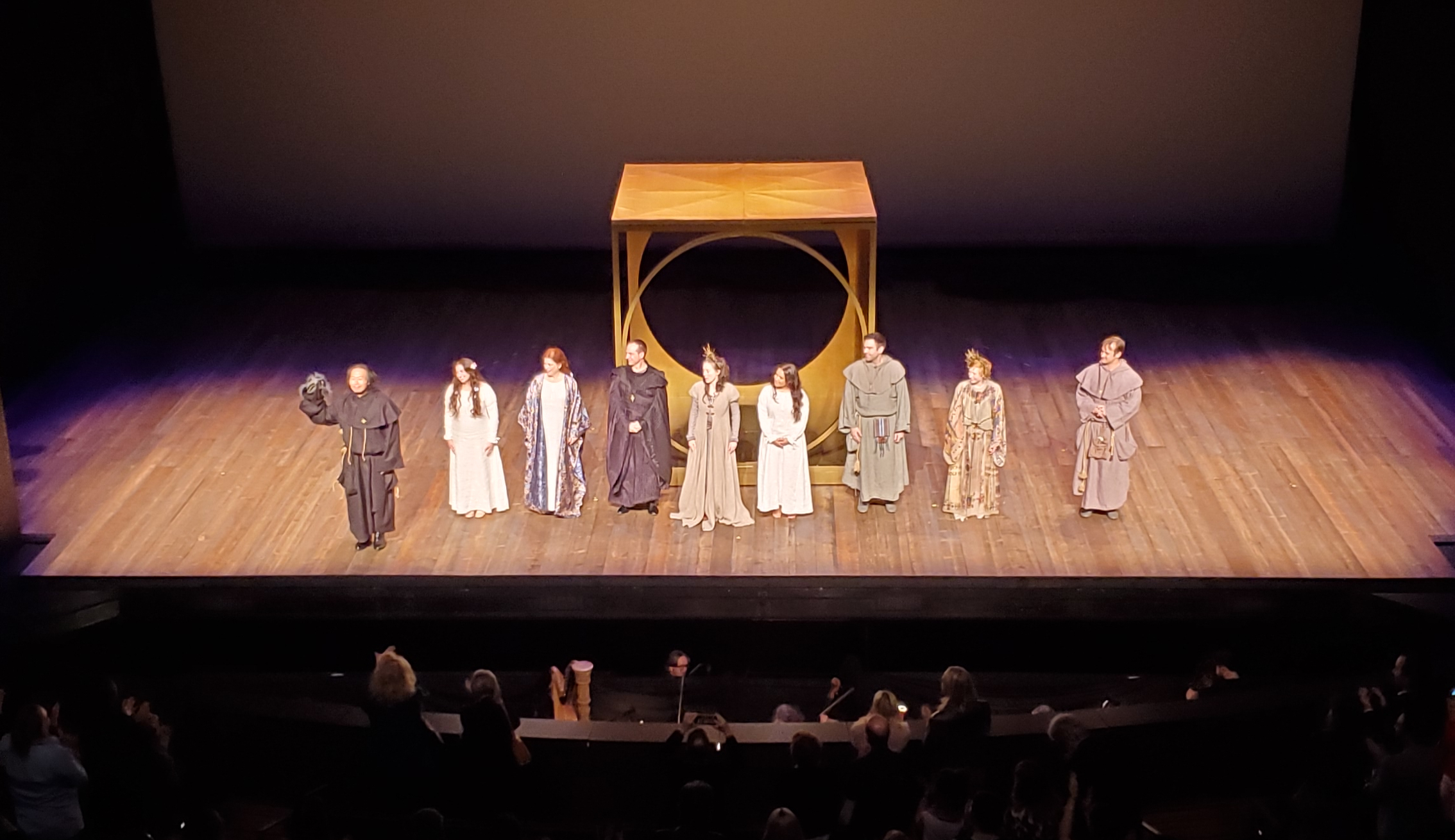
I was incredibly moved in the moment, and joined the rest of the audience in a standing ovation, thrilled by the production I had just seen.
However, I was aware that there were several issues in the back of my mind that weren’t quite sitting right.
First, was Hildegard a lesbian? This is a thorny question that doesn’t have an exact answer. In the first place, the whole concept of “lesbianism” simply didn’t exist in the 1100s. There was no concept of “sexual orientation” and the real life Hildegard even wrote passages condemning the physical acts. Not to mention that she had taken a vow of celibacy as a nun and had already “married Jesus,” so to speak, which would have been as real as anything to her back then.
Did she exhibit romantic love for Richardis von Stade? Possibly. The words she uses to refer to Richardis are often the same as words that were used at the time to discuss romantic love. In real life, Richardis was not raped or made pregnant by a monk (or anyone), but was indeed forced to relocate, and then died soon after, far away from Hildegard. Hildegard was indeed profoundly affected by the news.
However, the romantic love aspect is far from historical fact, and we can never truly be sure one way or the other. It is at least almost certain that they never had a physical relationship of any sort. I think it’s easy for us in 2025 to project our modern paradigms of love and sexuality back on these people, but the truth is that in those times, society was different–too different for today’s mindsets to map cleanly onto at all.
If we are mapping modern mindsets onto the past, it seems odd to ignore the other major–and more confirmed–factor in this companionship, namely the age gap. Hildegard and Richardis were 26 years apart, when Richardis was in her early 20s. Given that in this opera, Hildegard was the more active figure who pursued and initiated with Richardis, it could seem to take on a slightly more predatory angle. I suppose that’s why it was ignored and ages were brushed over in the work, but it does serve to further distance the plot from reality.
Next, was Hildegard so much more than this? Yes. She was a polymath, an herbalist, a scientist, and such a notable composer. None of these things were ever really highlighted. This seemed like a waste to me, a flattening of her character to something more like a teenage love story.
Overall, we are given a story that is clearly feminist, with strong themes of women overcoming male oppression and cruelty to find love and succeed in a hostile world. Obviously, I strongly support the message. But I wonder if it’s truly considered feminism to take a real life historical woman who has so many noteworthy achievements and talents, and wipe them away to replace them with this ahistorical love story.
This was the type of story I might expect to read in a modern romance novel, or even a teenage queer coming-of-age book. This is not meant to be an insult; there’s nothing wrong with those stories, indeed they can be very important. But does that mean we should tape them over the biography of an actual influential woman? I understand that it’s an adaptation, but I did come to Hildegard to see Hildegard von Bingen–not somebody else.
I am not a woman, so I can’t perfectly speak to women’s issues. But I am a queer man, and on that side alone, it seems like a missed opportunity to explore a more varied, complicated, interesting individual, who achieved so much more than simply “doomed love in a time of oppression.” Although it was a good story, it was simply not really Hildegard’s story, and I feel that this would have been a more interesting narrative to explore.
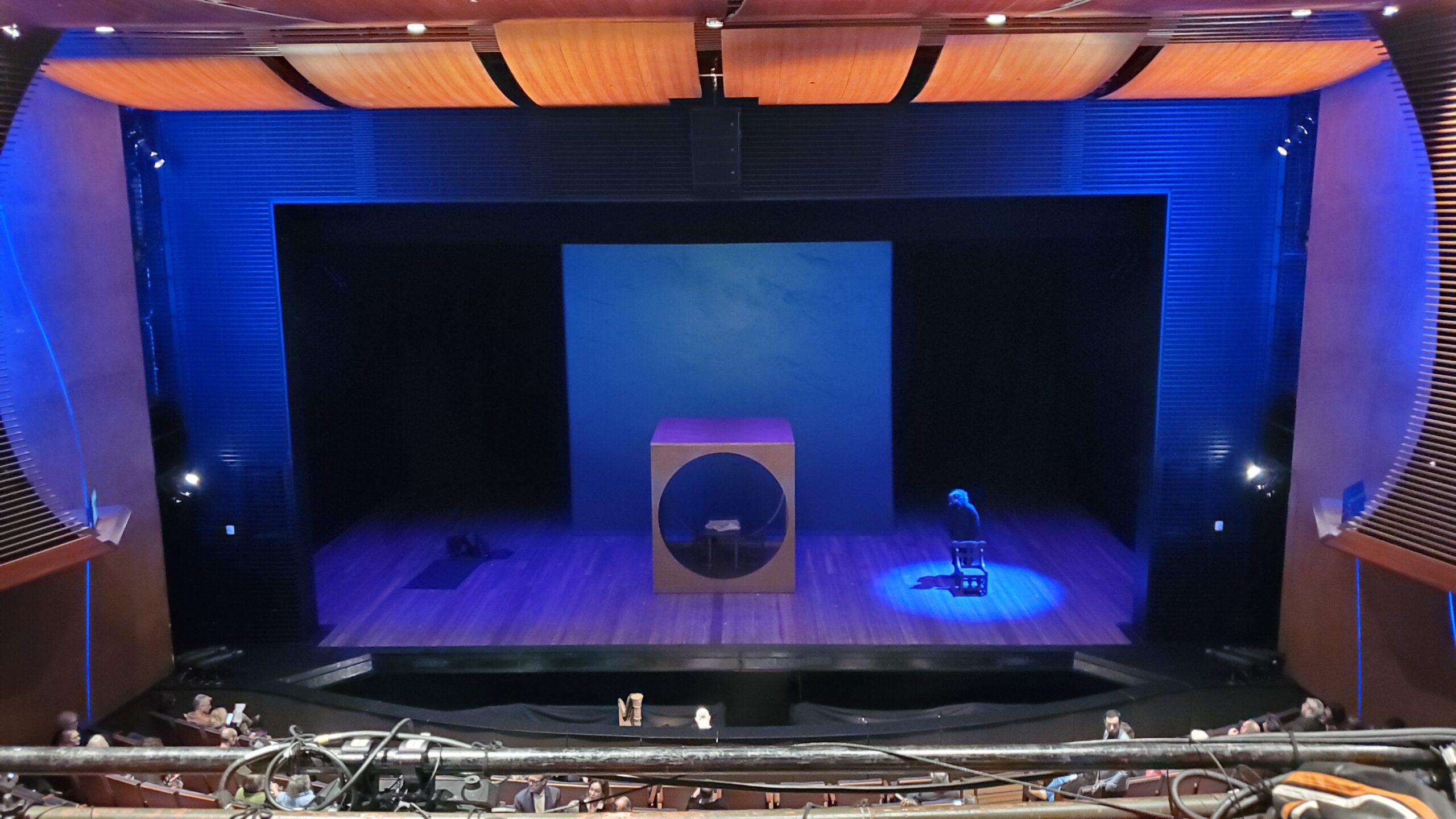
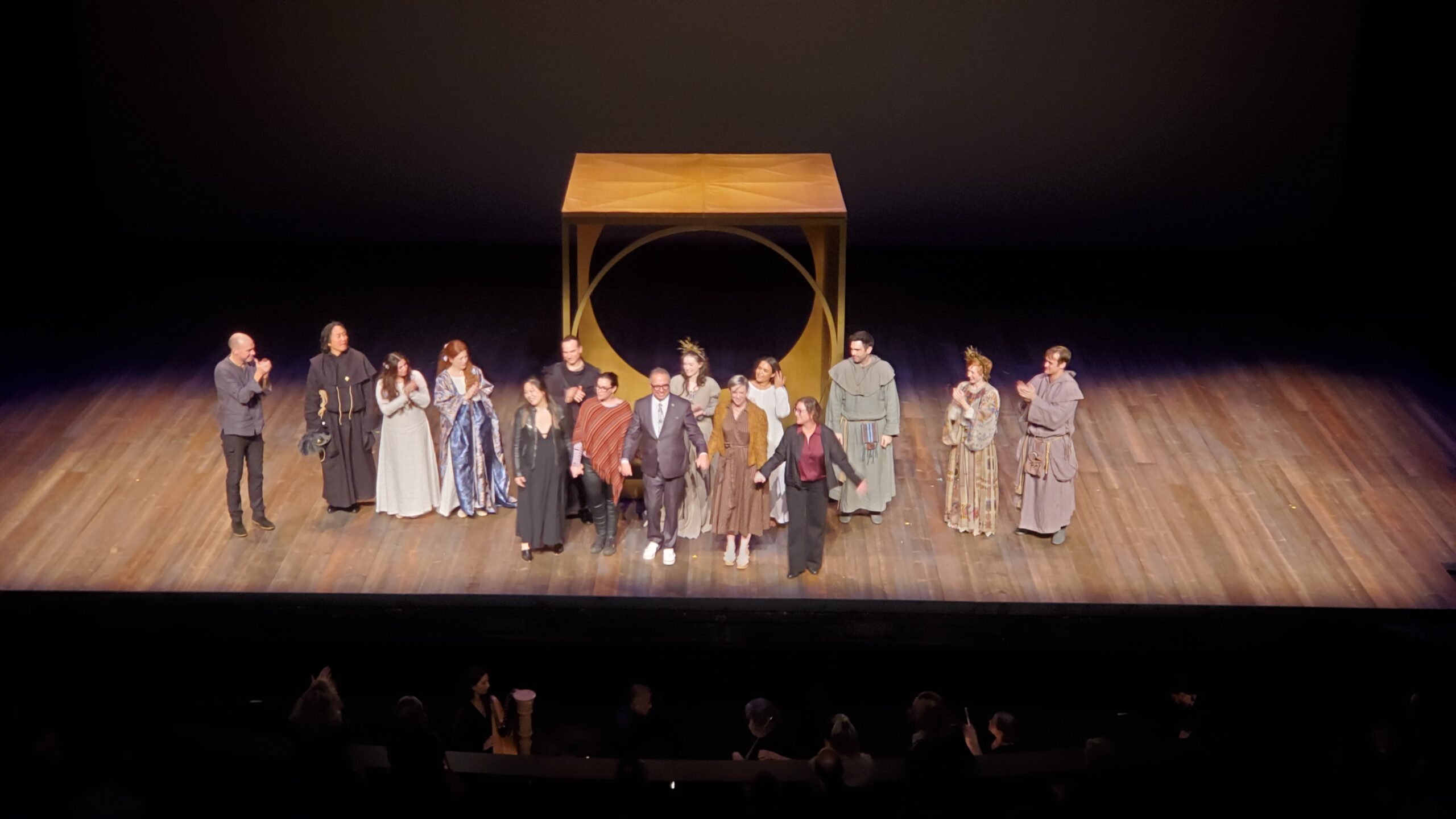
Moving onto the staging. It was a simple set, with one major cube element wheeled around and used as different rooms, plus a few other props like beds and chairs. The background was a simple screen, which occasionally featured projections.
It wasn’t bad. It all seemed well-made, it fit in well. But it did seem bare, especially for a time period that is similarly incongruous with the concept of minimalism.
The costumes were all wonderful. This was a highlight for me; I know from experience that it takes some work to get a “simple looking Medieval outfit” right. And the lead angel costume was especially wonderful.
The visions were also less frequent and less impressive than I was expecting. The lights and projections were perfectly serviceable, but nothing very new or noteworthy. The real life Hildegard, in her own writings, described her visions as out-of-body experiences where her soul was taken into the clouds and then to distant lands. They were full-sensory experiences that she received “in my soul alone, while my outward eyes are open”–not only in dreams, “but I see them wide awake, day and night.” I found the choice to display them only while she fell asleep, in projections on the screen above her bed, to be a little underwhelming. I still thought they were neat, I wouldn’t consider them a drawback, but I suppose I was hoping for more.
Musically, my thoughts are mixed. On the critical side, the songs didn’t seem to begin and end, and characters didn’t feel distinct from the music alone. The real life Hildegard’s music comes from a time before tempos and beats, so nowadays we interpret it as spacey, dreamy, wandering, without a clear “home” resolution or key.
I expected her songs to take this style in a modern direction. Instead, I think it actually retained too much of the wandering aspect–there are scant few defined melodies and recurring musical motifs in the work, and it often seems like it’s all purely atmospheric, rather than motif-driven. And every character’s music has this quality, not only Hildegard.
On the positive side, sometimes this actually led to a very good effect. The music was spatial, structural, haunting, moody, emotional, and elegant at times. It was still well-crafted and generally pleasant to listen to, if slow-paced. The orchestra itself did a grand job.
I would not consider this a “beginner’s opera” or to be easily accessible. After intermission, there were empty seats that had been filled in the first act; I definitely got the impression that some people were getting bored. This is a slow opera, especially in the first half.
The performances were one aspect that were universally top-notch. This must have been a challenging piece, but lead Nola Richardson’s voice was strong, comforting, emotional, and insistent. She never faltered once. The strength of her performance added much to this piece.
David Adam Moore, as the more adversarial Abbot Cuno, was given some good villain-adjacent parts, and he performed them with strict fierceness. He was convincingly powerful and stern, and he added some much-needed dynamism to the stage.
Mikaela Bennett played a very good reluctant and inexperienced love interest, who was given some dramatic moments that were performed very well.
Roy Hage was good as Volmar, but he wasn’t given a lot to do. I suspect that in this narrative which more powerfully emphasized male oppression, a role of a strong and steady male friend would somewhat undercut the message.
Did I like Hildegard? Unequivocally yes. It moved me, it left me in tears, it thoroughly entertained me for over two hours including one intermission. I agree with its important sociopolitical messages. I loved the cast.
But would I recommend it to everyone? No. For better or for worse, I have a feeling that this opera, at least in the form I saw, will remain a niche creation.
Full Cast & Context
The full cast of the world premiere of Hildegard included:
- Nola Richardson: Hildegard von Bingen
- Mikaela Bennett: Richardis von Stade
- David Adam Moore: Abbot Cuno
- Roy Hage: Volmar
- Blythe Gaissert: Clementia / Margravine von Stade / Angel 2
- Raha Mirzadegan: Gerta / Angel 1
- Patrick Bessenbacher: Mechtild
- Paul Chwe MinChul An: Otto
- Chloe Engel: Faceless Woman
Hildegard was commissioned, developed, produced, and co-presented by Beth Morrison Projects. The main production figures:
- Sarah Kirkland Snider: Music and Libretto
- Elkhanah Pulitzer: Director
- Gabriel Crouch: Music Director
- Beth Morrison: Creative Producer
- Deborah Johnson: Artwork and Projection Design
The full crew & creative team:
- Marsha Ginsberg: Scenic Designer
- Molly Irelan: Costume Designer
- Pablo Santiago: Lighting Designer
- Drew Sensue-Weinstein: Sound Designer
- Annie Jin Wang: Dramaturg
- Laurel Jenkins: Movement
- Sarah “Blue” Herdrich: Stage Manager
- Cori Matos Aguilera: Associate Producer
- Louise Lessél: Video Associate
- E.M. Gimenez: Video Engineer
- Thomas Jenkeleit: Props Supervisor
- Zoe Lesser: Assistant Director
- Michael Bennett Lewis: Associate Set Designer
- Raven Zhan: Assistant Set Designer
- Katie Friedman: Costume Design Associate
- Nicole Jaja: Assistant Lighting Designer
- Mikayla Bettner & Nat Kelley DiMario: Assistant Stage Managers
- Oliver Chan, Sujin Choi, & Yihao Zhou: Rehearsal Pianists
The musicians:
- Armen Anassian: Concertmaster, first violin
- Olivia Tsui: First violin
- Cynthia Moussas & Haesol Lee: Second violin
- Shawn Mann: Viola
- Anya Garipoli: Harp
- Rowena Hammill: Cello
- Nathan Farrington: Bass
- Amy Tatum: Flute
- Sierra Allen: Clarinet
- Amber Wyman: Bassoon
LA Opera is our city’s primary opera company, founded in 1986 and based at the Dorothy Chandler Pavilion, but with occasional shows at the Wallis. They balance the core repertory with newer or less expected works, and have lately leaned into bigger premieres. It’s Los Angeles’s anchor opera institution.
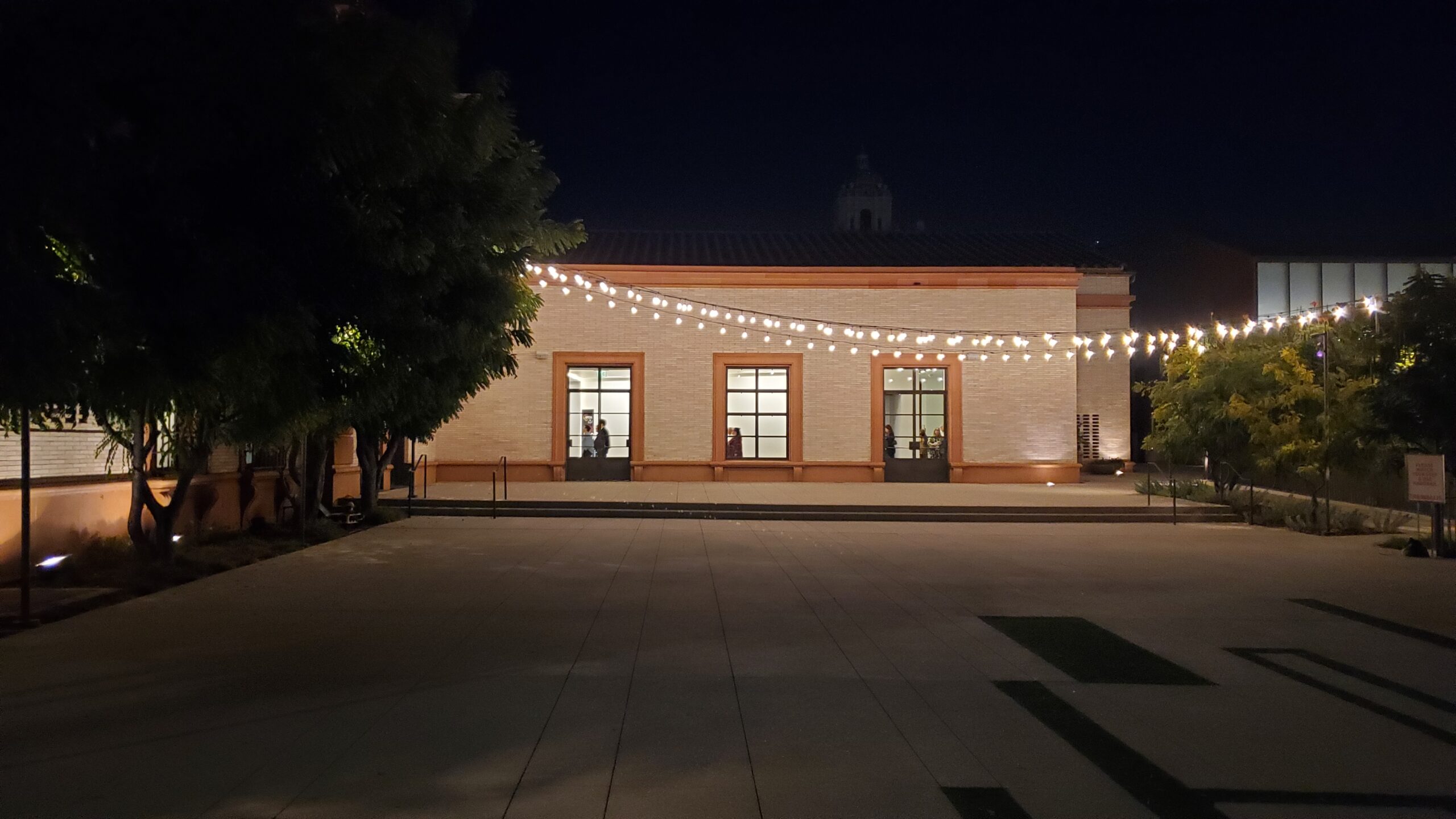
The Wallis Annenberg Center for the Performing Arts opened in 2013 in Beverly Hills, partially housed in the restored 1933 Beverly Hills Post Office building. It’s named for Wallis Annenberg, the media heiress and philanthropist behind the Annenberg Foundation. The complex mixes the old Spanish Revival architecture with a sleek new theater space below, and is more intimate than the other Music Center venues.
Beth Morrison Projects is an opera producing engine founded by Beth Morrison in 2006. It focuses on contemporary opera and musical theater, with brand new works and fresh composers. If something new and slightly risky is happening in American opera, it just might be a BMP production.