It’s been half a century since Hamlet has been shown at the Mark Taper Forum (in Downtown Los Angeles). But I’m not so sure that this production actually counts as Hamlet at all.
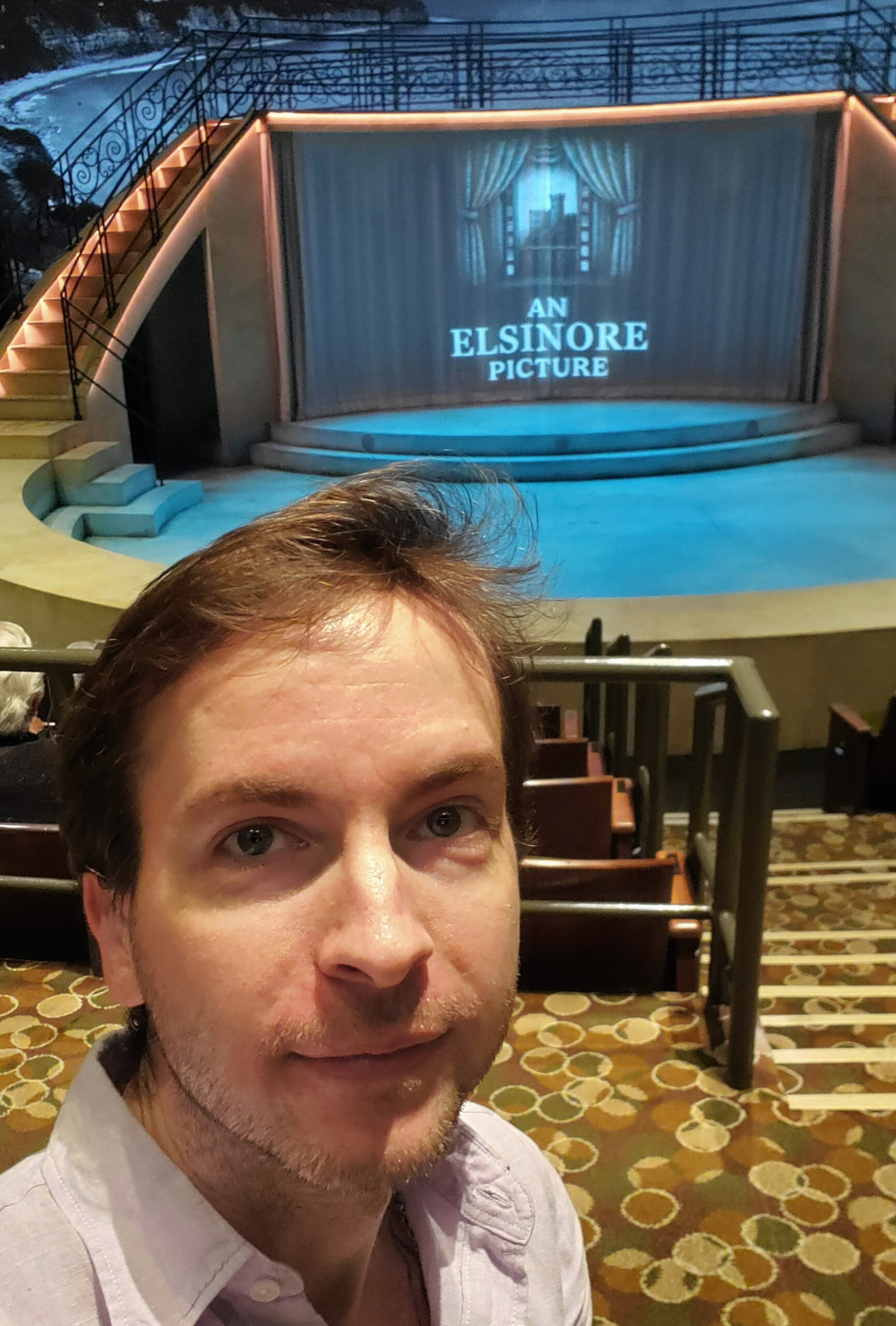
Here I am before the show, on 7/1/2025.
Usually when a director puts their own spin on Shakespeare, it’s still basically the same play–but perhaps set in some updated time and location, like a 1920s jazz-era Othello or an inner-city urban Love’s Labour’s Lost. But even then, it’s still fully Shakespeare. Compressing a section or removing a disputed line here and there doesn’t give a modern director the right to add a “co-written by” credit for themselves.
Director Robert O’Hara’s Hamlet, however, is different. This is an adaptation that is at least 33% new lines and content, including a radically different plot, unrecognizable ending, and overall interpretation. (Spoilers ahead.)
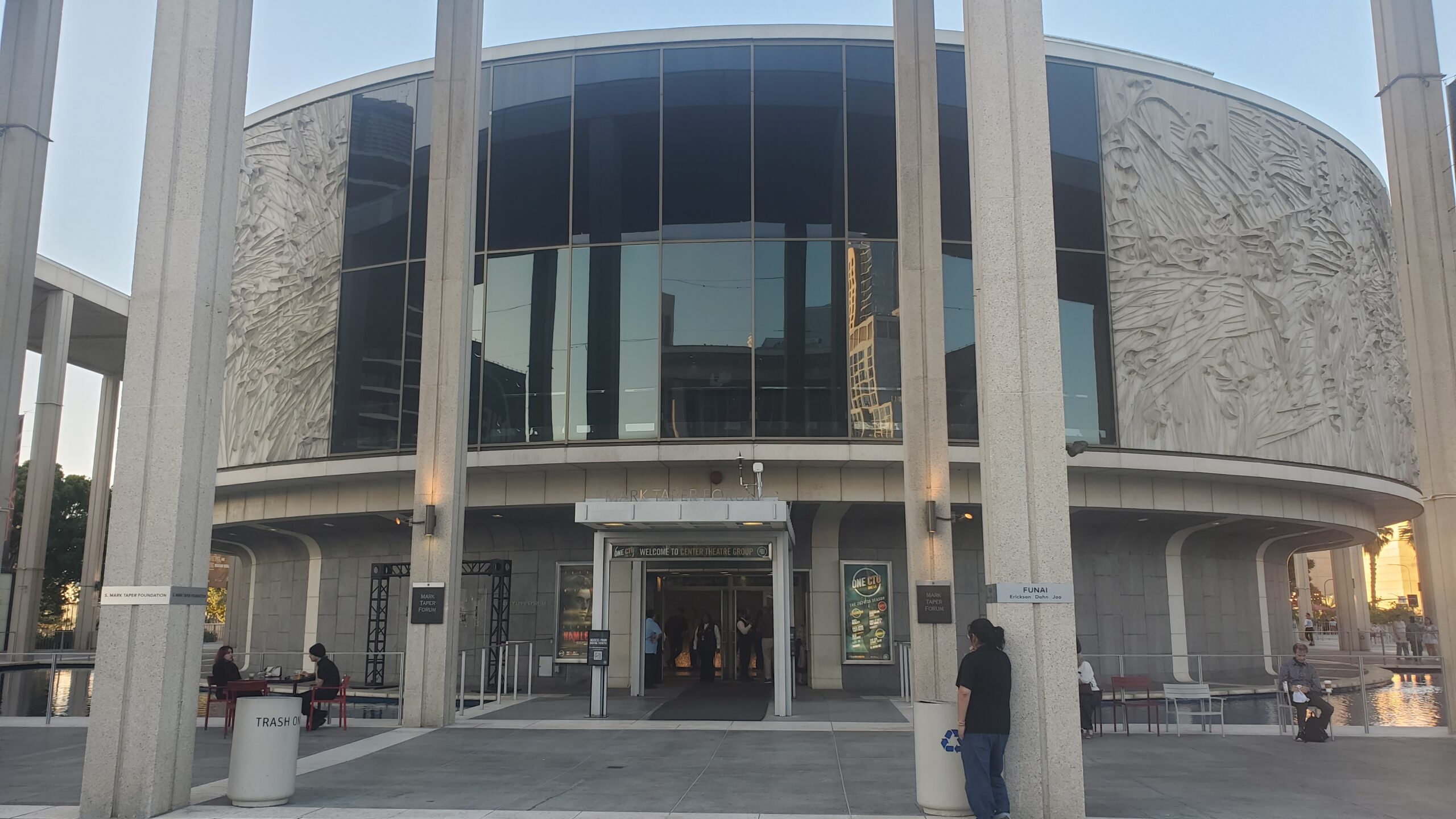
Exterior of the Mark Taper Forum (daytime)
Perhaps this was known to many attendees going in, but I was in a state of blissful ignorance that I would be seeing anything other than a nice traditional take on Hamlet when I sat down.
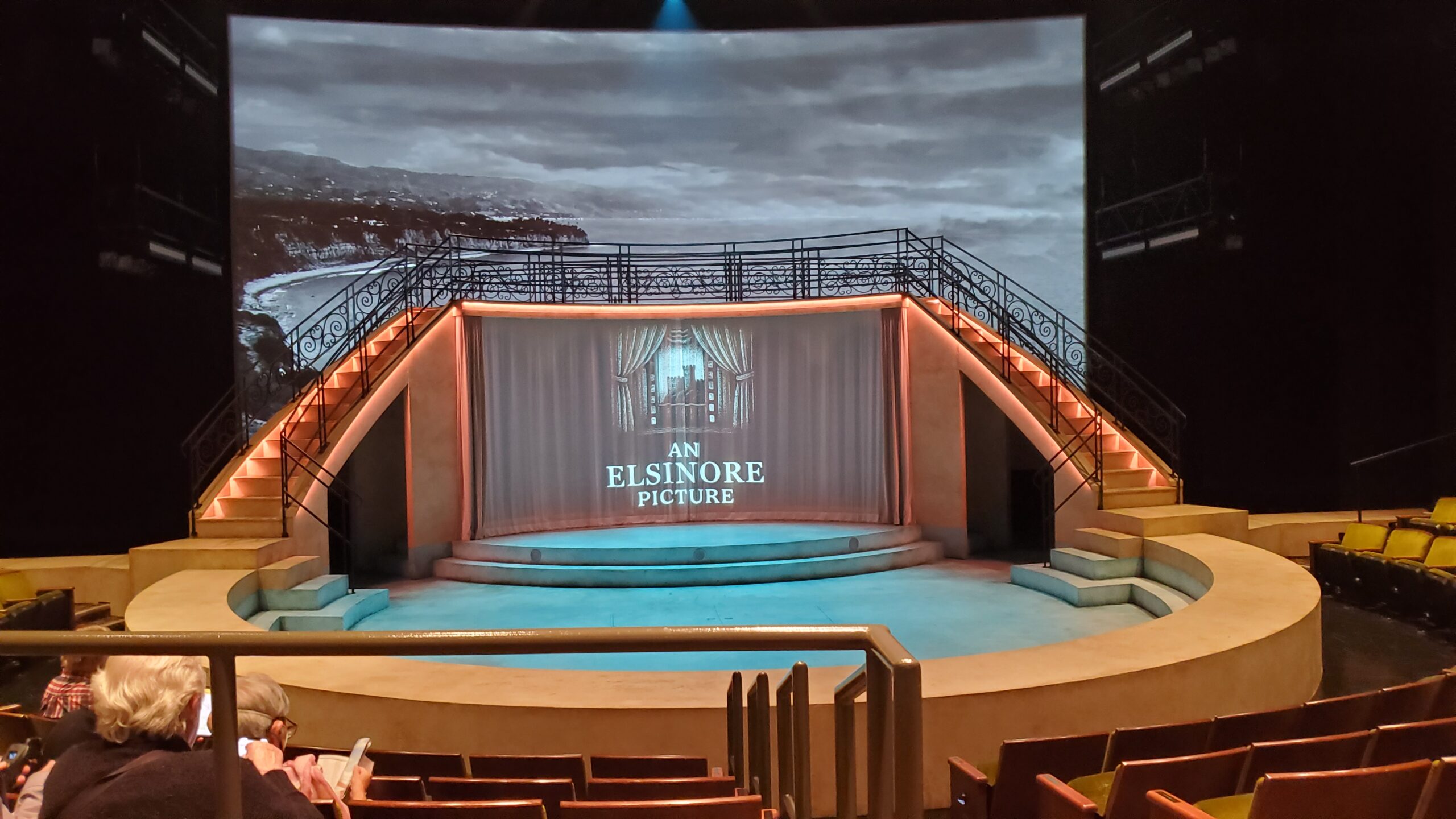
My view of the stage (seat EE103).
The first hour, hour and a half, say, was grand. Patrick Ball’s Hamlet was moody and tortured, and Ball was excellent in his emotional portrayal. Jakeem Powell’s Horatio was given ample time to shine, and he did! Coral Peña’s Ophelia shined in her more limited time on stage.
The script added a copious amount of brand-new sexual content mostly spread between this trio, which at first was interesting, but quickly felt overdone. Watching Hamlet and Horatio passionately make out was my first clue that this was not going to be regular Hamlet, and I was all-in. But as the play went on, it felt like the added sexual content was just there for shock value, pushing an envelope that didn’t have anything meaningful inside of it.
Ariel Shafir as Claudius was magnificent, and he filled up the stage with his presence every time he appeared. Gina Torres (who I recognized from various TV) portrayed Gertrude with deep sadness and guilt.
Unfortunately, both Peña’s Ophelia and Torres’ Gertrude are given very little to do.
The two fellows who played Rosencrantz and Guildenstern (Ty Molbak & Danny Zuhlke) were bang-on in their acting, although the mood for the duo felt a little like it was ripped straight from a college stoner movie.
Finally, Ramiz Monsef’s Polonius was slick and polished, and he was a delight to see on stage every scene as well.
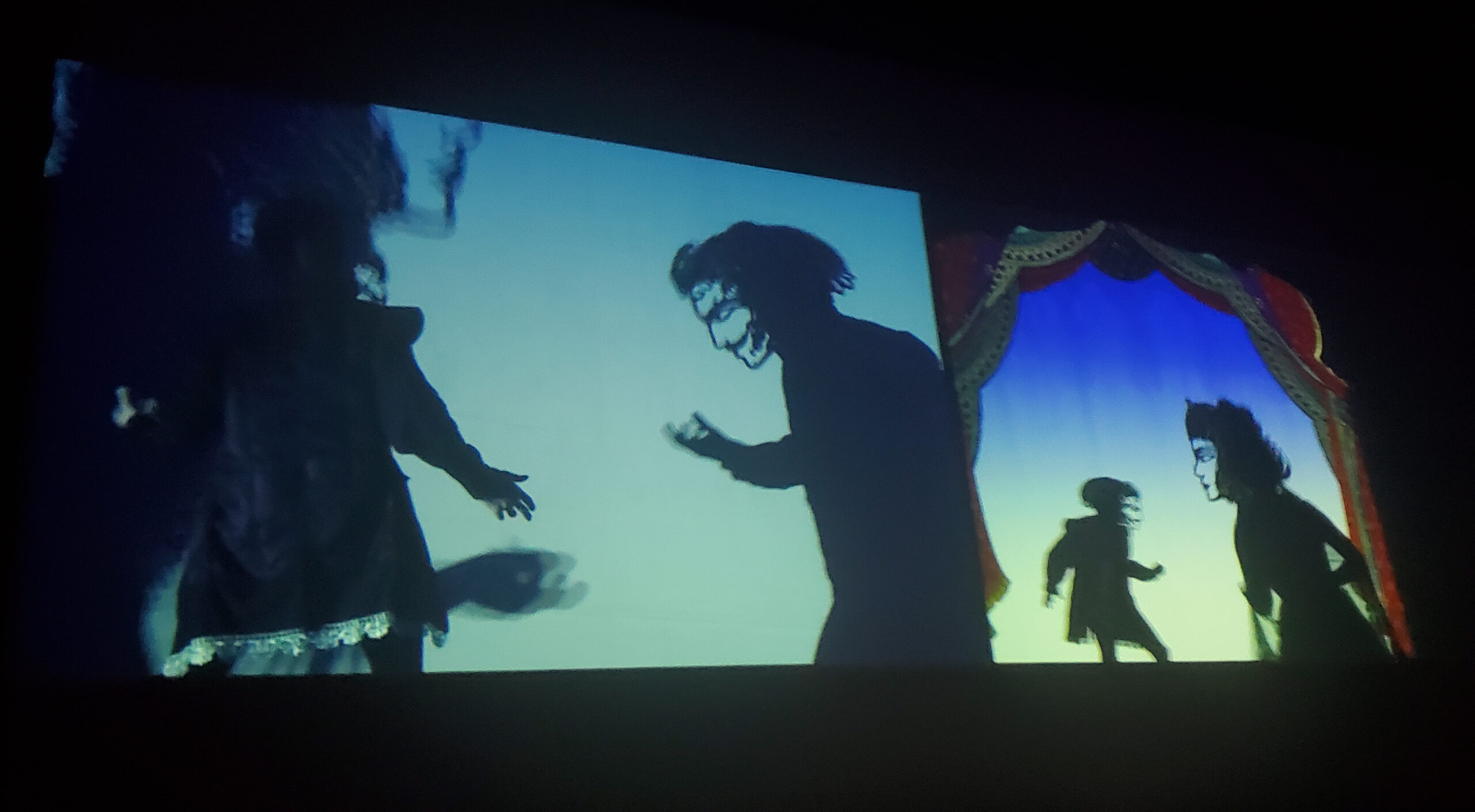
I felt like the first hour, hour and a half, moved very quickly and was cutting out a lot of key scenes. It was almost all Hamlet’s point of view, which was quite an acting load for Ball. The scene transitions were fast and sharp, I loved the sound design, and the effects were fantastic–most notably the gigantic ghost, projected up behind the whole stage at large scale, foggily reaching through from the afterlife. I never got tired of this, nor of the robed phantasms that seemed to lead and chase Hamlet around in procession.
But then the transition came.
At around the 2/3rds mark, Hamlet ceased to be Hamlet and instead became, I don’t know, “Fake Noir Hamlet” or, if you please, Noirlet? Hamnoir? Well, whatever it was, it was Robert O’Hara’s, and it wanted to let you know that it was not your great-great-great-grandfather’s Shakespeare anymore.
It did this by making everybody talk extremely casually and drop a ton of F-bombs. The first one had great dramatic effect. The second one was fine. By 5, 6, whatever, it felt like the writer was simply saying “look how many times I can put swear words in Shakespeare!” By the end, the effect had been completely diluted for me.
This new plot centered around: what if Hamlet had actually been some sort of film set in the 1930s when big studios had their notorious fixers, and Claudius and Gertrude had actually been producers or heads of the studio the whole time, and I guess Hamlet had just gone totally crazy and only thought he was in Denmark and it was all a big hallucination from his point of view?
“Detective Fortinbras” (played very dramatically by Joe Chrest) led the various characters through their own backstories, repeating the events from their “real” points of view. I kept waiting for some big reveal to happen, or some reason that we were taking this major, permanent detour.
Instead, near the very end, the words “200 Years Later” appeared, projected onto the curtains, which I reread three times over to make sure it wasn’t me having the hallucination this time.
Then, what proceeded was a dialogue-free, shirtless, interpretive dance… staging… of, I guess, the climax of Hamlet, except set in the future with dramatic lighting and face paint. My jaw had fully dropped; despite enjoying the staging for what it was, my mind was struggling to connect this to anything that had happened over the last two hours and wondering how on earth this was supposed to wrap anything up or provide any finality at all.
That sense of finality never came.
This Hamlet took a while for me to wrap my head around. Perhaps one needed to be a greater Hamlet scholar than I to fully appreciate it, I don’t know. Robert O’Hara’s Wikipedia entry states that the director is “…often praised for his bold and daring themes, yet criticized in the execution of them.” Here I would argue it was the opposite. O’Hara’s Hamlet was executed with perfect precision, yet I would question if the themes here were very good or coherent–or what they even were meant to be at all.
I loved the cast, I loved the staging, I loved the effects, I loved so much of this. But I don’t think the adaptation was worth it. It was not better or more meaningful than normal Hamlet, it was not a clever subversion, it did not raise any other points or examine new issues through a familiar lens, not any of that. It felt like it was different just for the sake of being different, and the juice wasn’t worth the squeeze.
Full Cast & Context
The cast:
- Patrick Ball: Hamlet
- Coral Peña: Ophelia
- James T. Alfred: Head Attendant
- Ariel Shafir: Claudius
- Gina Torres: Gertrude
- Ramiz Monsef: Polonius
- Ty Molbak: Laertes/Rosencrantz
- Jaime Lincoln Smith: First Player/Attendant
- Jakeem Powell: Horatio
- Joe Chrest: Detective Fortinbras/Ghost
- Danny Zuhlke: Guildenstern
- Fidel Gomez: Gravedigger
The crew:
- Robert O’Hara: Director/Adapter
- Clint Ramos: Scenic Design
- Dede Ayite: Costume Design
- Lap Chi Chu: Lighting Design
- Lindsay Jones: Original Music and Sound Design
- Yee Eun Nam: Projection Design
- Teniece Divya Johnson: Fight Direction/Intimacy Coordinator
- J. Jared Janas: Wig, Hair, and Make-up Design
- Nicholas Polonio: Dramaturg and Associate Director
- Henry Russell Bergstein, CSA: Casting
- Lindsay Allbaugh: Associate Artistic Director
- David S. Franklin: Production Stage Manager
- Camella Coopilton: Stage Manager
William Shakespeare probably wrote Hamlet around 1600–1601, right in the middle of his most productive stretch, when he was turning out plays for the London stage at a fast clip. England was under the rule of Queen Elizabeth I, theaters were booming, and Shakespeare was part-owner of Lord Chamberlain’s Men, which meant he was writing with specific actors, audiences, and performance spaces in mind.
Hamlet draws loosely on older Scandinavian revenge stories, but Shakespeare made it far stranger and more inward-looking, focusing less on action and more on hesitation, memory, and madness. It was likely first performed at the Globe or a similar playhouse, and from the start it stood out as darker, longer, and more psychologically dense than most plays people were used to seeing, which is probably why it stuck.
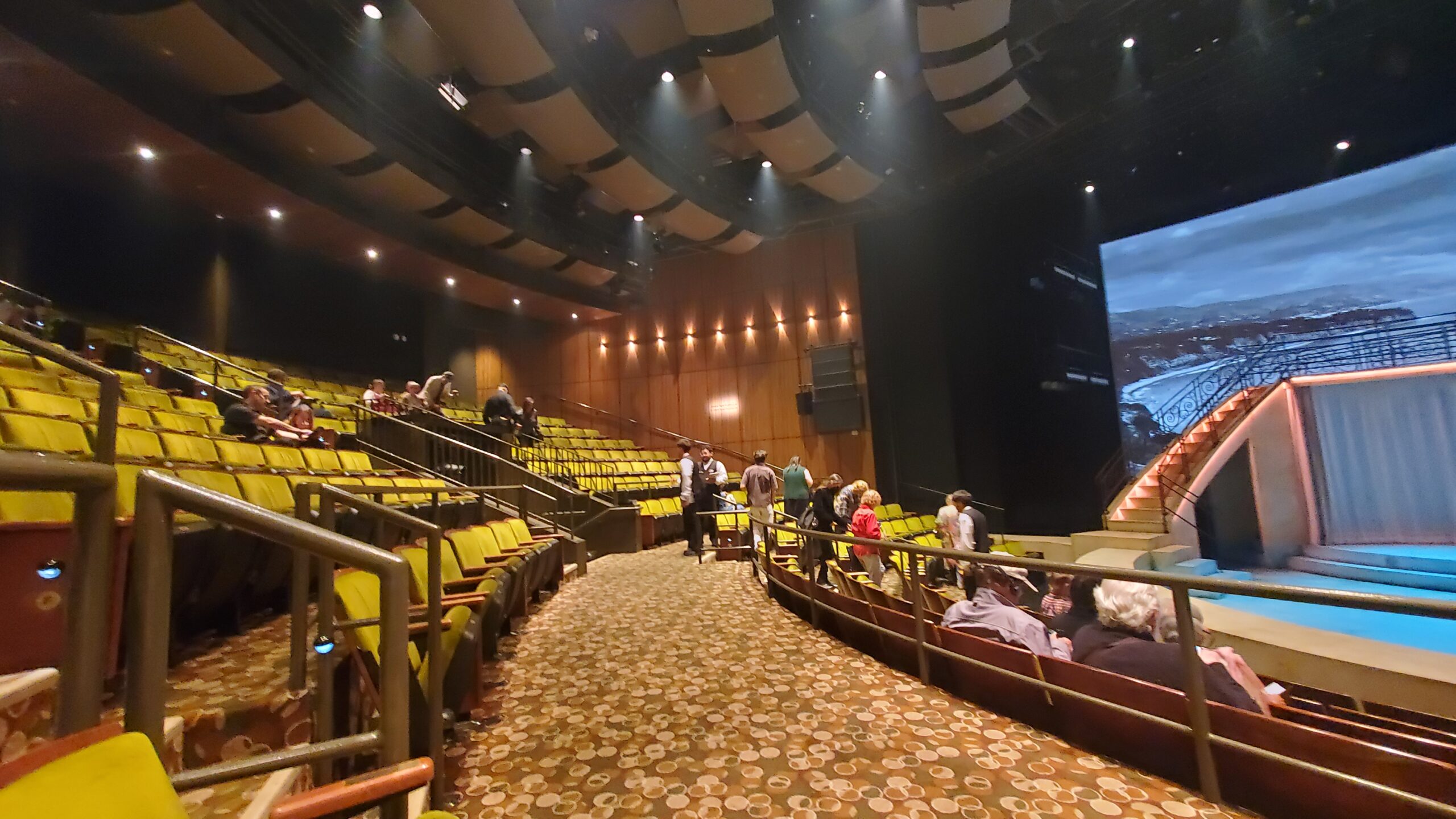
Looking left from my seat.
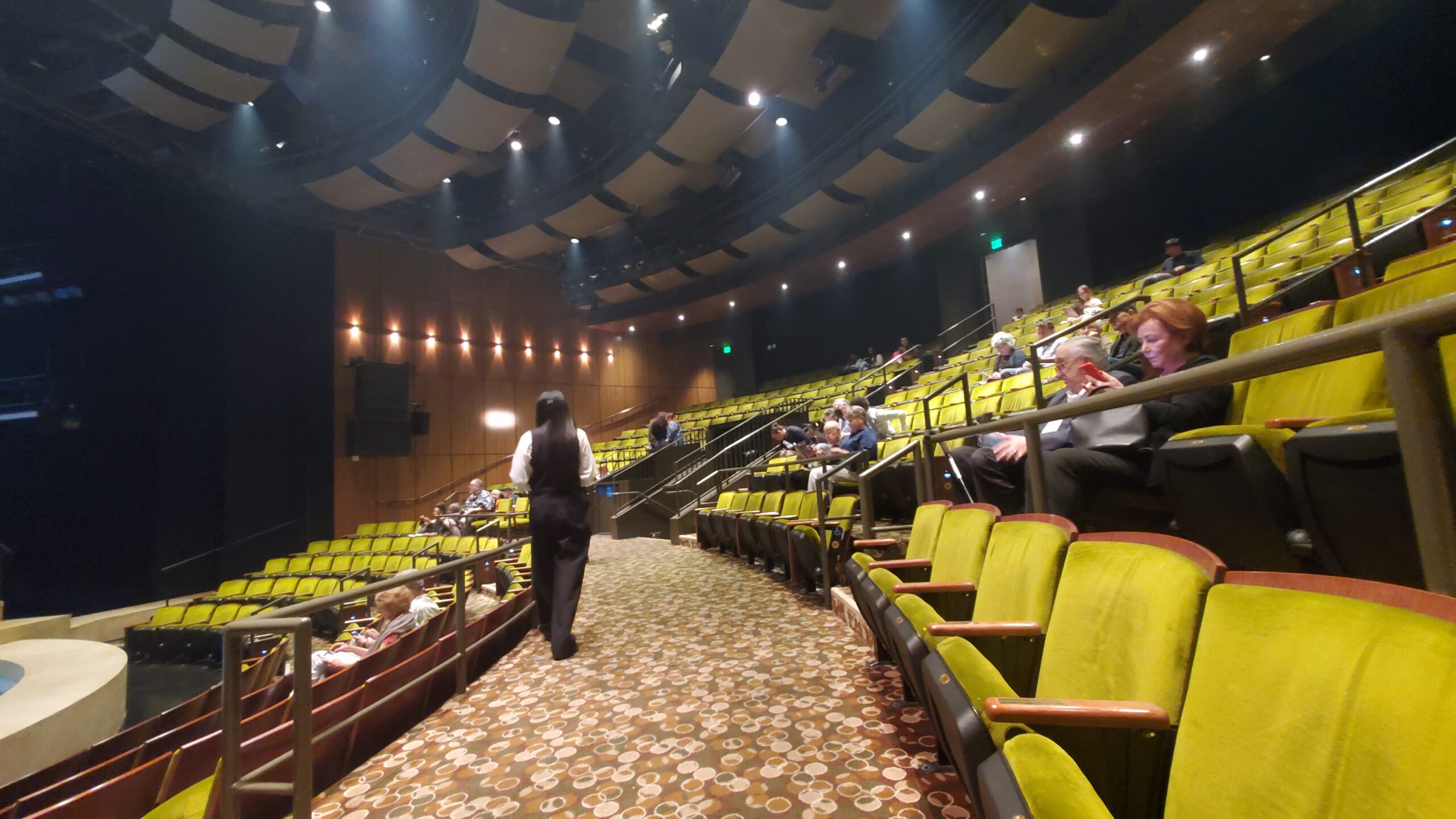
Looking right from my seat.
The Mark Taper Forum is a lovely theater with 736 or 739 seats (the program and the Wikipedia give conflicting counts). It didn’t seem like there was a bad seat there. My perspective photos were taken from seat EE103, which I thought was a great seat.
The show was a full two hours, and there was no intermission. It was put on by the Center Theatre Group.
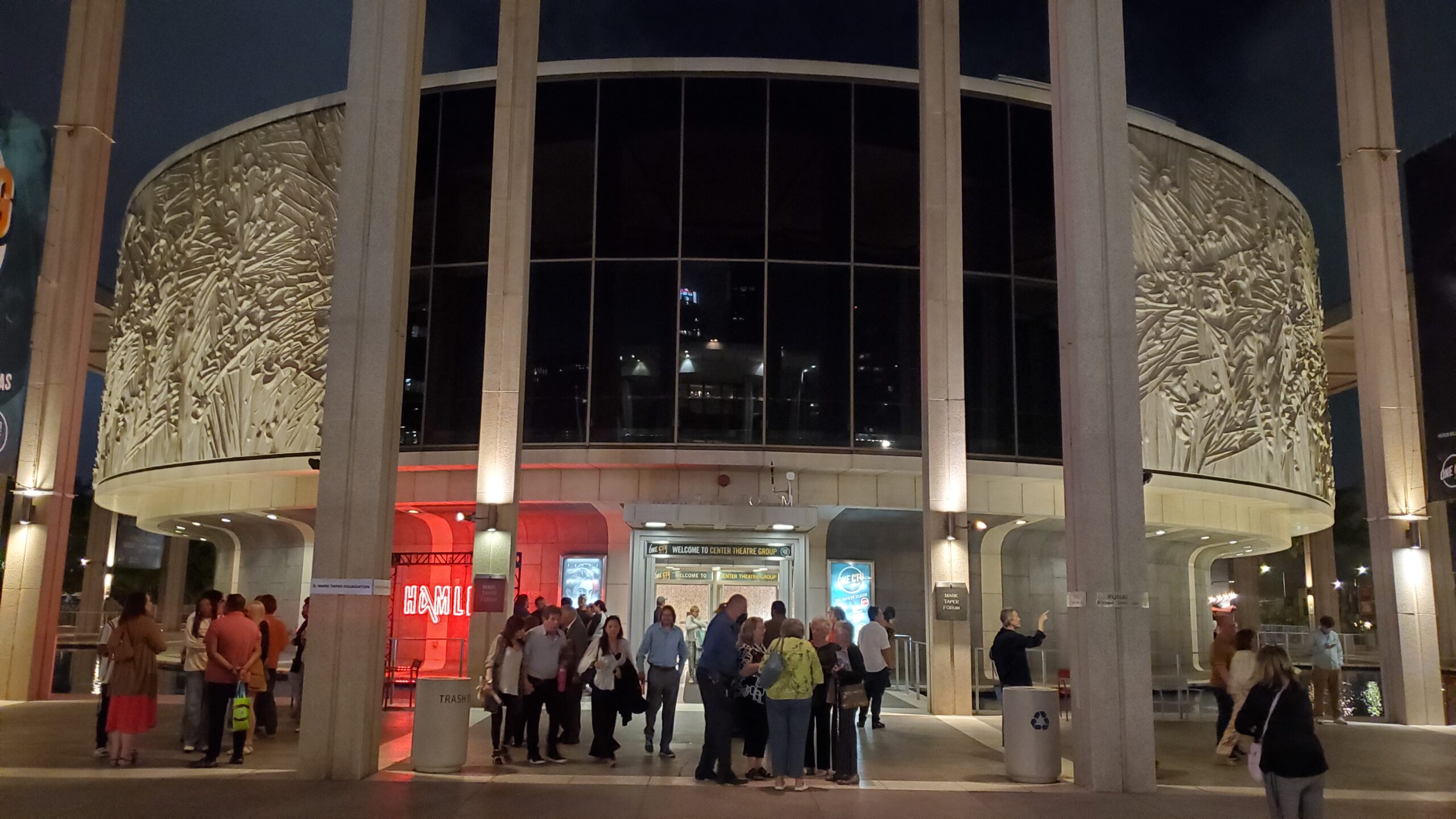
Leaving the Mark Taper Forum after the play experience.
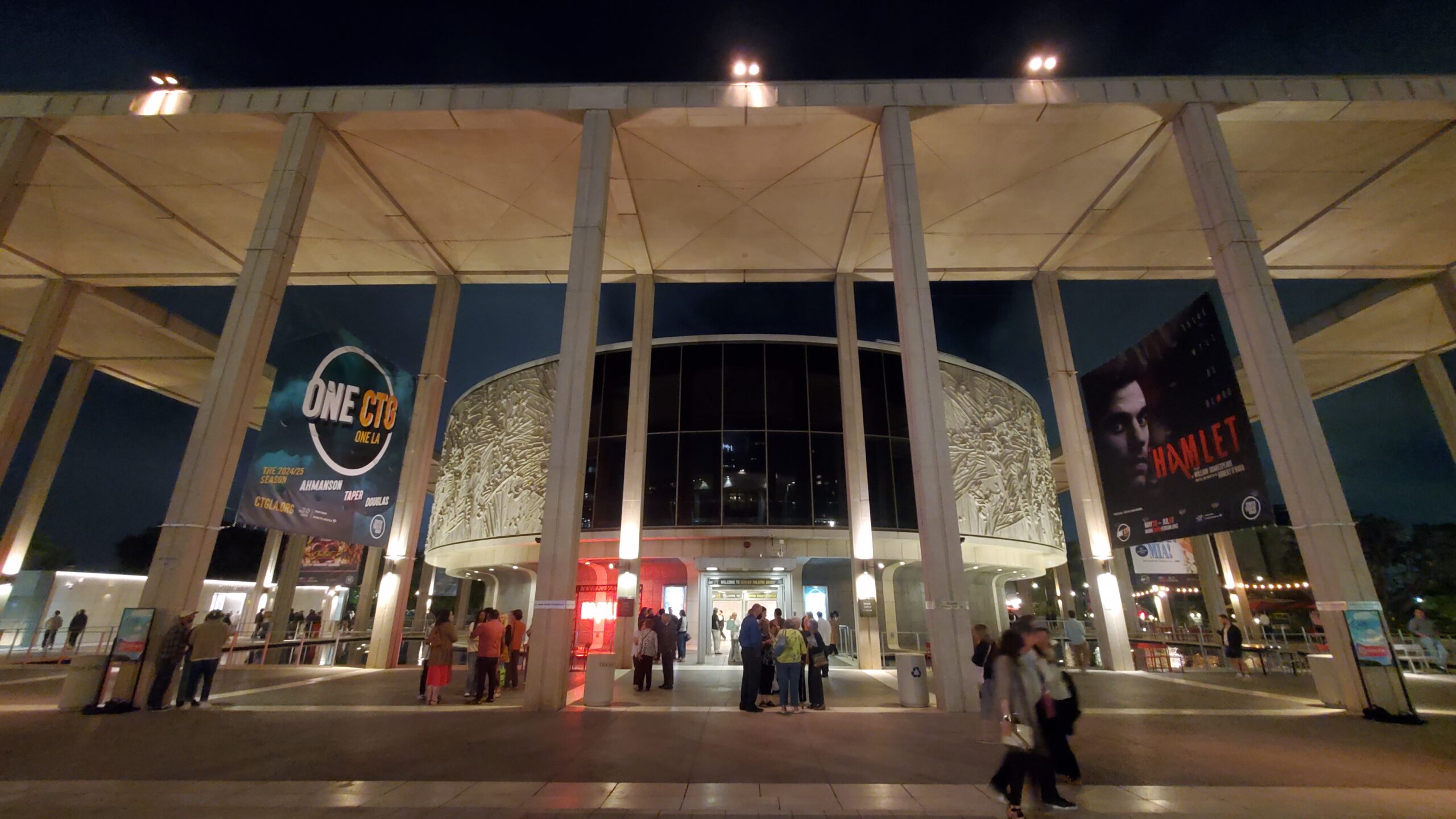
Wider shot, to get the Hamlet banner.
Center Theatre Group is the largest producing not-for-profit theater company outside of New York City, originally founded in 1967 and with more than 700 productions in its history.