It is impossible to fully describe The Cortège without experiencing it in person. Let’s get that part out of the way immediately: this is an experience and it is uniquely difficult to put into words, and hard to even classify. Immersive, Dance, Theater? It nearly deserves a category all its own.
I went to the Cortège on 9/28/2025 without knowing what to expect, and left in a state of awe.
Arrival
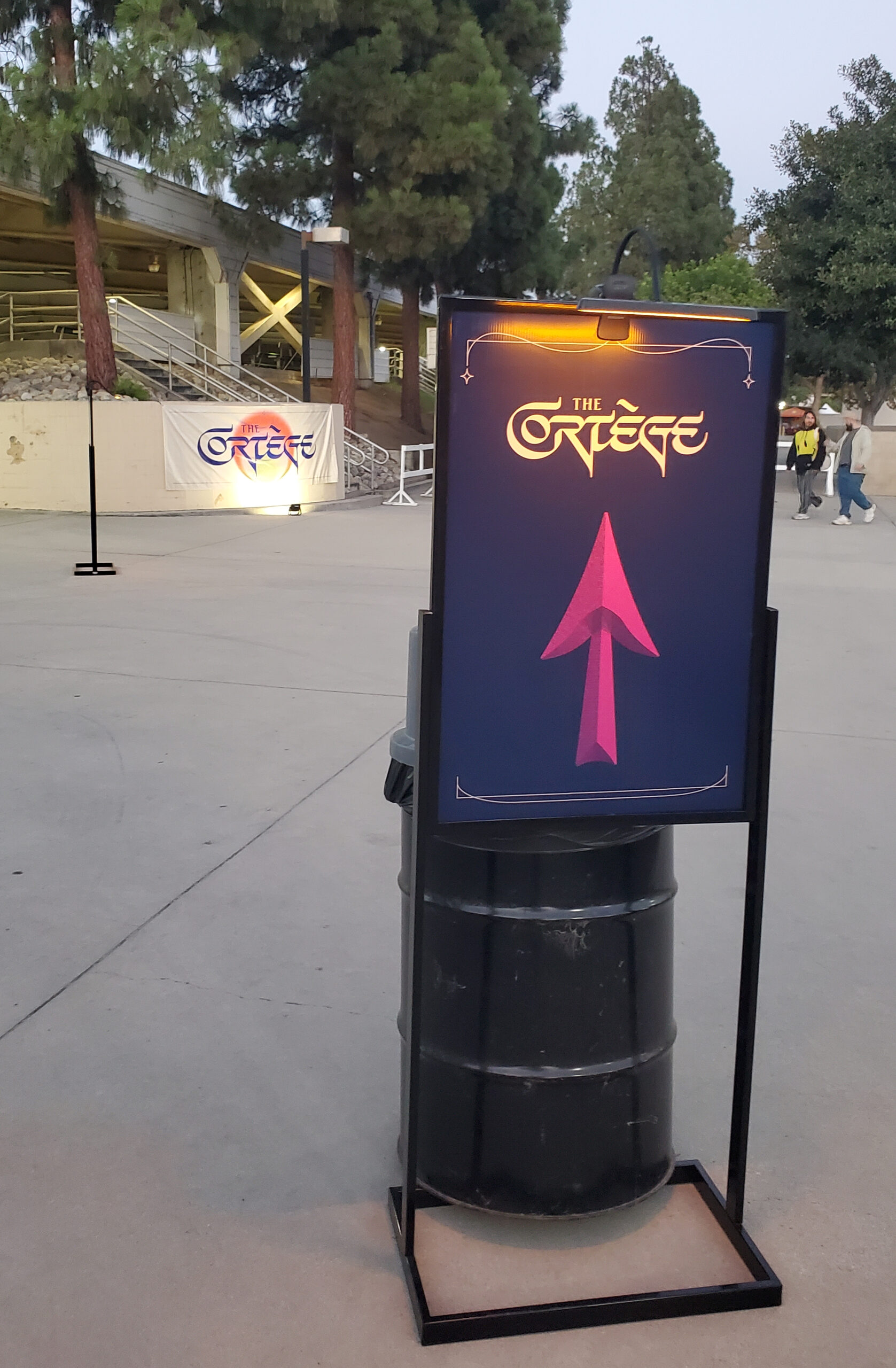
The Cortège was held on the grounds of the Los Angeles Equestrian Center in Burbank. Definitely not a normal venue location and not somewhere I’ve ever been before. There were some people riding horses in a circle in a large stadium on the way there; the walk was a little confusing at first, but from the parking lot you could soon find signs pointing the way.
From there, you were led into an entry area, and given a pair of glowing orange headphones. For most of the rest of the night, most of the sound would only come through these headphones–turning an outdoor event into something up close and personal.
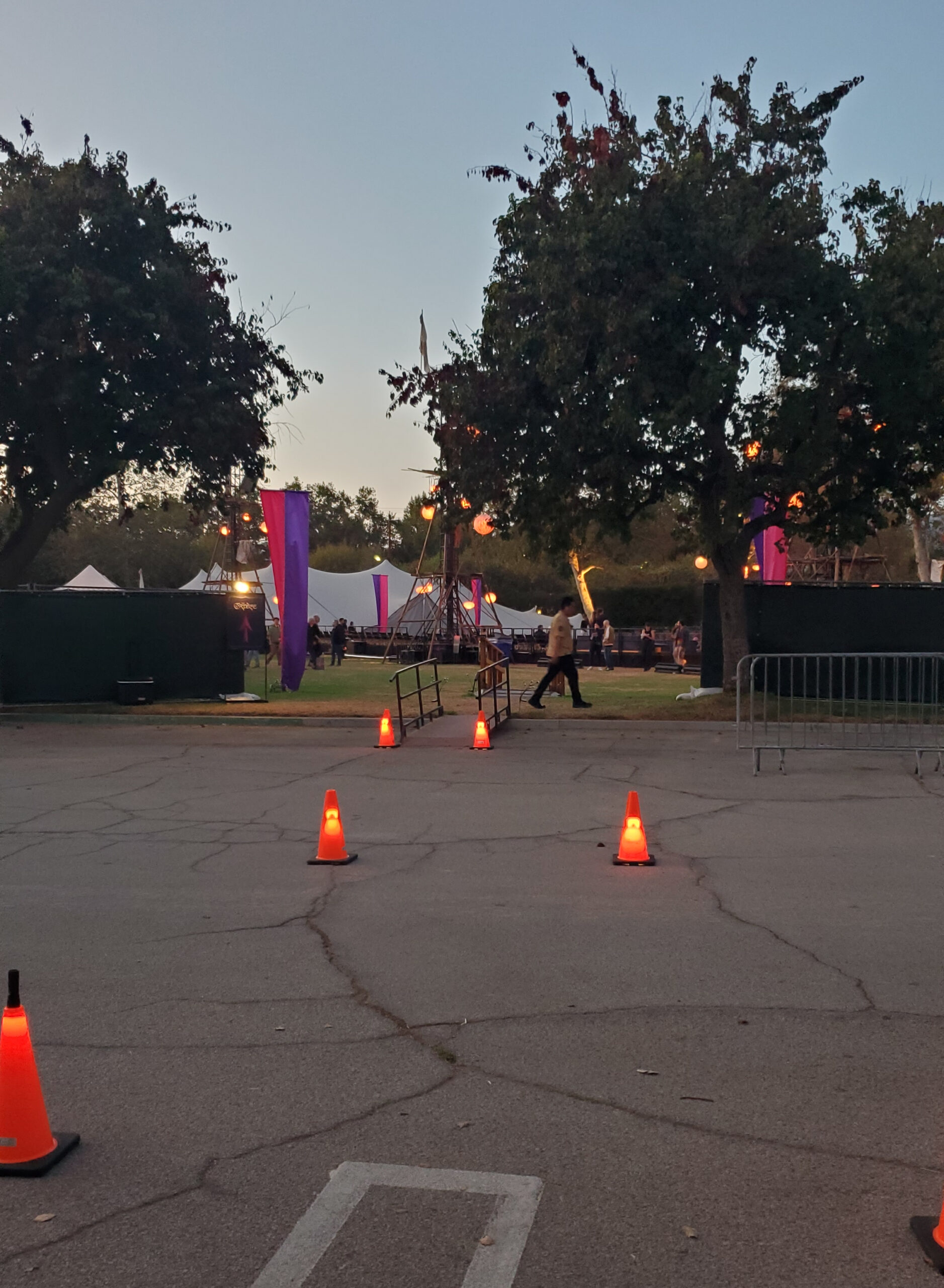
You then follow glowing cones and glowing lights to the main procession pathway.
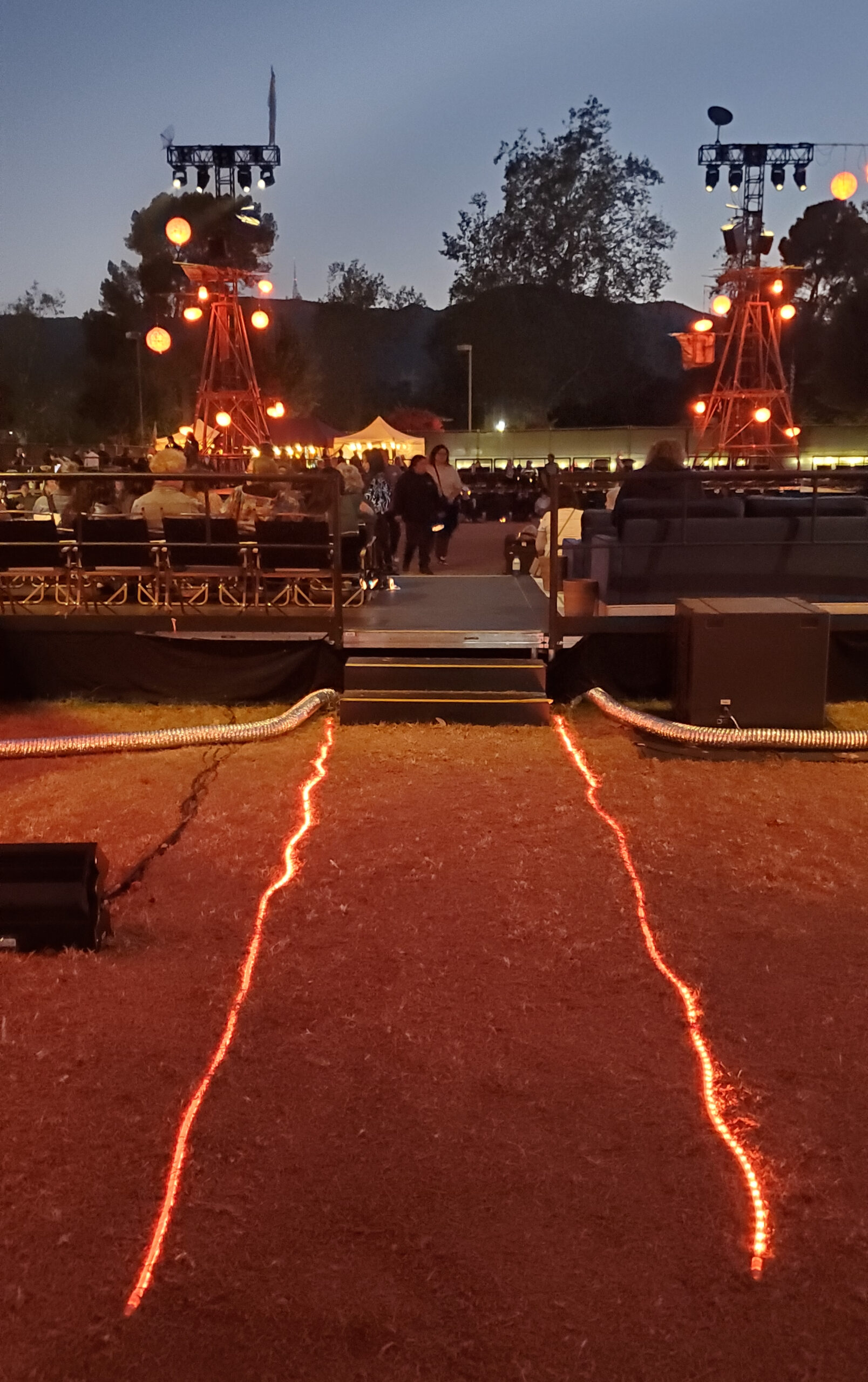
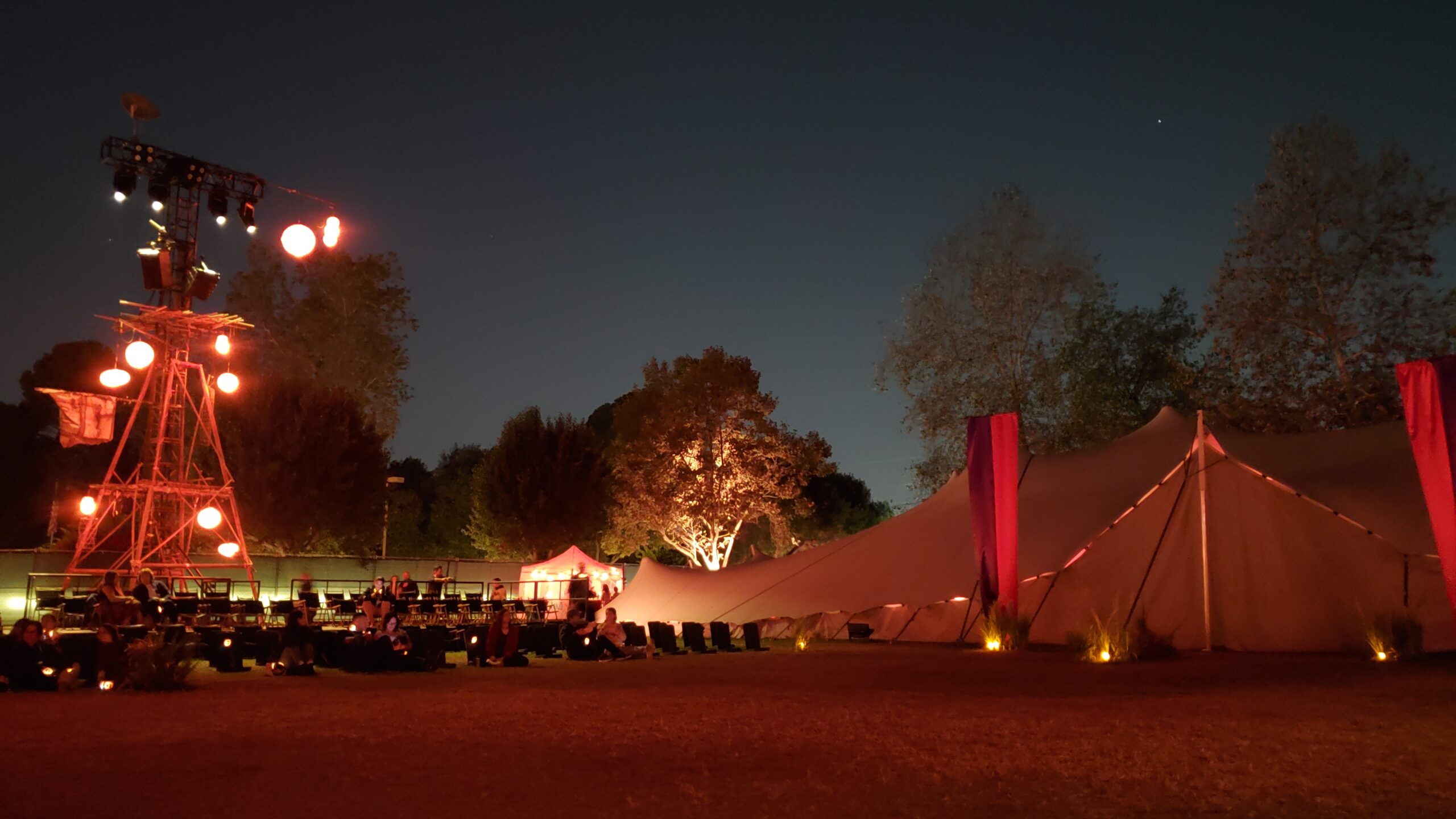
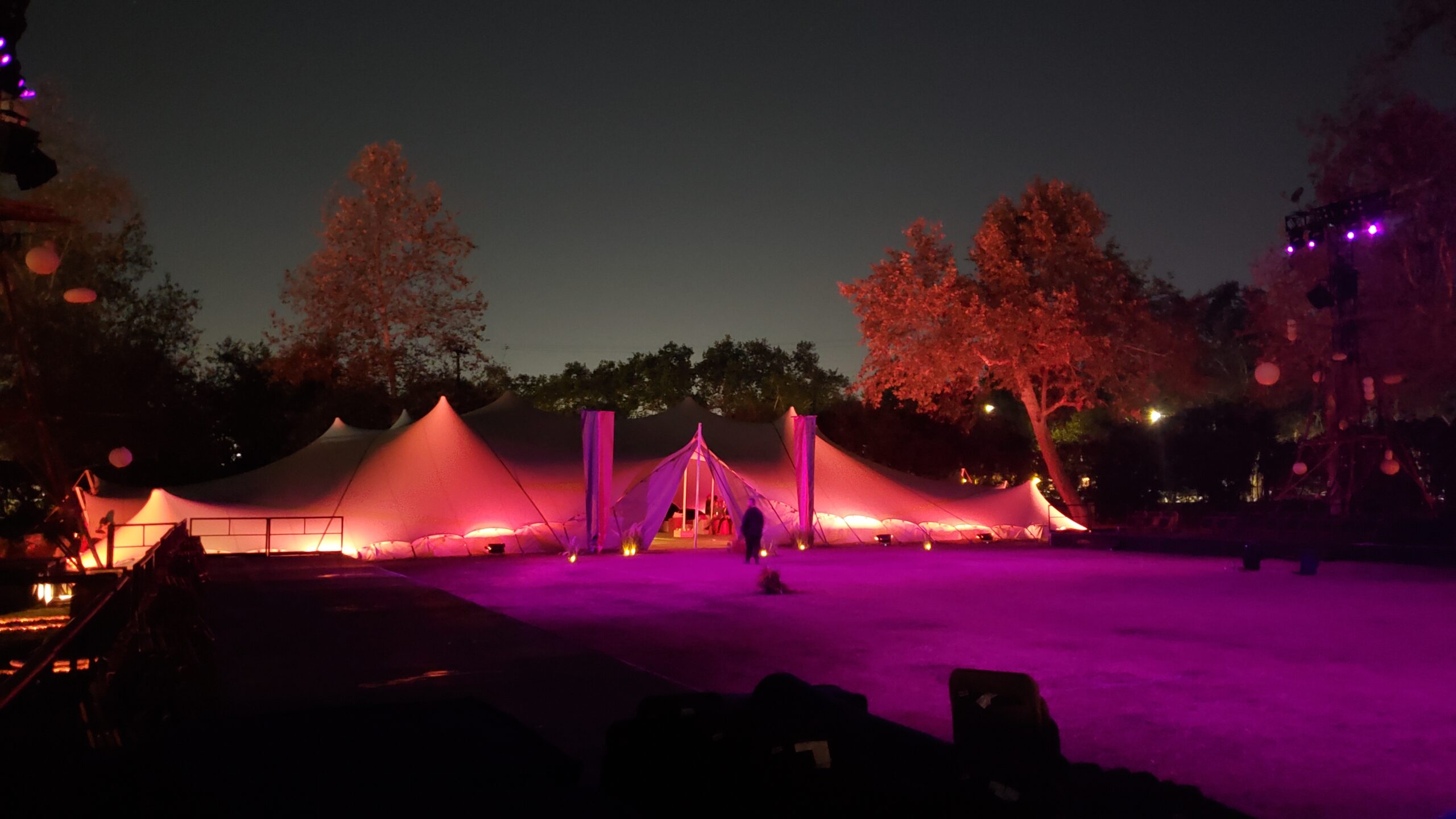
It’s a long strip of grass with rows of seating on both sides. I was in the front row, a little more towards one end (with the tent) than the center.
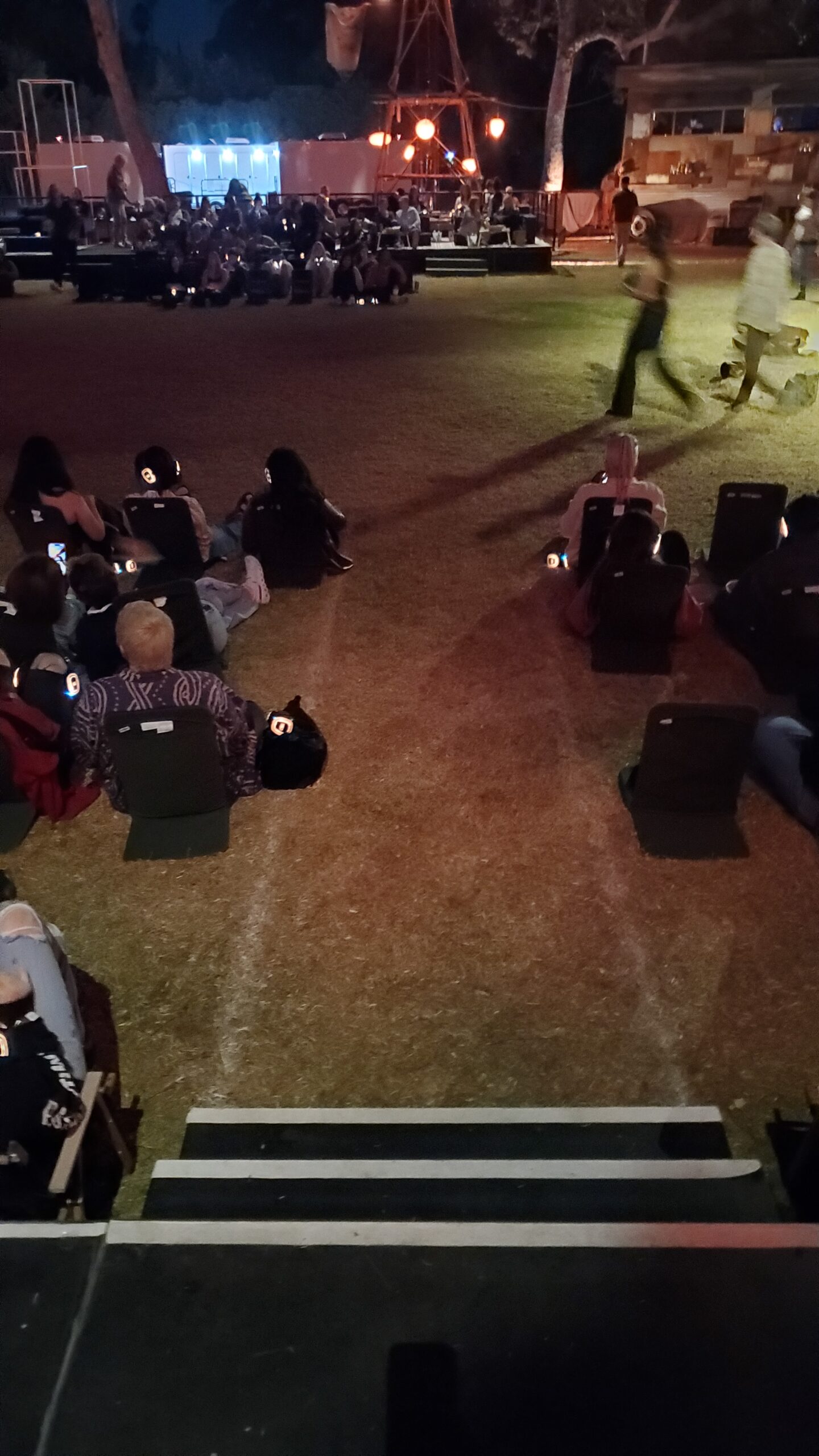
You can walk around before the show begins, and find the tents with merchandise, vendors, food, and drinks. They had canned wine from a brand called “Just Enough” which I unfortunately found unpalatable even for my forgiving tastes.
They did at least have ample restrooms, which is always a concern for outdoor events; these were the nice real restrooms brought in on trailer, a major upgrade from the usual porta potties.
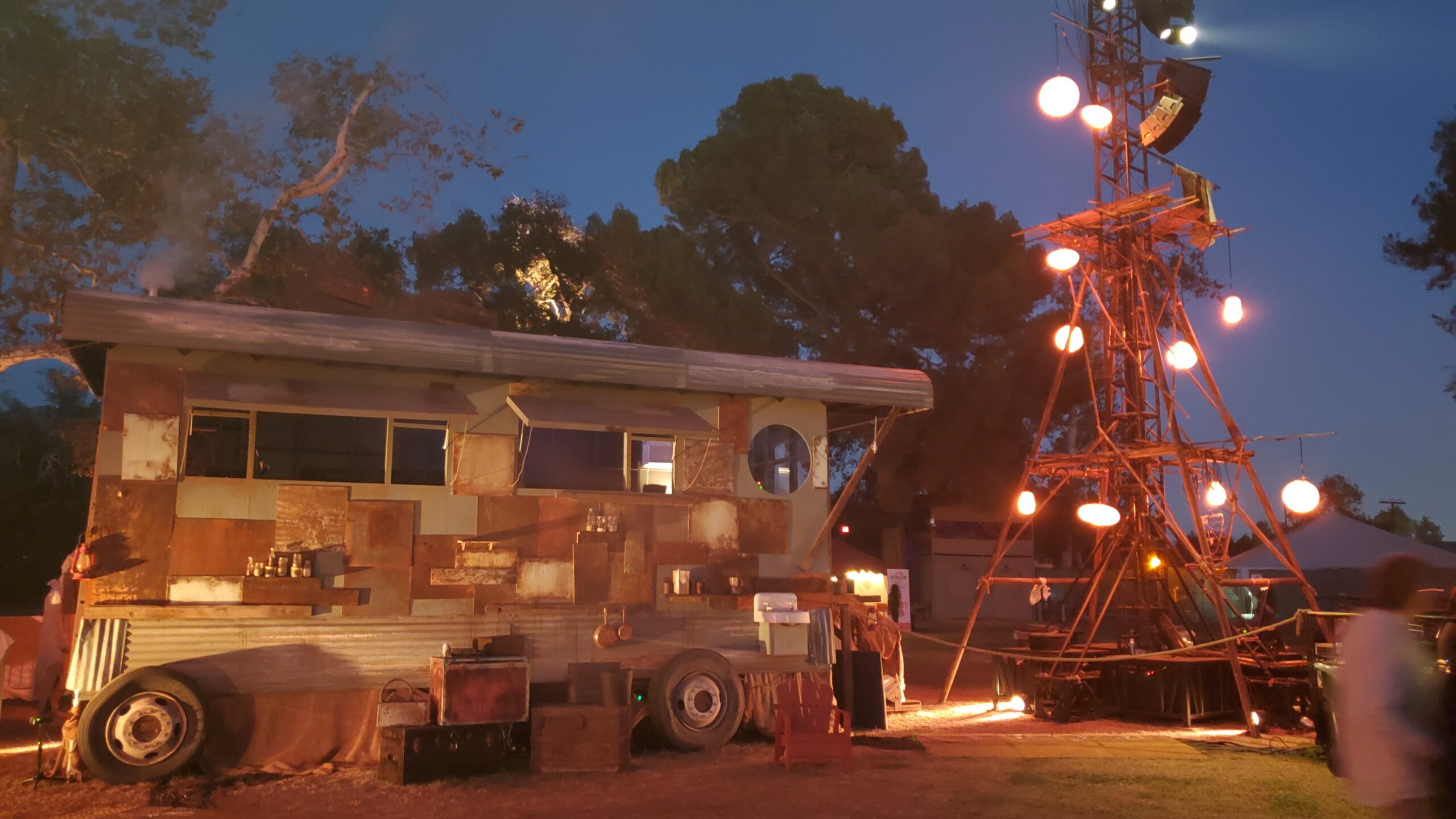
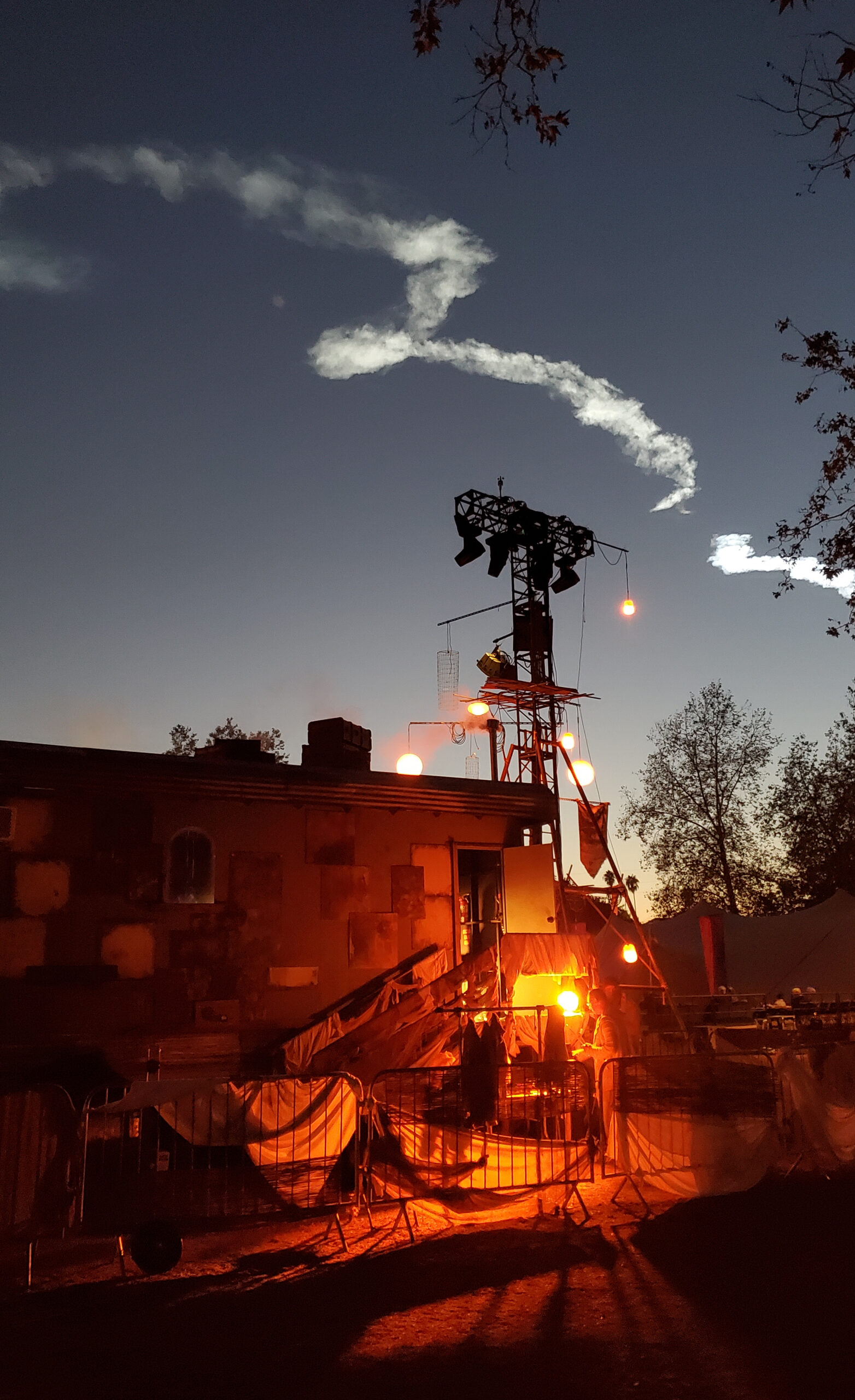
A control hut was set up in the rear center, and dressed up to look like a rundown shack built by wanderers. Perhaps in a sense it really was just that. A recent starship launch provided a corkscrew cloud pattern in the sky above–unrelated to the event, obviously, yet fitting.
I walked around a good deal, feeling as though in some ways, the experience was already starting. You see, the word cortège is a real term from 16th-century French, and it means a solemn procession, especially for a funeral, connotating a ceremonial ritual and retinue accompanying a person of some significance. This was meant to be a funeral procession for our times, and even if it hadn’t officially started, the arrival at a real funeral is an authentic part of that funeral. So I walked, and felt the mood around me, tentative, somber, and yet oddly festive. The night was warm and I took plenty of photos.
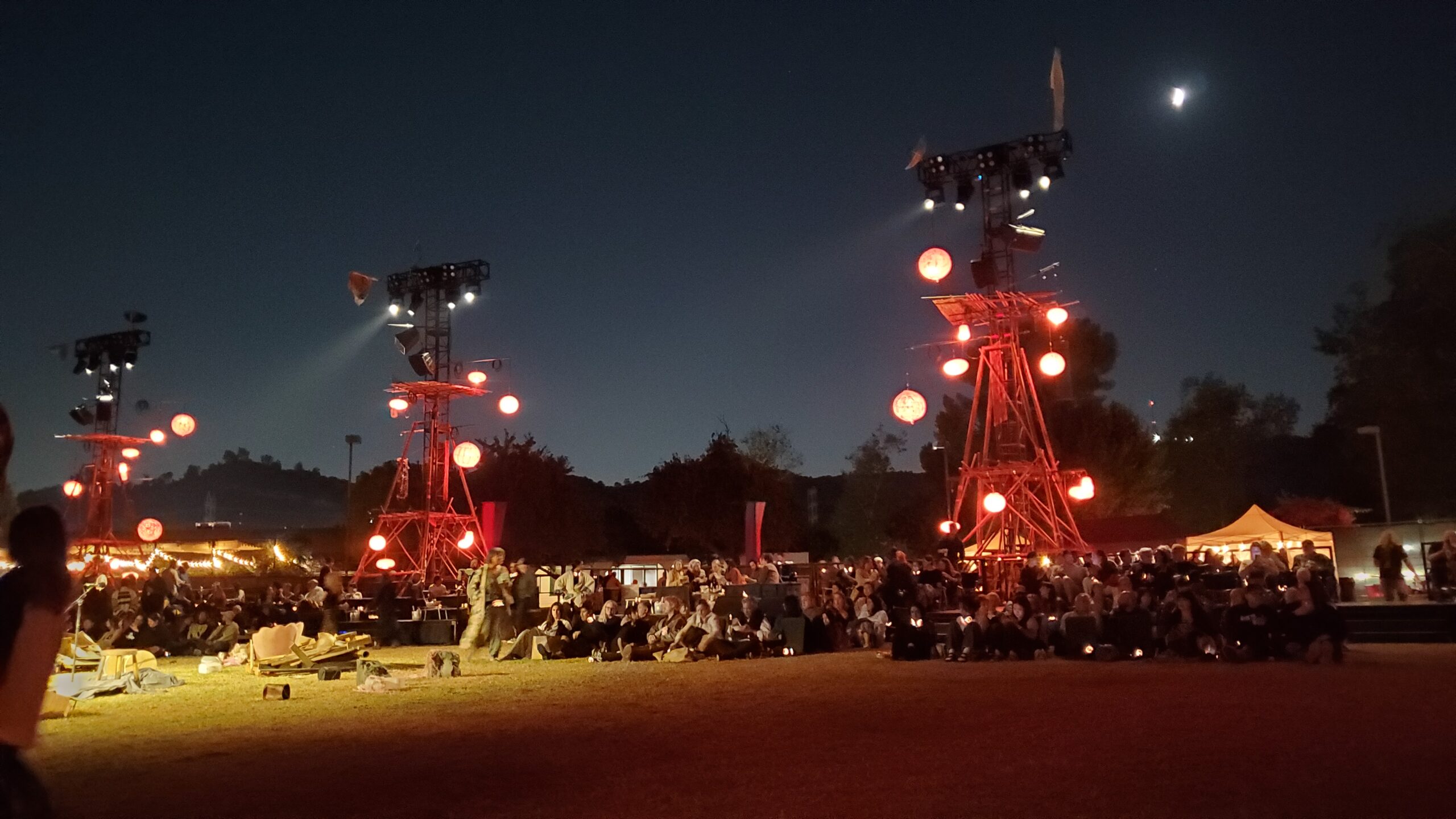
In the center of the procession strip was a circle of instruments and a smoking barrel.
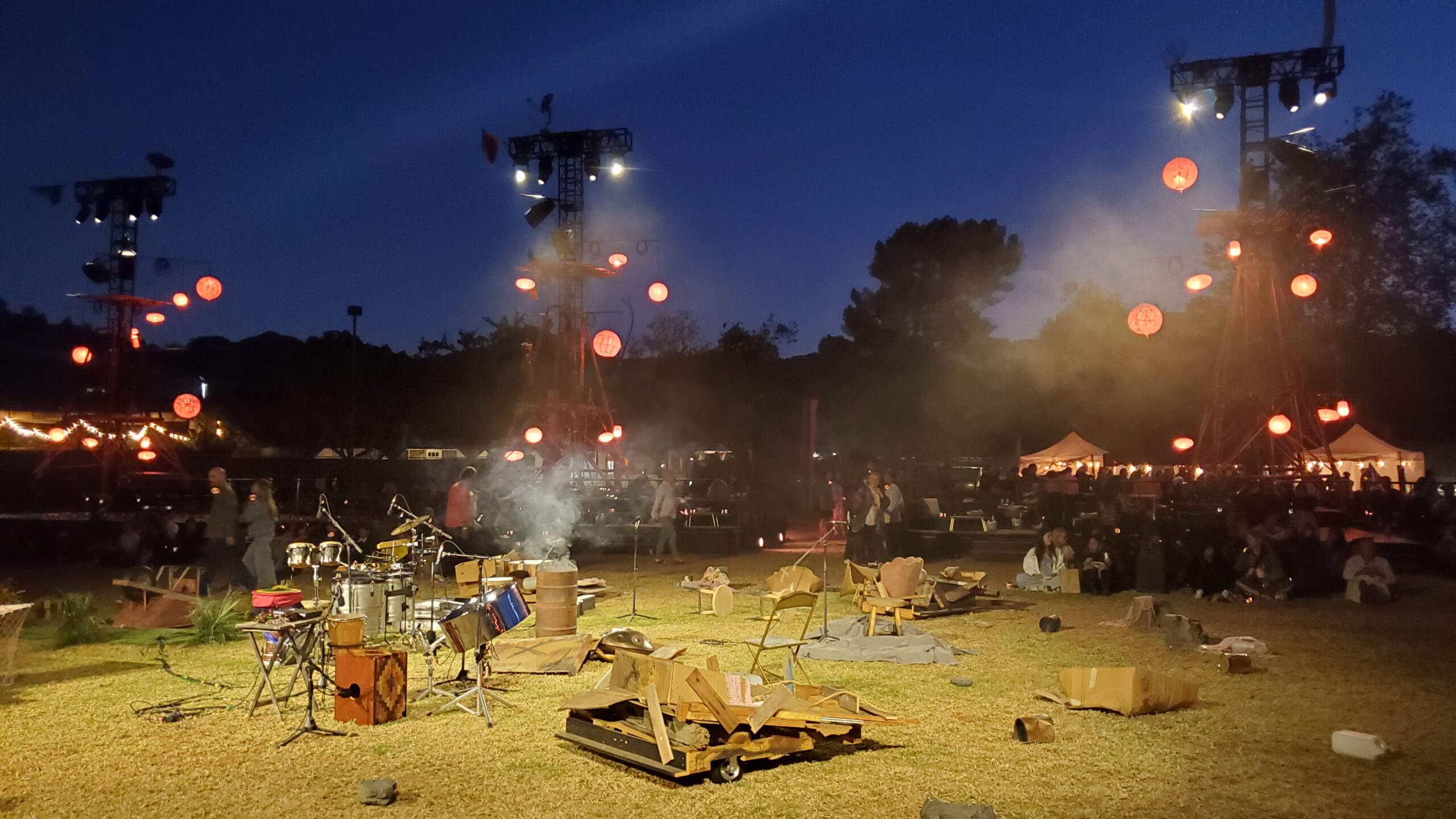
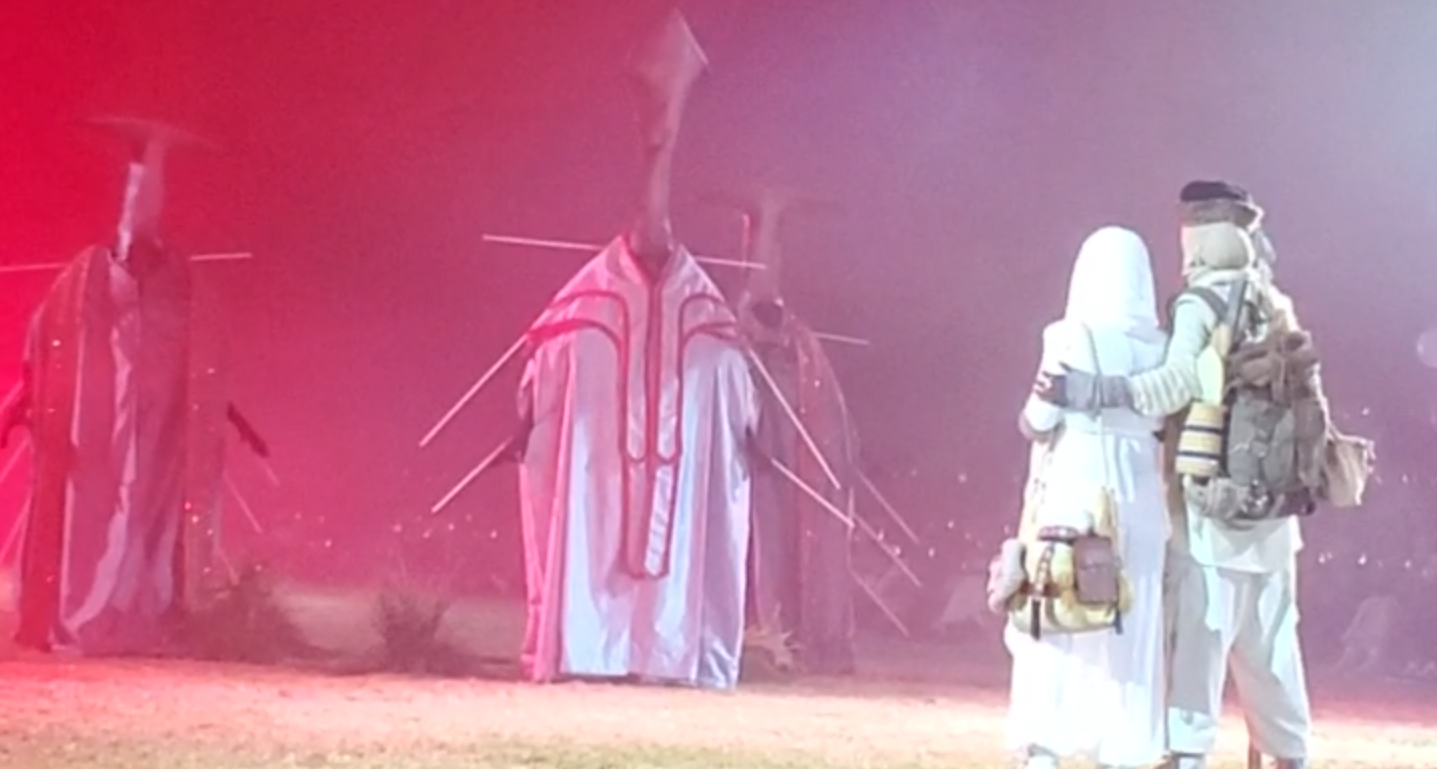
As the sun passed over the horizon and dusk swept over the land, musicians dressed like otherworldly desert nomads emerged and began to play, signaling that it was time for the audience to take their seats.
The Cortège
The nomadic musicians played songs that brought you into the mood: foreign, unsettling, yet familiar.
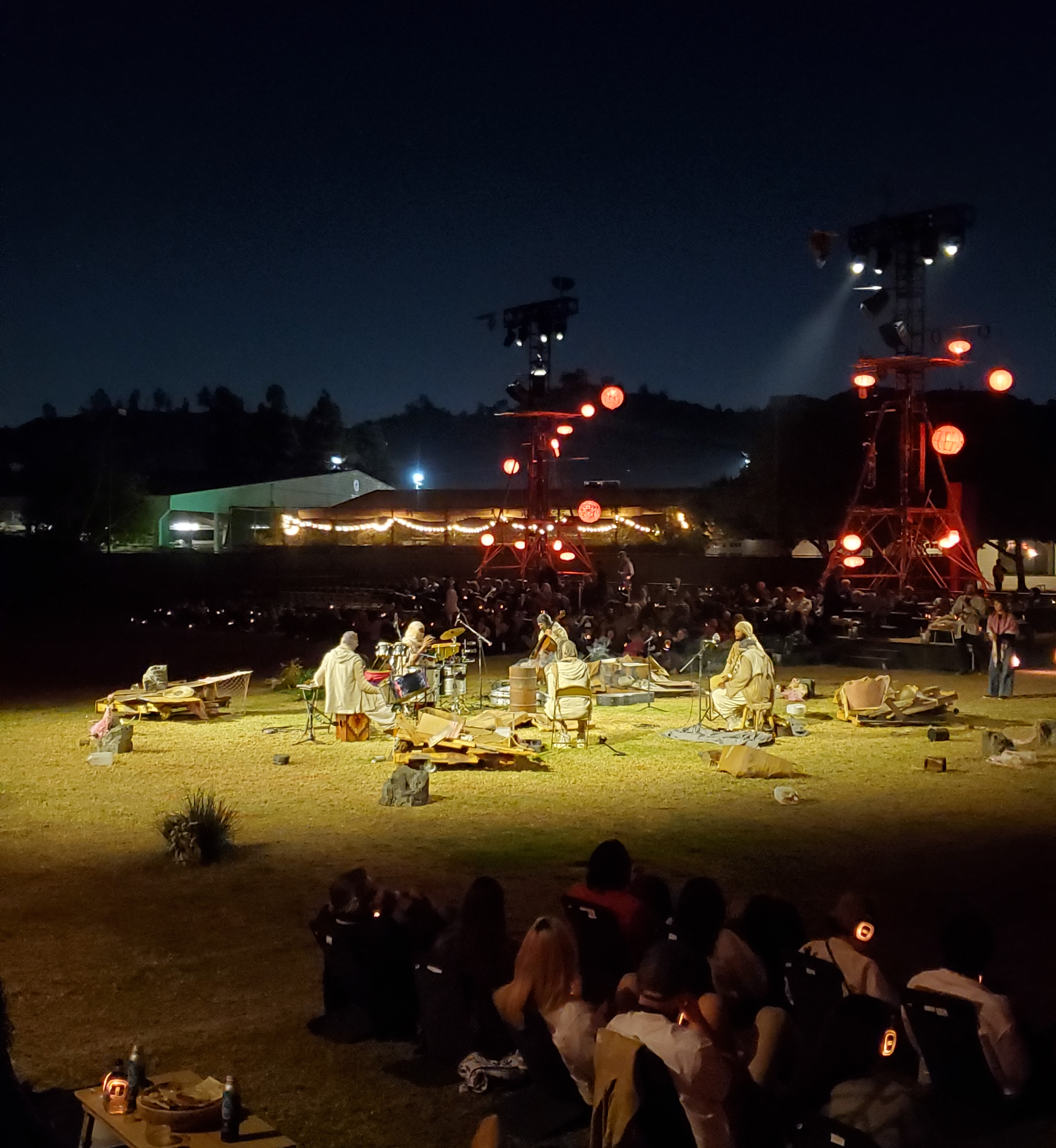
They left after just a couple songs, taking their instruments with them. A group of nomadic dancers emerged and took their place.
I took plenty of video, but bear in mind that the audio was all broadcast over the audience’s wireless headphones. All you’ll be able to hear in these videos is, at best, a dull bass beat. It’s another reason why this experience is impossible to truly record, describe, or reproduce–you’ll just have to trust that it was enrapturing in the extreme.
From the nomads came our protagonist, who is nameless in the story–the entire production is completely without words or dialog of any sort–but in the credits is named Em, short for Everyman, portrayed by Jaden “Cap Jay” Mosby. Em walks forward constantly, staying in the same place because there’s a flat treadmill in the ground, allowing him to stay in the center of the procession.
What happens for the rest of the event is meant to be a celebration of Em’s life. You can suppose that in this world, the real Em has already passed, but we–those who have come to celebrate and remember him–are invited to watch a recreation of the major turning points of his life, told through dance and performance, before the final ceremony.
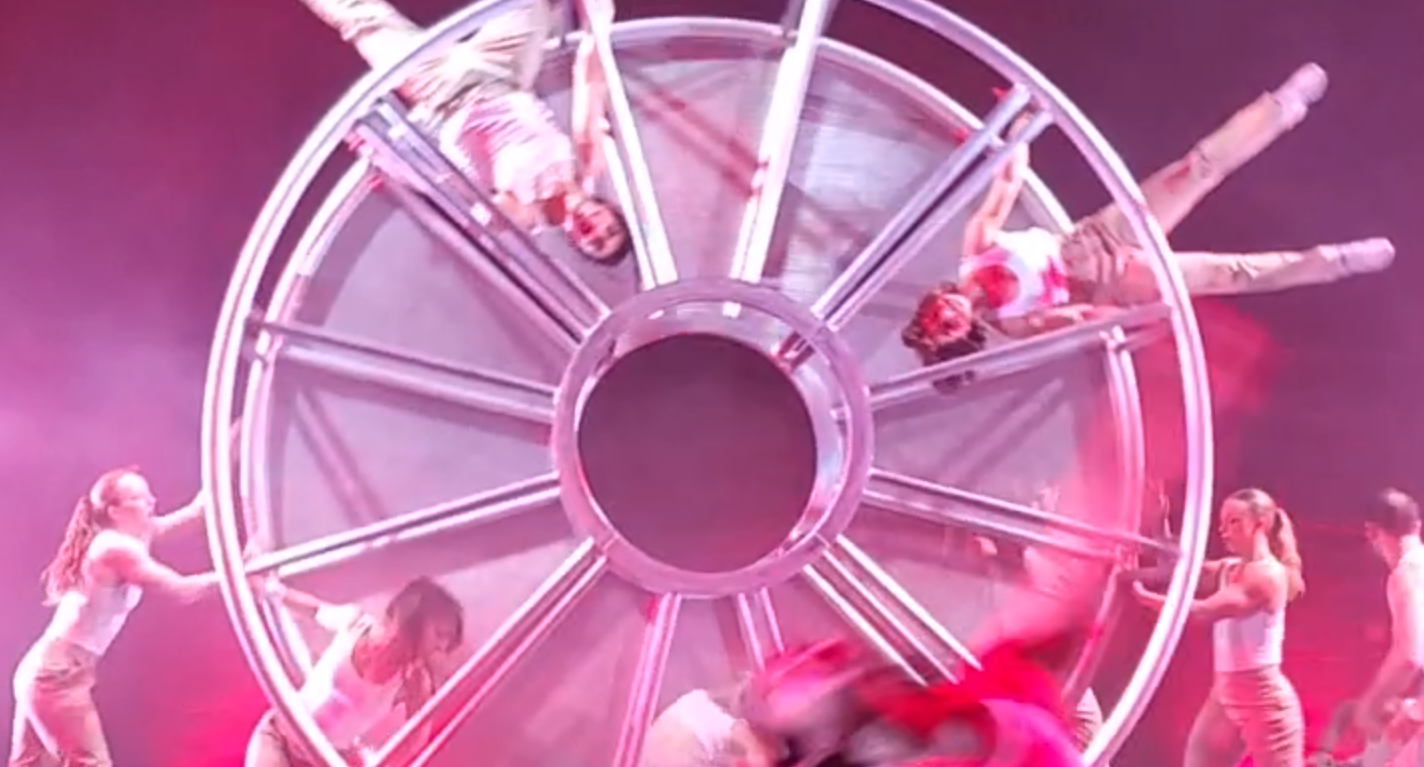
And so we see Em encounter and interact with other figures, all in the most elaborate and imaginative costumes I have ever had the pleasure of seeing in person. The figures emerge from one side of the pathway–usually the side with the tent, so they walk forward “against” him, for better or for worse–but others come from behind. Some figures aid him; others seem like annoyances, while some fight against him.
At times, drones fly up from behind the audience and form massive coordinated shapes, symbolically corresponding to what’s going on in the story–even though we are never really told what is going on exactly, or what those symbols mean. This is intentional, as if there is a language barrier, or just because it’s meant to reflect basic stages of Joseph Campbell’s hero’s journey that we’re all intimately familiar with already.
Some parts leave no doubt as to what is happening–most obviously, when Em’s romantic interest emerges from a band of nomads behind him. Credited only as “Her” and portrayed by MiYU, this feminine figure encounters Em and soon joins him on his journey through life. It’s no surprise that MiYU is also credited as the lead choreographer, because her movements steal the show even against a background of other enormously talented dancers.
Because Em’s journey is not given many specifics, he serves as a (mostly) blank slate that each member of the audience can project themselves onto. We barely even see his skin color–he doesn’t even need to be male, really. And because each member of the audience is listening to the immersive audio tracks privately through the headphones, it feels personal, like it’s just mine and just yours, regardless of the fact that everyone else is wearing the same headphones and hearing the same thing. In fact, the crowd nature adds to it–we instinctively believe that everyone else must be feeling their own versions of our projections onto Em. And so, without a single word uttered, you can become Em, feel his victories, his defeat, his pain, his love.
At times, live musicians reemerge and add live sound on top of the prerecorded elements.
Obstacles emerge, some mightier than others; Em is usually victorious, or at least walks away unscathed, but some separate him from Her, others beat him down or confuse him.
The world seems to get more complicated. Robot dogs arrive; although these ostensibly can be interpreted as spirits or given other meanings in this context, it’s hard for me personally not to interpret them as a bad omen, inherently fascistic in nature. Even the normalization of them in this context seems almost dangerous to me.
Em’s partner is pregnant, and the promise of new life brings joy. But the obstacles and opponents get fiercer, from merchants to what look like imposing religious authorities.
Sadly–yet inevitably, as this is his cortège, after all–Em is struck down.
It’s a devastating moment. Despite being out here for less than two hours at this point, you feel like you know Em, like you love Em. You’ve related this experience to past funerals–real ones–and reflected on how you felt. The performance has been circling around confronting your own methods of processing grief, edging closer and closer, and when Em falls and does not get up again… it hurts.
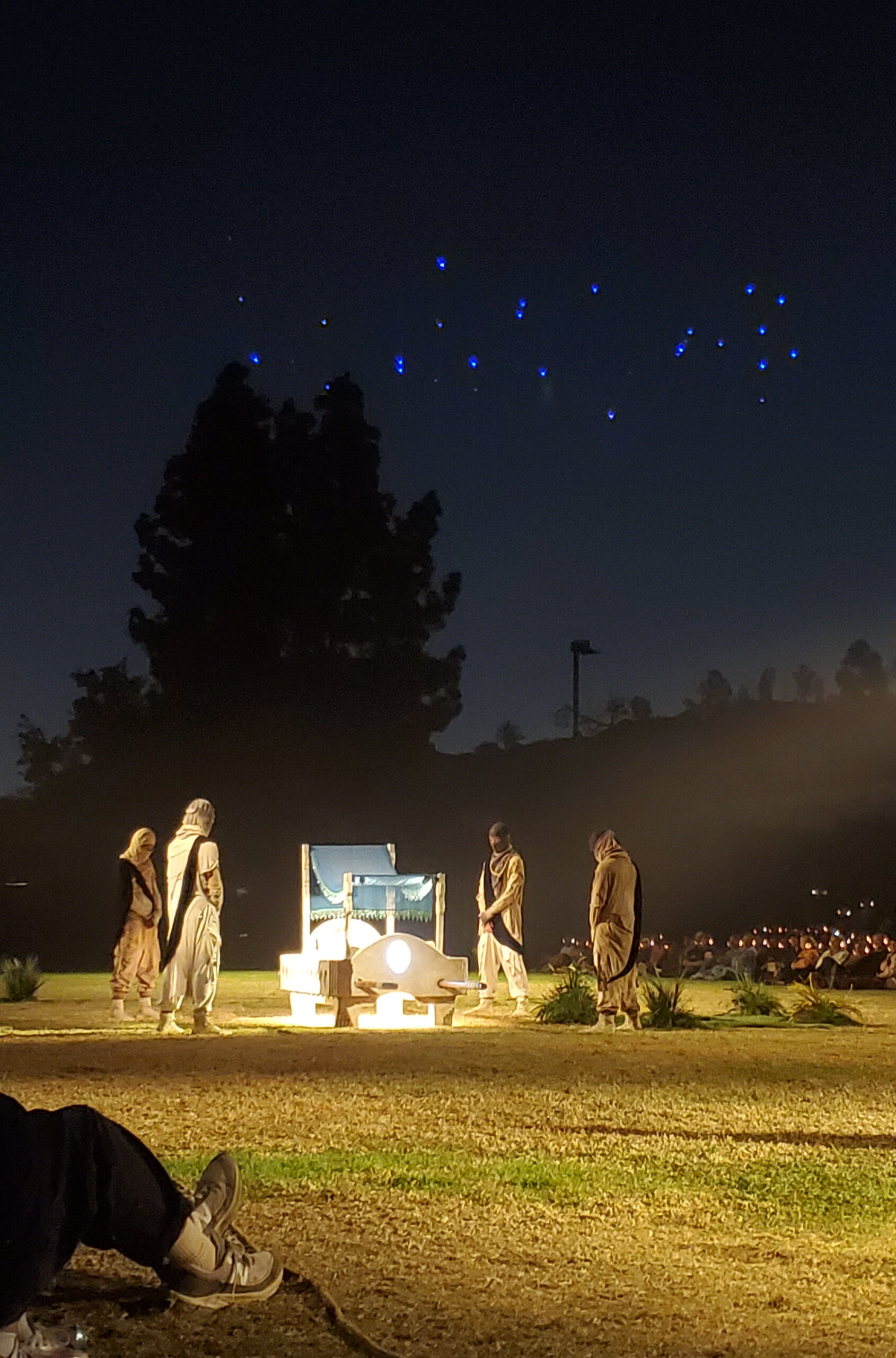
Other figures emerge, perhaps the gatekeepers of some alien afterlife.
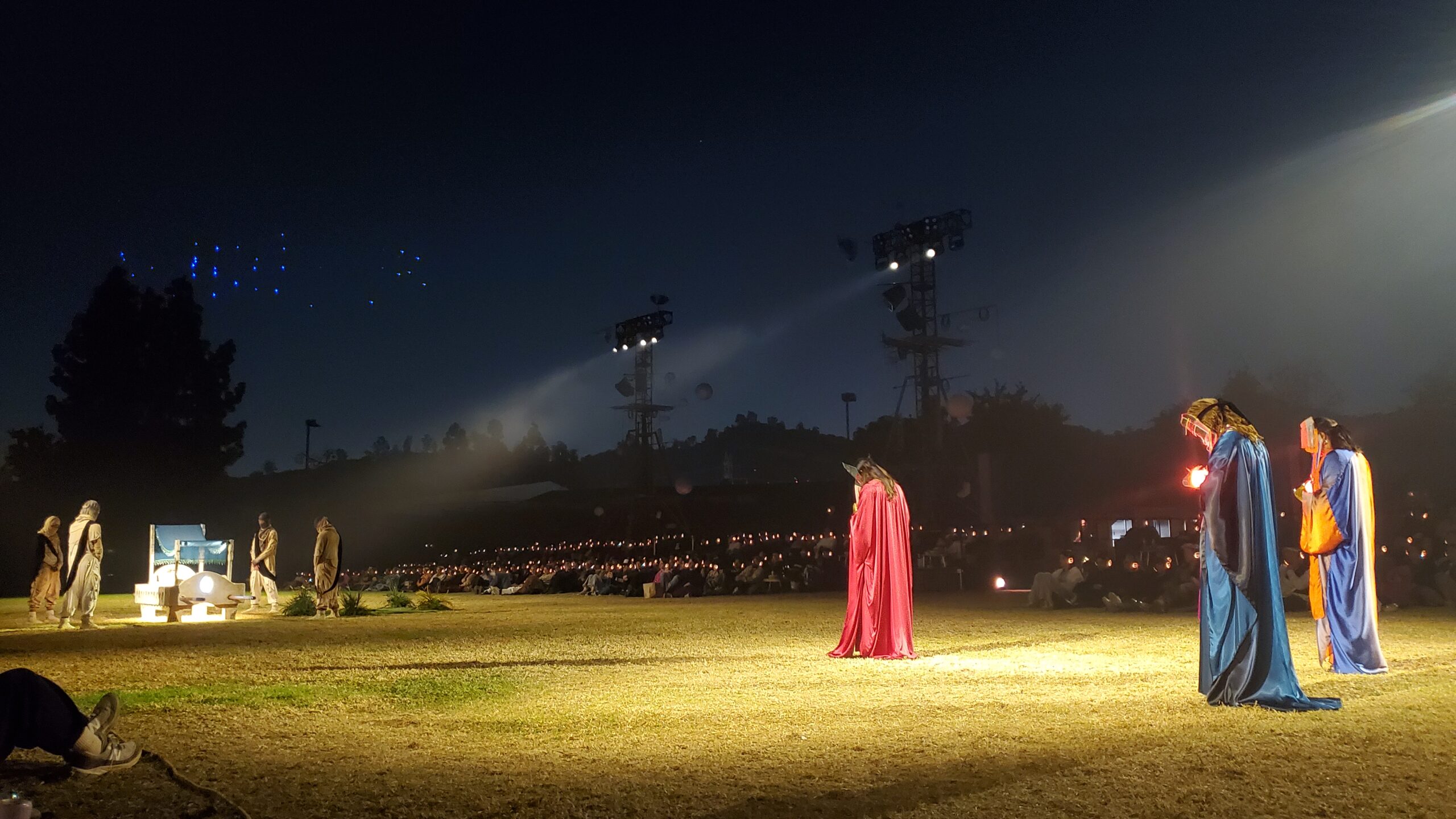
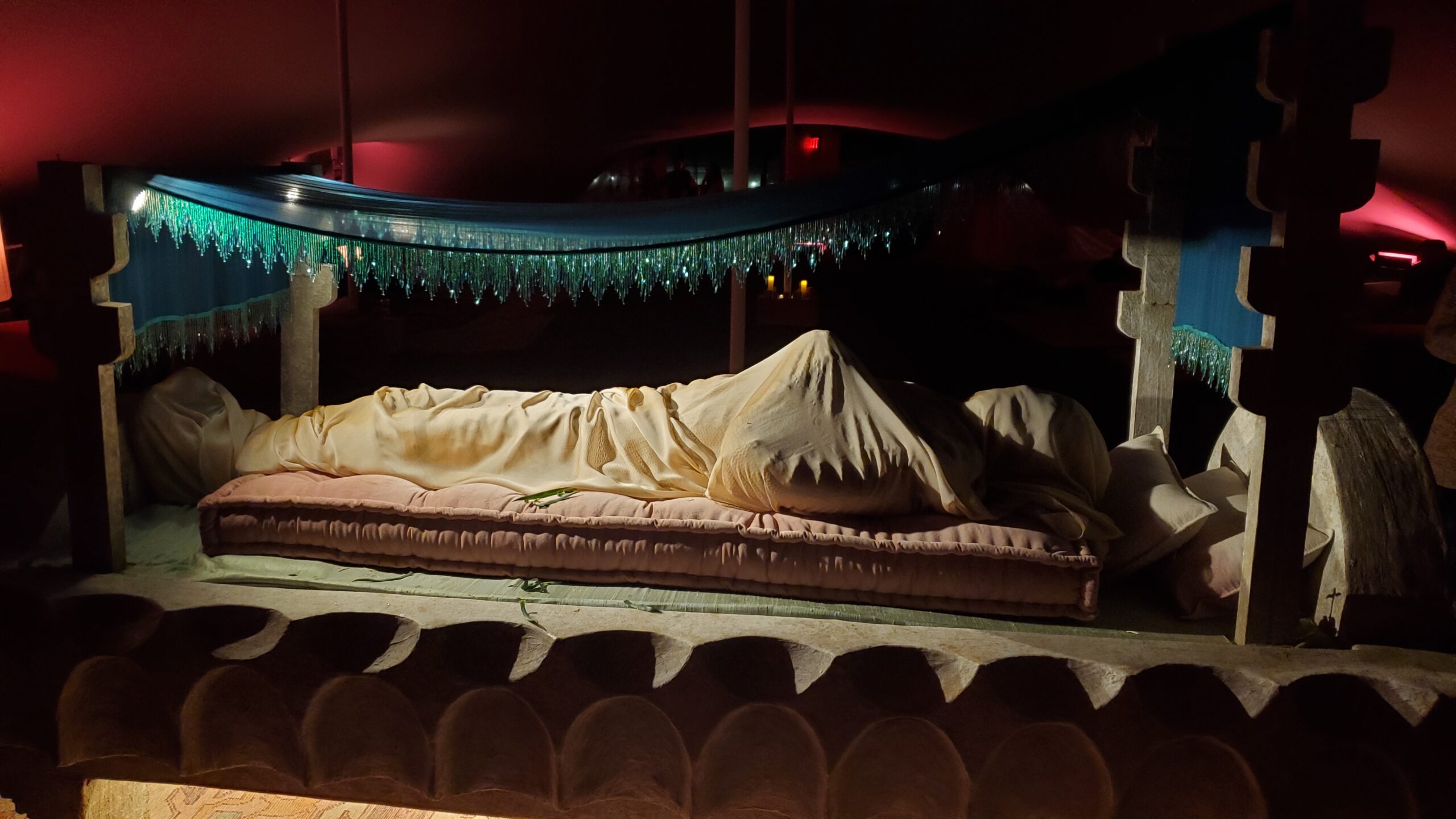
Soon an open casket platform is brought out, and nomadic pallbearers lead Em, finally, into the tent.
But more figures emerge from both sides. More costumed creatures and robots alike, including some from earlier and some not seen before, even a giant female figure the height of three humans, with glowing eyes and arms that open down for you, and large featureless fur-covered dancing beasts.
They invite the audience up. You are no longer watching. You are celebrating. You wipe your tears and wander and dance and feel elated to have been a witness to Em’s life. And there is a lot of dancing!
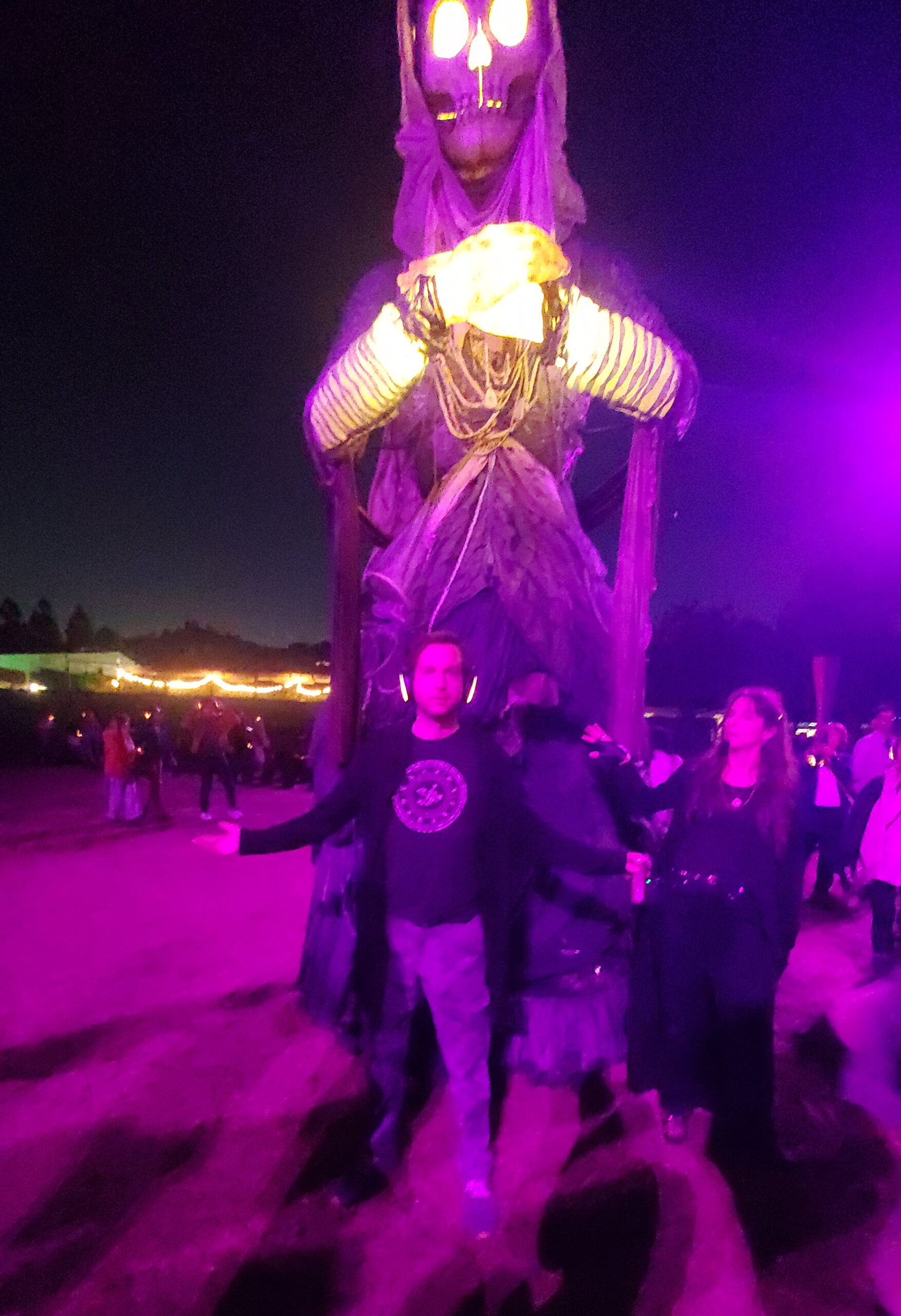
If you’re like me, you also get a photo with the giant glowing deathly woman.
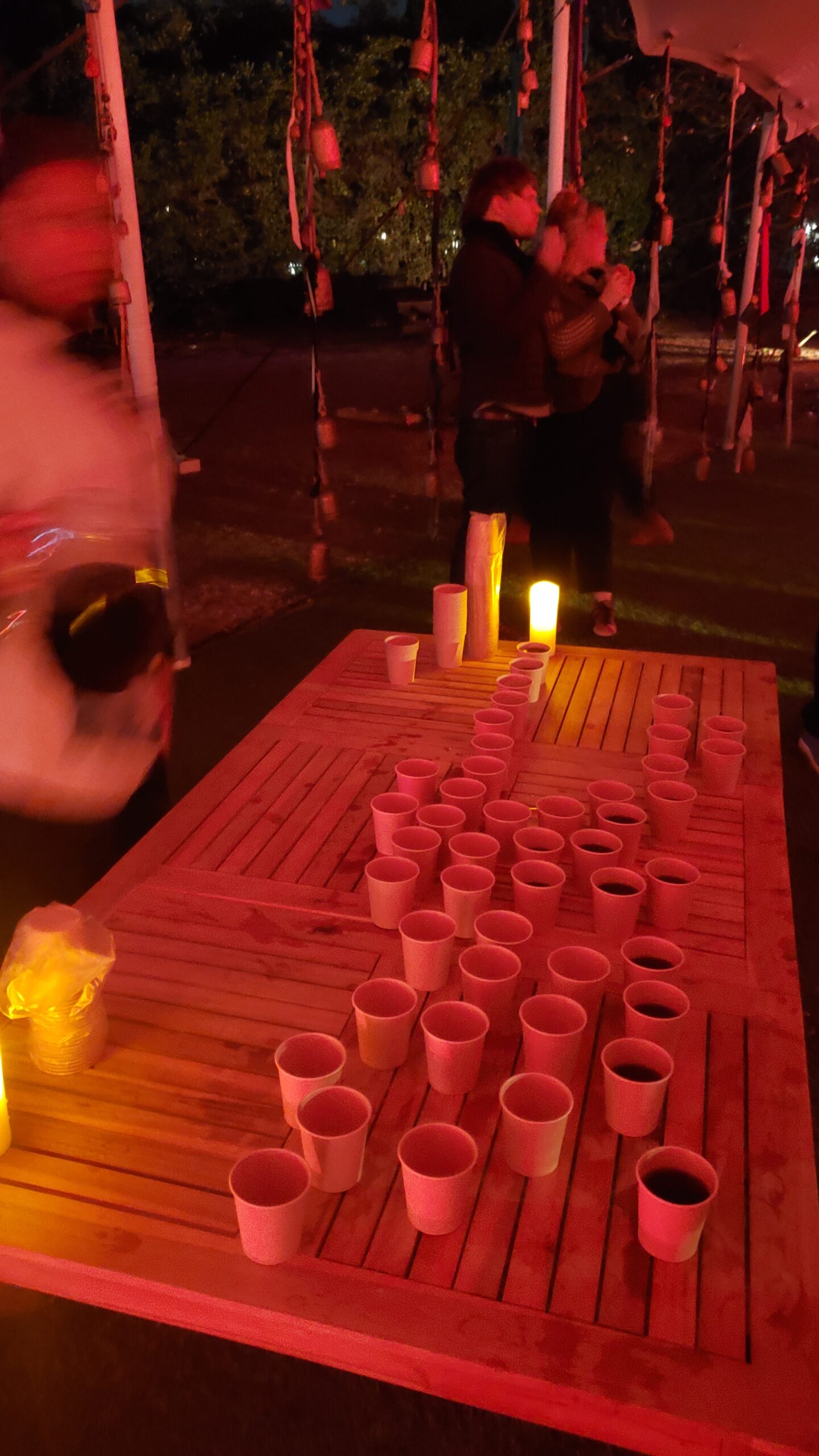
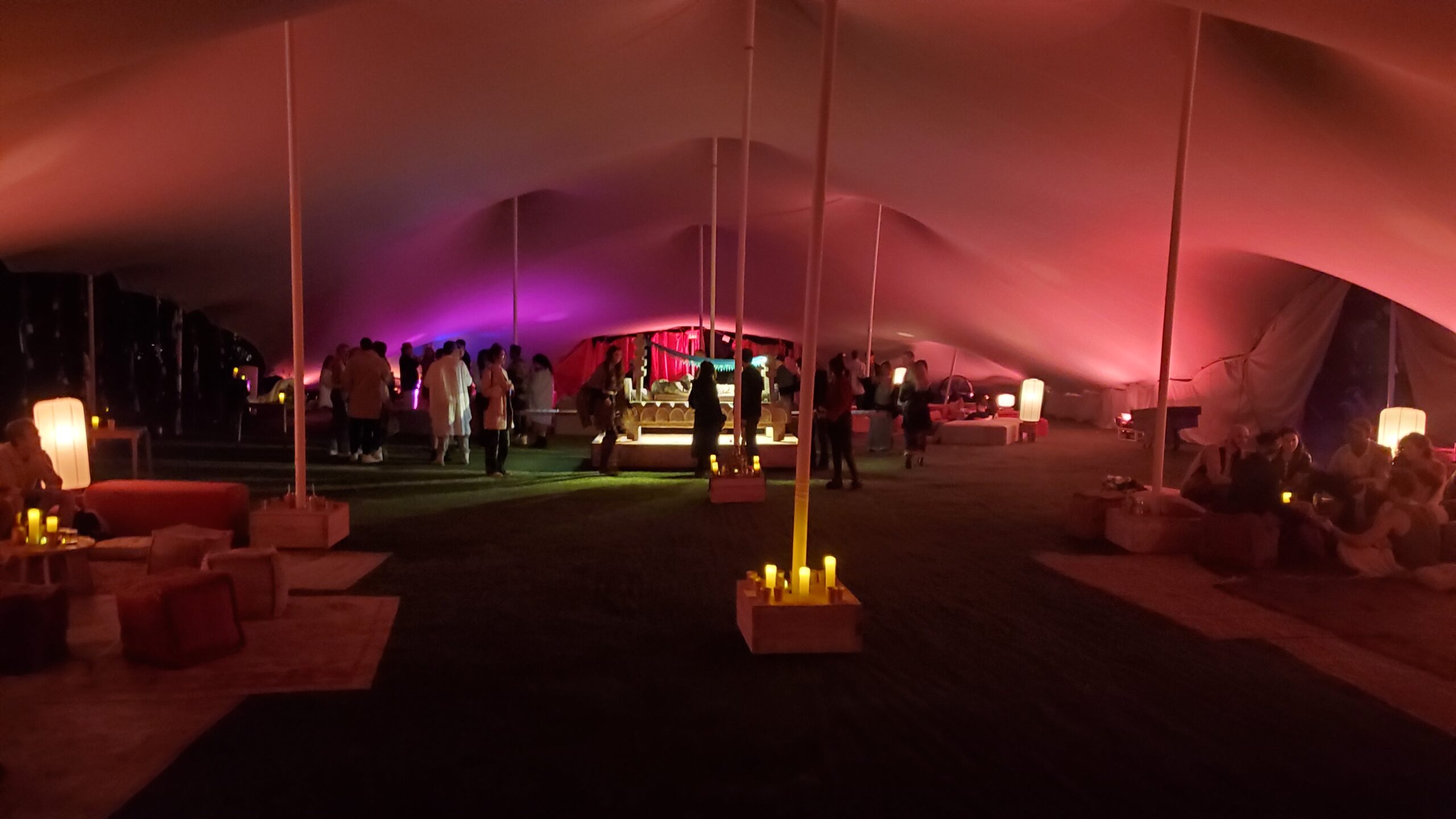
When all is said and done–only when YOU are ready, you’re not rushed–you move on to the afterlife tent yourself. The tent has calming tea offered on a table in the entryway.
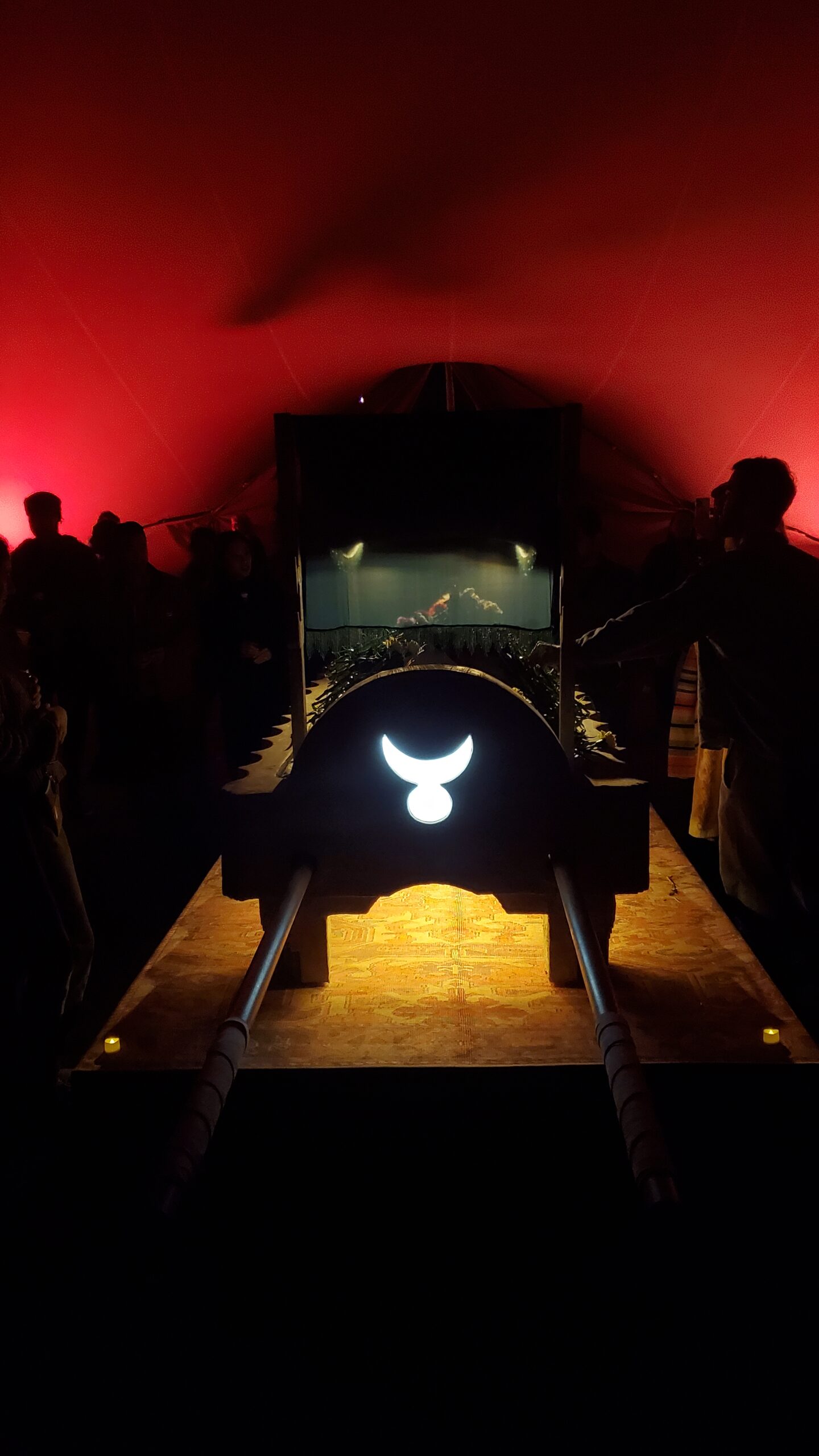
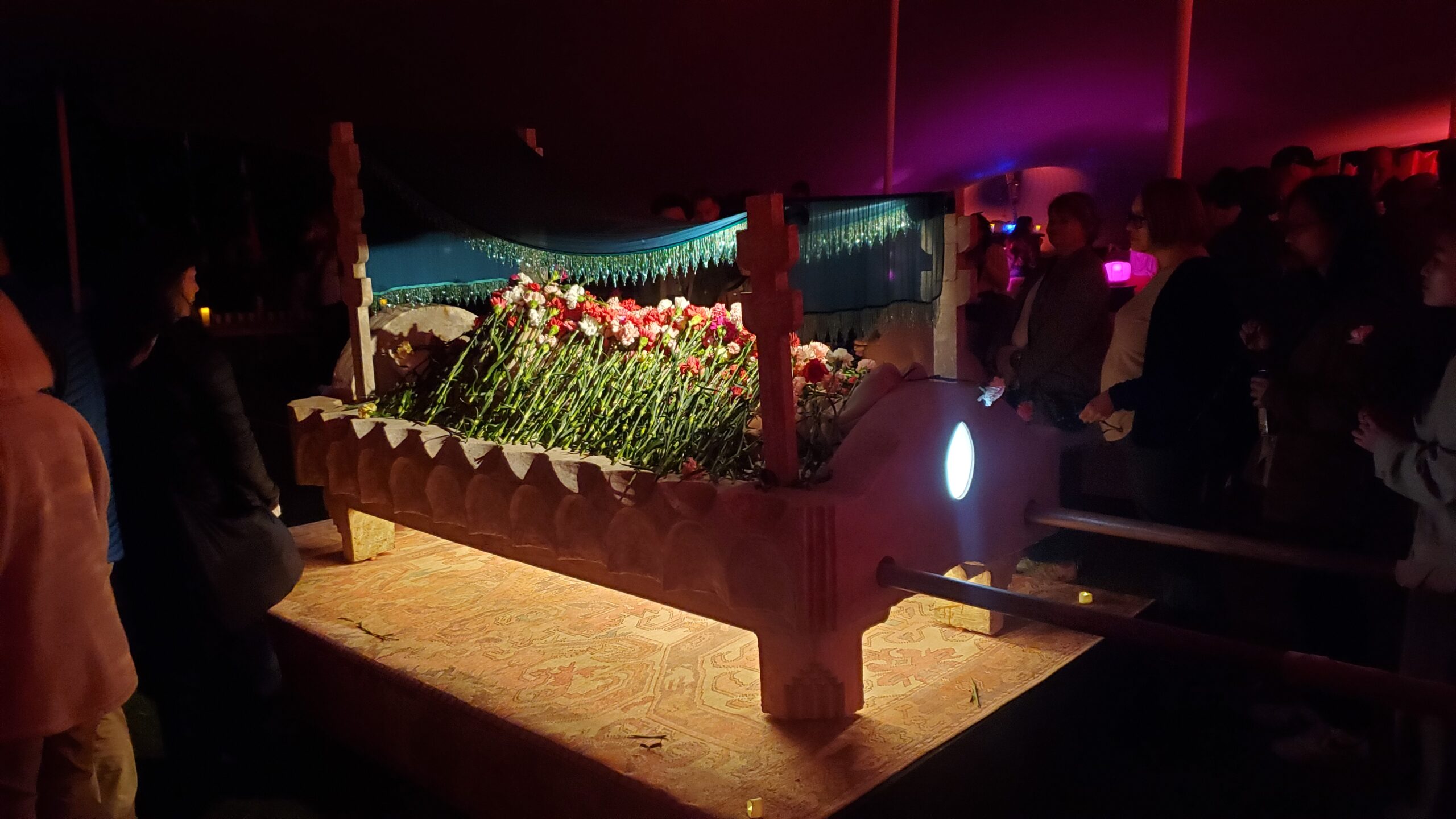
You are also given a rose, and directed to Em’s casket, where you can lay your rose along with all the others over his body and pay your final respects.
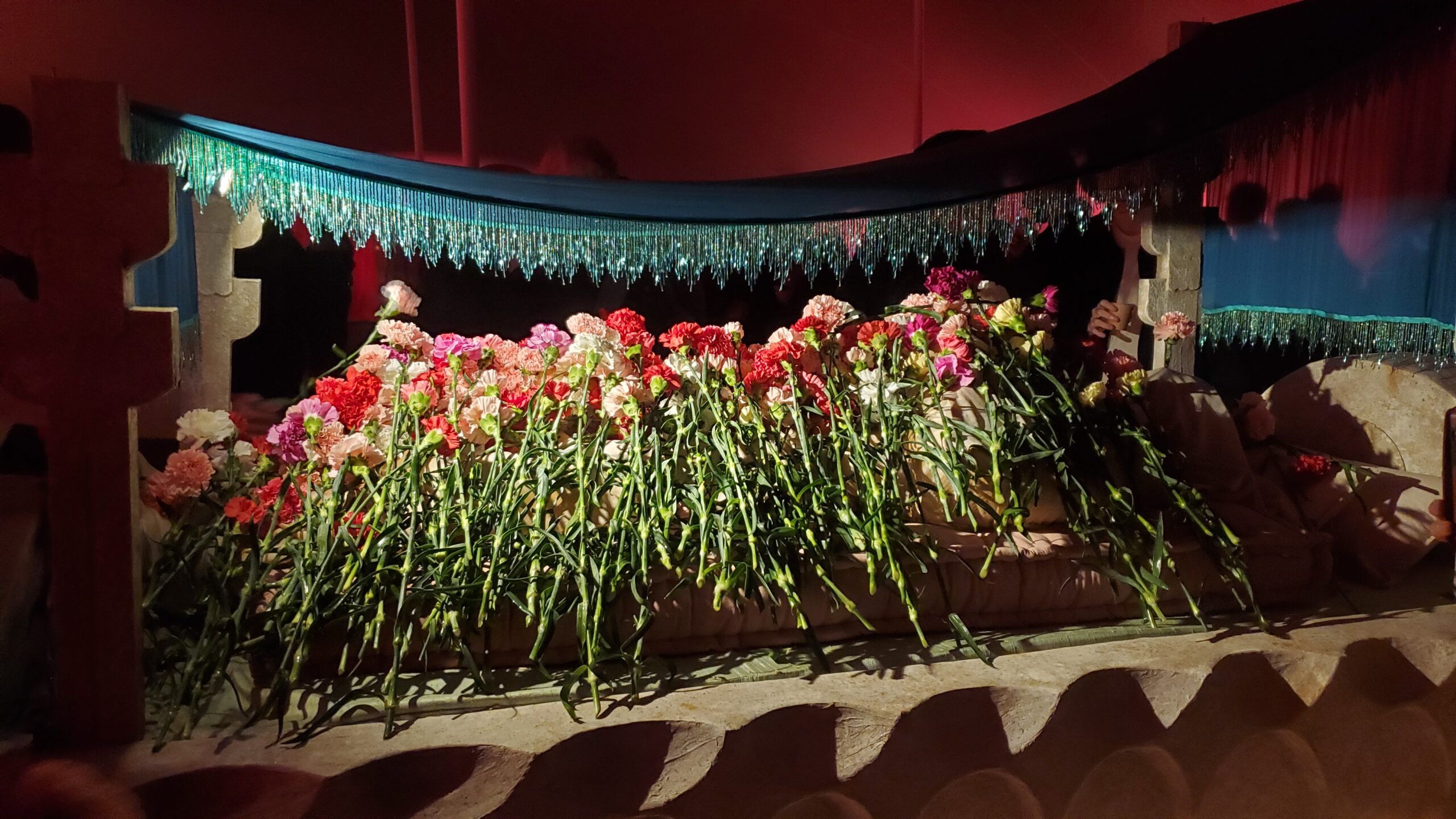
The communal tea ceremony afterwards lasts as long as you want it to as well. You can leave right away, or you can hang around, talk with your friends, and meet new people who have just gone on a similar journey as you have. The tent feels much larger on the inside.
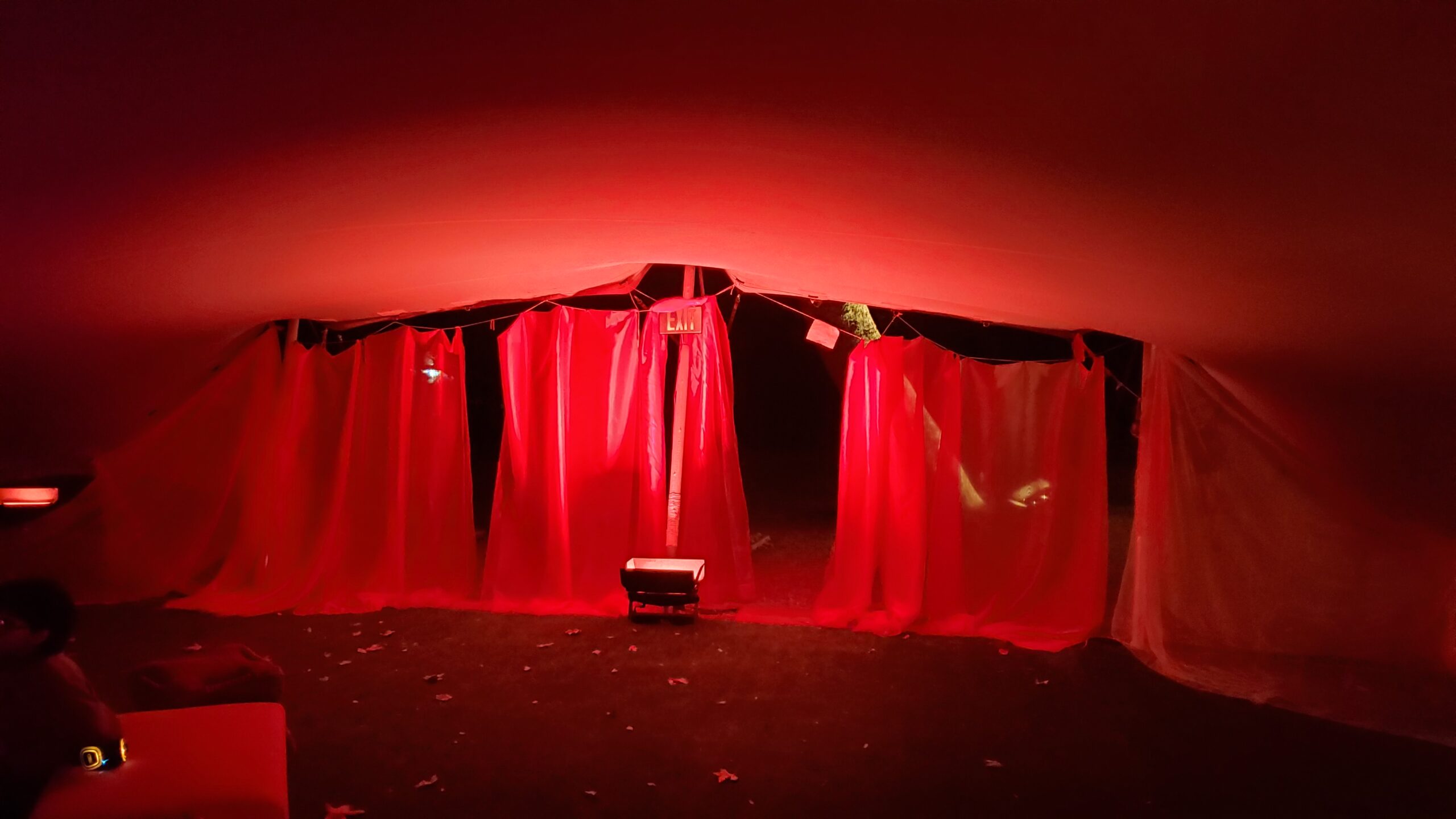
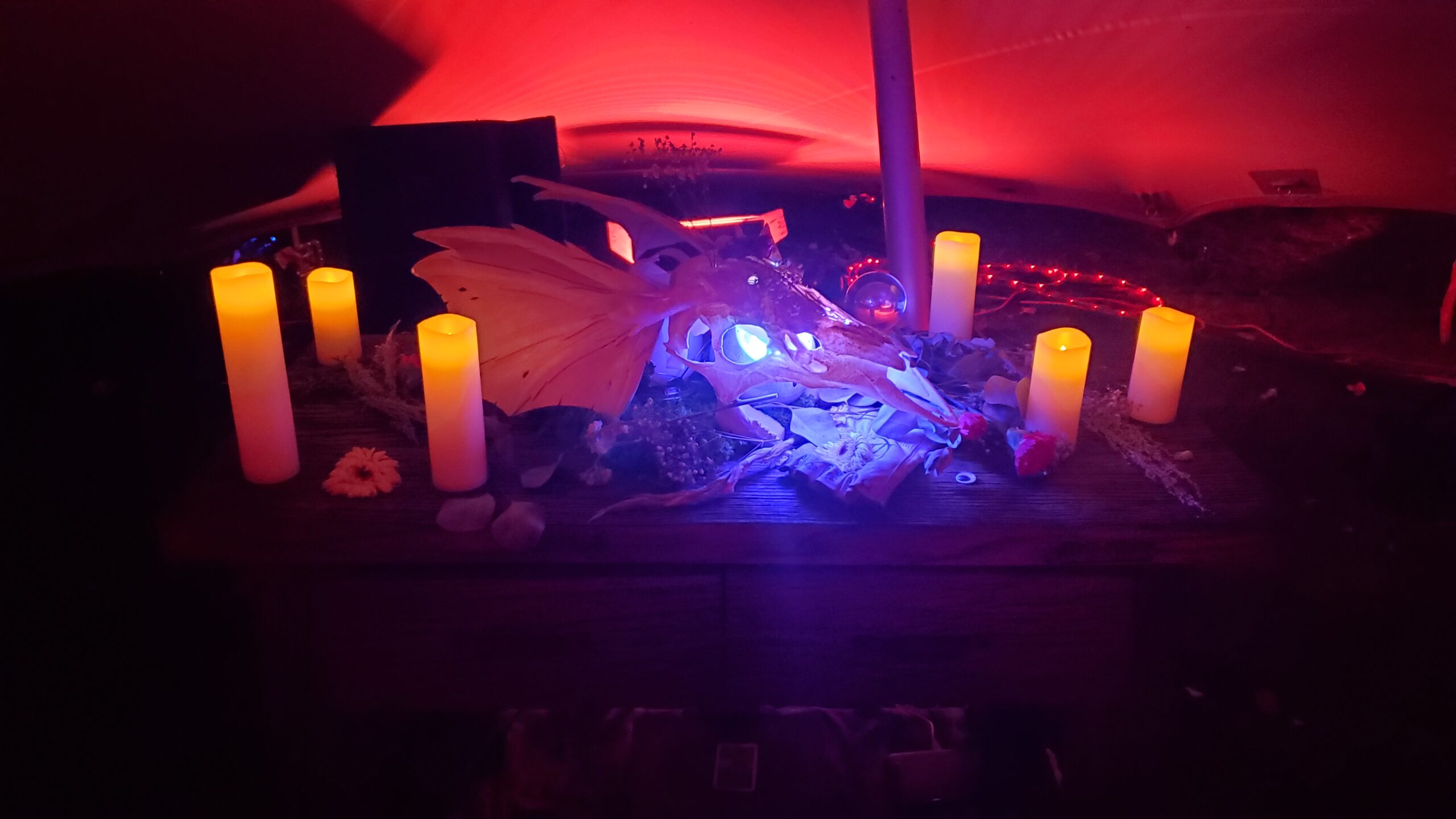
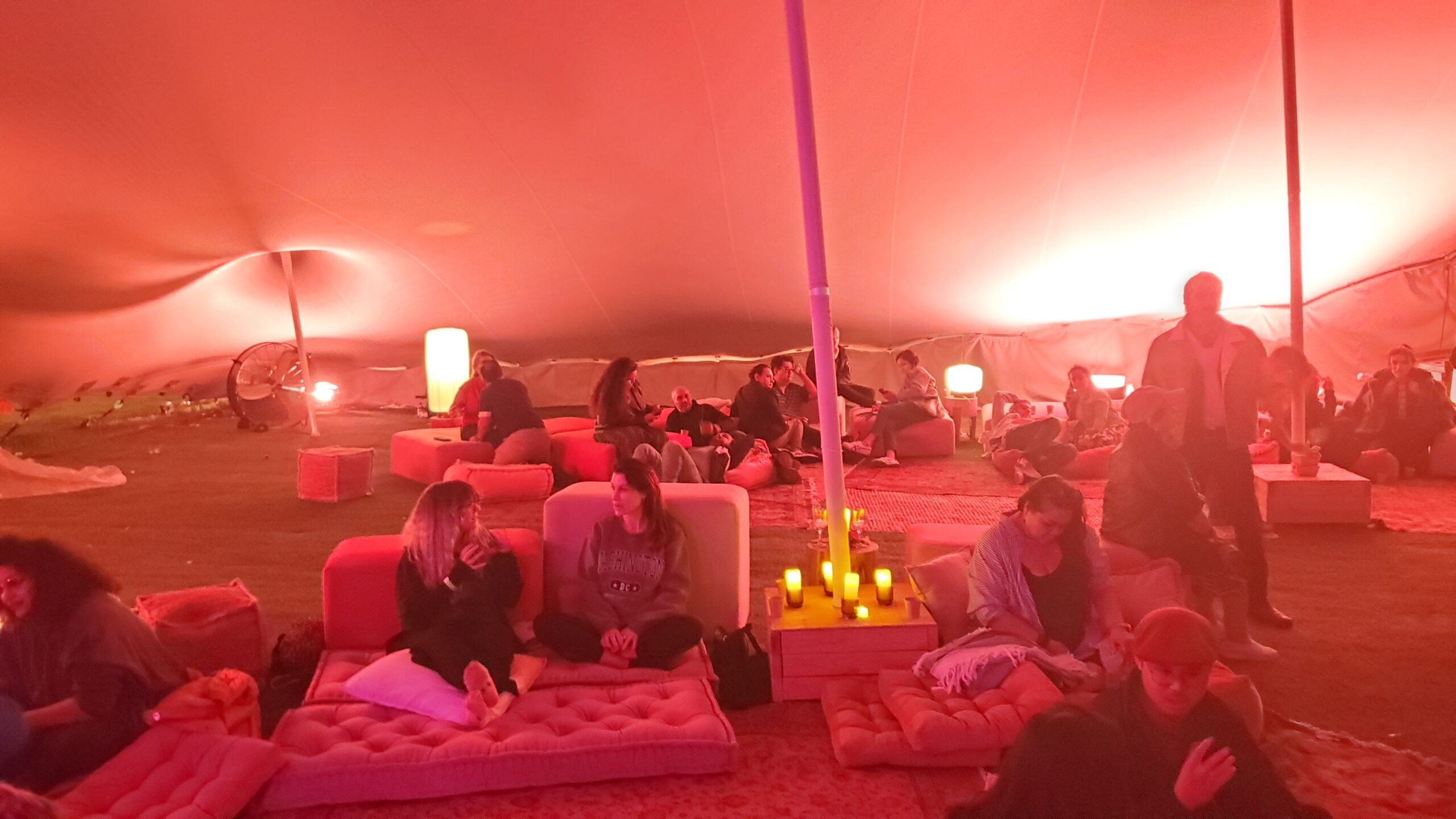
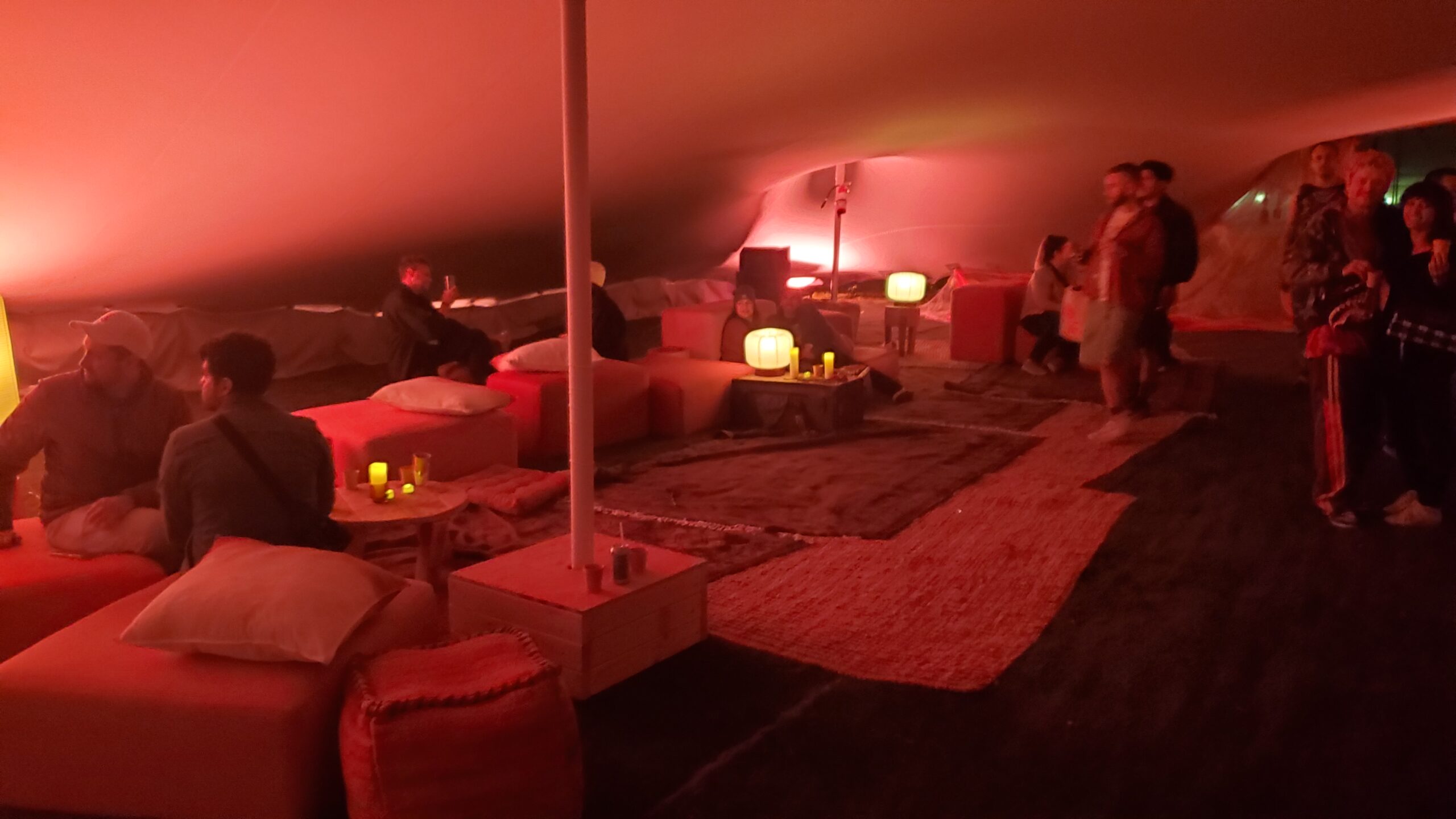
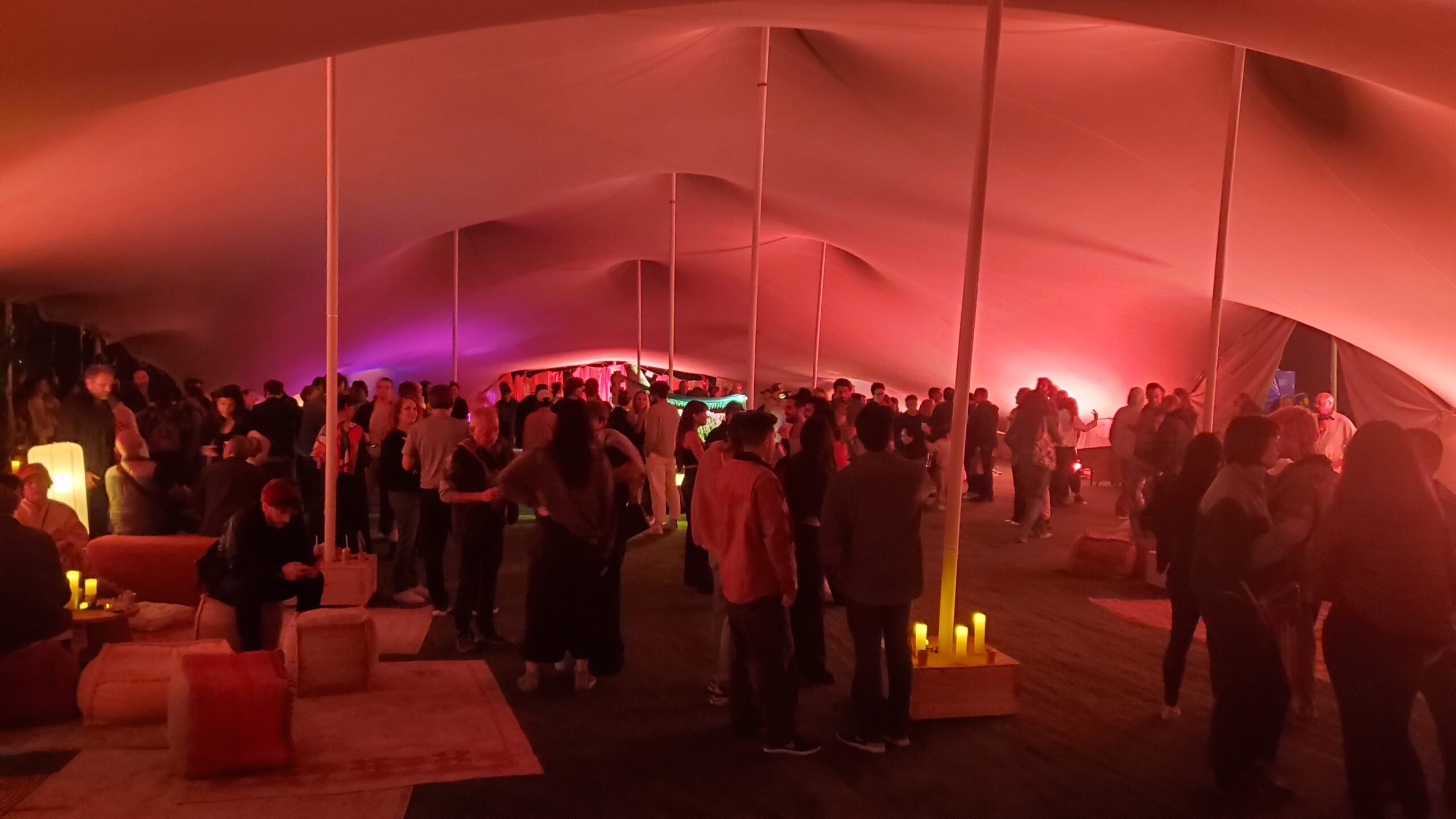
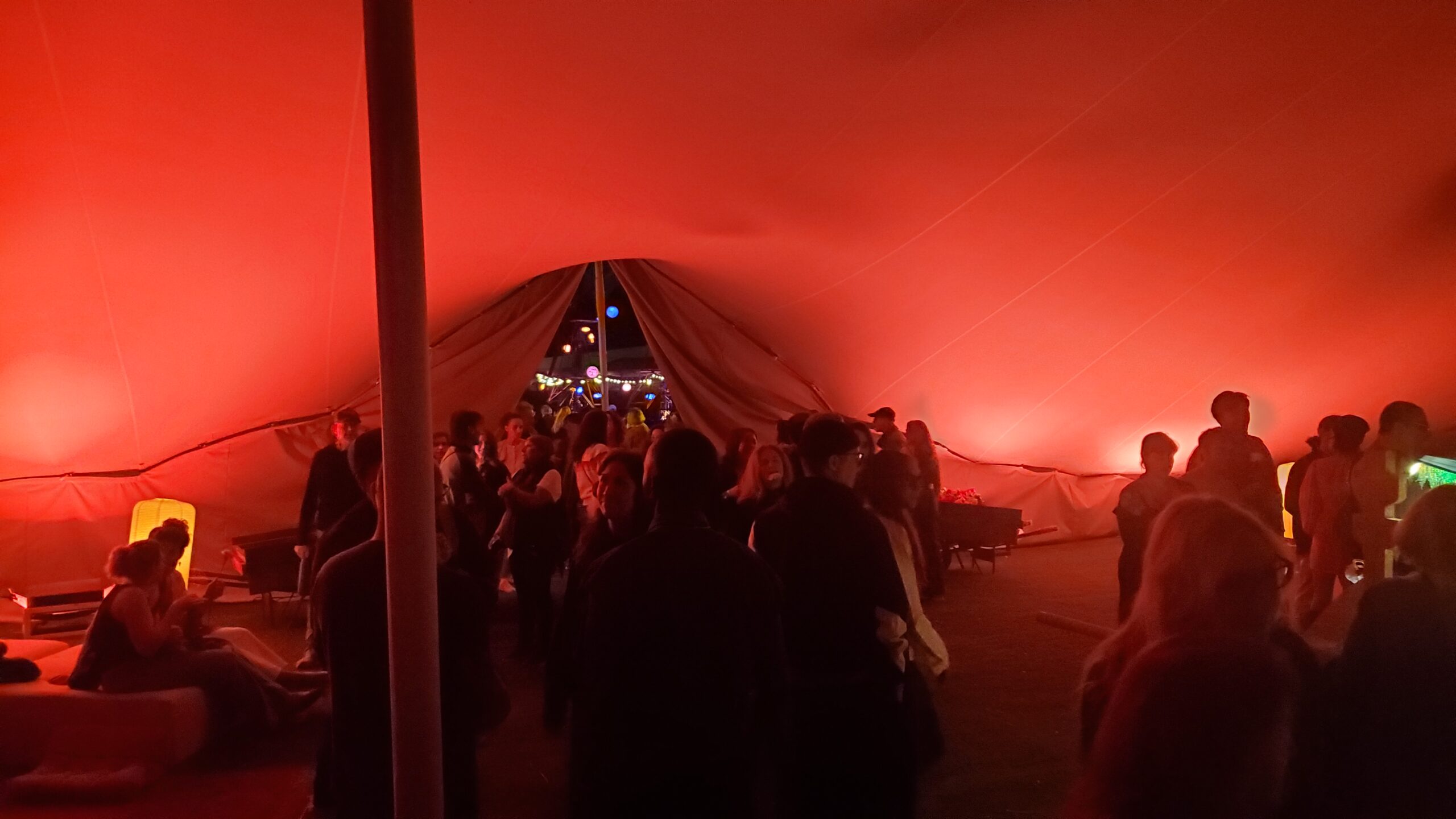
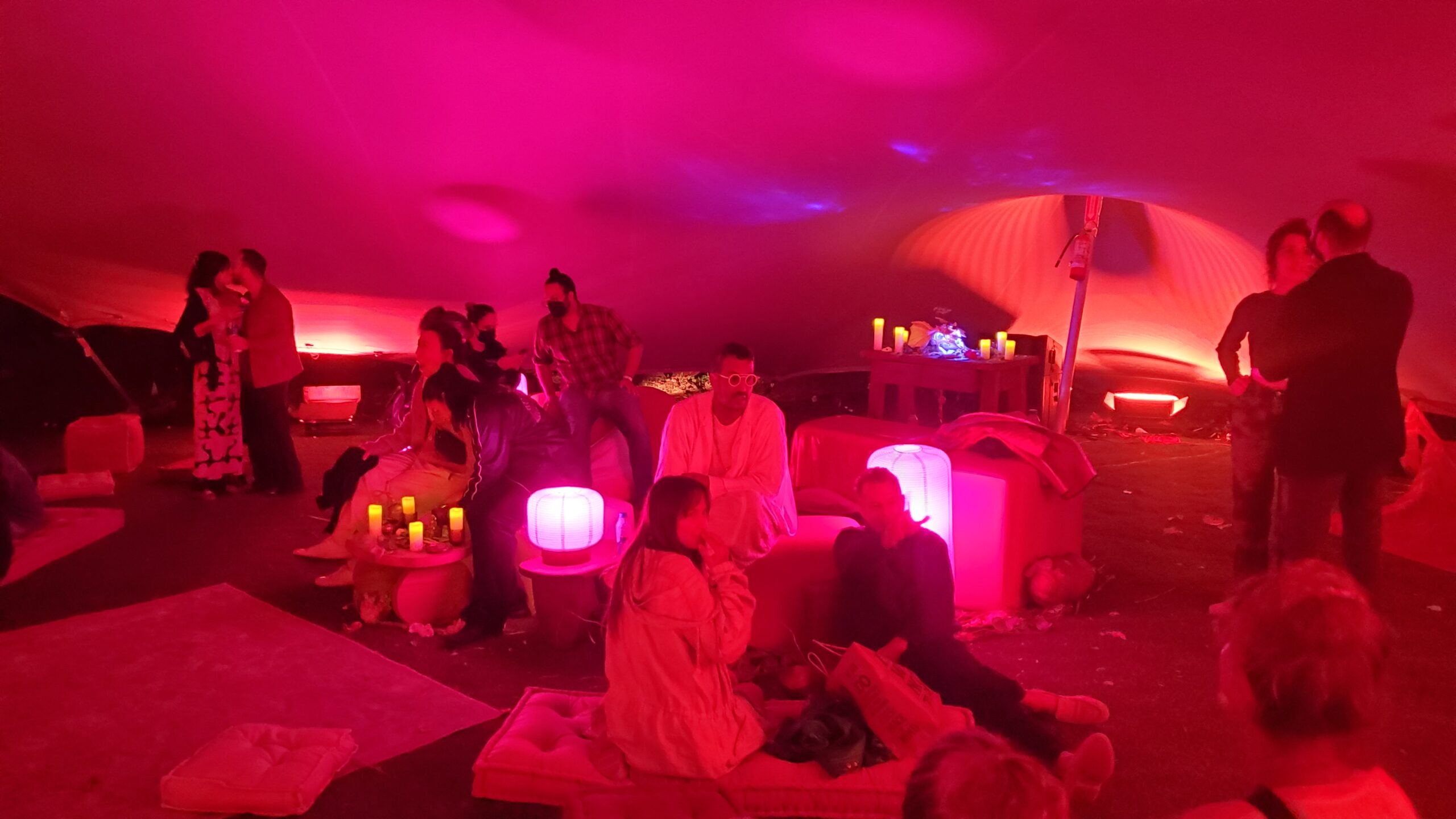
And as the night goes on, the tent slowly clears out, and you go home.
Perhaps with lingering thoughts following you along the way.
My Thoughts
I’ve never been to any event like The Cortège, and I doubt I’ll ever have the pleasure of attending another in the future. Though if The Cortège was ever put on again, I would go in a heartbeat, probably multiple times.
The organizers drew from a wide array of different mythologies, as well as the worlds of psychology, art, music, and dance, to create something that truly feels new. I mean, it still has to feel recognizable in some ways, to ensure that you can relate and connect to it. But it’s like being exposed to a mythology that you just never knew existed before, and being invited to one of their sacred events without being given the manual first.
The show feels old and new all at once, with many of the costumes suggesting archaic archetypes, contrasted with the inescapably futuristic drones and robots. I do wish the robot dogs were incorporated better, perhaps costumed somehow. It slightly broke my immersion seeing them without any fancy adornments or decorations, when everything else in the show was so elaborately enhanced.
This was a mythic pageant, playful at times but serious when it mattered. It led to honest confrontation of internal grief, even making the mourning communal, and reorienting it into a celebration only after giving it the necessary processing time. And in the end, when you yourself were invited into the tent symbolic of the afterlife, it gave you a chance to re-emerge and find safe emotional passage beyond the veil.
It was as alien of a performance as I’d ever seen, and yet as innately human of a performance too.
Full Cast & Context
There’s a full cast and credit list online, but I’m not always sure what name or role corresponded to which part in the performance. So I will reproduce the credit list in entirety.
First, the cast:
- MiYU: Lead Choreographer, Her
- Jaden “Cap Jay” Mosby: Everyman (Em)
- Simon Nikan: Movement Troupe
- Edye Kelly: Movement Troupe
- Tyler Singletary: Movement Troupe
- Cristian Barreto: Movement Troupe
- Jacqueline Barone: Movement Troupe
- Jesse Smith: Movement Troupe
- Lily Frias: Movement Swing
- Vasco “VJ” Vea: Movement Swing
- Sean Dixon: Ensemble, The Immeasurabes
- Randal Fisher: Ensemble, The Immeasurabes
- Chris Johnson: Ensemble, The Immeasurabes
- Peter Jacobsen: Ensemble, The Immeasurabes
- Brandon Samuels: Ensemble, The Immeasurabes
- Alma Margado: Swing, The Immeasurabes
- Chuck Lines: Swing
- Stephen Sullivan: Swing
- Chris Schultz: Swing
- Emily Hinkler: Swing
- Elizabeth Hinkler: Swing
The crew:
- Sam Koshfam: Technical Systems Manager
- Daniellow Ribiat: Assistant Technical Systems Manager
- Kevin Huang: Lighting / SFX Designer
- Leanna Lincoln: SFX / LFX
- Gaura “Gopal” Gilbakian: Head Carpenter
- Viktor Brown: Stage Hand & Vibes Lead
- Caroline Sebastian: Wardrobe Supervisor & Props Master
- Aimee Finley: Asstistant Wardrobe Supervisor
- Poppy Crawford: Wardrobe, Dresser
- Sean Powell: Wardrobe, Dresser
- Starlette Cravens: Props & Assistant Stage Manager
- Bobby Gibson: Props & Assistant Stage Manager
Costumes, Puppets, & Props:
- Jonny Cota: Ensemble & Collective, Merchants & Peddlers, Sentinels
- Sam Hill: Gaia
- Astor Yang: Shaman
- Jeff Hull: Shaman
- Spencer Hansen / Blamo: Leviathans
- Orly Anan: Umbra
- Lash Himes: Sovereign Ones
- Damselfrau: Sovereign Ones, Sentinels
- Handsome Little Devils: Final Boss / Joyful Death
- Jacquelyn Scott: Shaman Staff
- Fonco Studios: Citadel, Palanquin
- PBZ: The Vardo. Transmission Towers
- Unitree: Robots
Technology partners:
- Studio Hock: Drone Creative Design
- Nova Sky Stories: Drone Aviation
- Unitree: Quadruped Robots
- Sound Off Experience: Simulcast Headsets
- [namethemachine]: Score Mixing & Time Code
Visomnia:
- Jeff Hull: Creation Director, Co-founder
- Isobel Macondray: Executive Director, Co-founder
- Corey Johnson: Executive Producer
- Christina (Xtina) Chu: Creative Strategist
- Kirsten Nicholas: Marketing Lead
- Emmy Frevele: Creative Producer & Assistant Choreographer
- Brian Satz: Producer & Music Director
- Justin Zsebe: Assistant Director
- Wendy Edwards: General Manager
- Carlos De La Torre: Production & Stage Manager
- Donald Weston: Show Caller
- Eric Stevens: Guest Experience Producer
- Kourtney Iman King: Marketing Coordinator
- Annie Phung: Community Outreach
- Mimi Chang: Publicist
- Rajasri Narasimhan: Publicist
- Chelsea Welsh: House Liaison
- Robert Mann: Front of House Manager
- Cedar Miles: Assistant Front of House Manager
- Adriana Bartolomei: Business Operations & Admin
- Angie Han: Business Operations & Admin
Brilliant Work:
- Elliott Dunwody: President & Executive Producer
- John “JT” Vitale: Senior Producer
- Tom Sepe: Technical Director
- Alex Standi: Line Producer
- Matty Dowlen: Chief Executive Officer
- David Shulman: Chief Financial Officer
- Scott Nuñez-Peterman: Chief Creative Officer & Executive Creative Director
The score:
- TOKiMONSTA: Advent (The Cortège Original)
- Air: Alone in Kyoto
- Chancha via Circuito: El Mago Georges
- Freedom Fighters: Aura
- Andrew Bird: Rare Birds
- Alef: Sol
- El Búho: Silk Road (The Cortège Original)
- Boreta: Citadel (The Cortège Original), Samsara (The Cortège Original)
- Jaia: L’Ivresse Des Profondeurs
- Kiasmos: Thrown
- Rival Consoles: Haunt
- Turbine: Hiatus
- Beautiful Chorus: Faith’s Hymn
- Artifical Algorithm: Slow Meadow
- Tunnelvisions: Guava
- The Immeasurables: Prelude (Live), Passage (Live)
Their listed partners are BAILLAT STUDIO, Black Magic Factory, Blood Company, Energy Club, Fever, the Los Angeles Equestrian Center, Nattografi, and Solarpunks.
Finally, in its own credits-style acknowledgments, The Cortège cites a wide constellation of spiritual, ritual, artistic, and subcultural influences shaping its vision. I wouldn’t normally reproduce all of these here, but for this event in particular, I find them very interesting.
The long list of inspirations points to Jungian psychology–especially archetypes and the collective unconscious–as a psychological backbone, alongside the miracle and morality plays of medieval Europe, particularly Everyman. The credits name ceremonial costume and movement traditions such as Kukeri, Zaouli, and Mardi Gras processions as visual and kinetic inspiration, and reference guided psychedelic and entheogenic practices as part of the ritual framework. It situates itself in dialogue with pre-Christian pagan rites–Norse blóts, Druidic oak ceremonies, Anglo-Saxon symbolism–and a global spectrum of memento mori and death rituals, from Tibetan sky burial and Día de los Muertos to Torajan funerals, New Orleans jazz processions, ancient Egyptian funerary customs, and Roman Parentalia.
The credits also note technological art spectacle in the spirit of Survival Research Labs and the Cacophony Society, the intensity of hip hop, house, and battle dance, contemporary expressions of mythic and mystical thought through figures and podcasts like Michael Meade, The Sacred Speaks, This Jungian Life, and Wisdom of the Masters, and avant-garde performance and language works such as Nick Cave’s Soundsuits, the cosmology of RAMM:ELL:ZEE, and Babel(words) by Sidi Larbi Cherkaoui and Damien Jalet–altogether framing the project as a procession through psychology, ritual, death, spectacle, and ecstatic movement across cultures and eras.
The Los Angeles Equestrian Center sits along the LA River in Burbank and has been a hub for horse shows and training since the early 1980s. It is one of the main public equestrian facilities in Southern California, with arenas, boarding, and space for competitions.
Brilliant Work is a Los Angeles based creative studio that works in branding, film, and design. It tends to collaborate with artists and cultural institutions, producing campaigns and visual work that feel polished but not overly corporate.
Visomnia is an LA music project that blends electronic textures with dreamy pop structure. The sound leans atmospheric, layered, and a little nocturnal.
MiYU is a Japanese singer and songwriter who has built a following online with acoustic performances and original songs in both Japanese and English. She first gained attention through YouTube covers and then shifted into her own material. Her style is soft, intimate, and very much internet era singer songwriter energy.
Jaden Mosby, who performs as Cap Jay, is an American rapper and songwriter. His work moves between melodic hooks and straightforward hip hop delivery. He has been building his name through independent releases and online platforms rather than through major labels.
Funeral corteges are the formal processions that accompany the dead to burial. The word comes from French, which itself came from the Italian corteggio, meaning a train or procession. In Europe they often included clergy, family, hired mourners, and sometimes musicians. In the 19th century black carriages and horses became standard in cities. Today the tradition survives in motorcade form, sometimes with police escorts and hearse in the lead. It is part ritual, part public signal that someone’s life is being marked on its final journey.