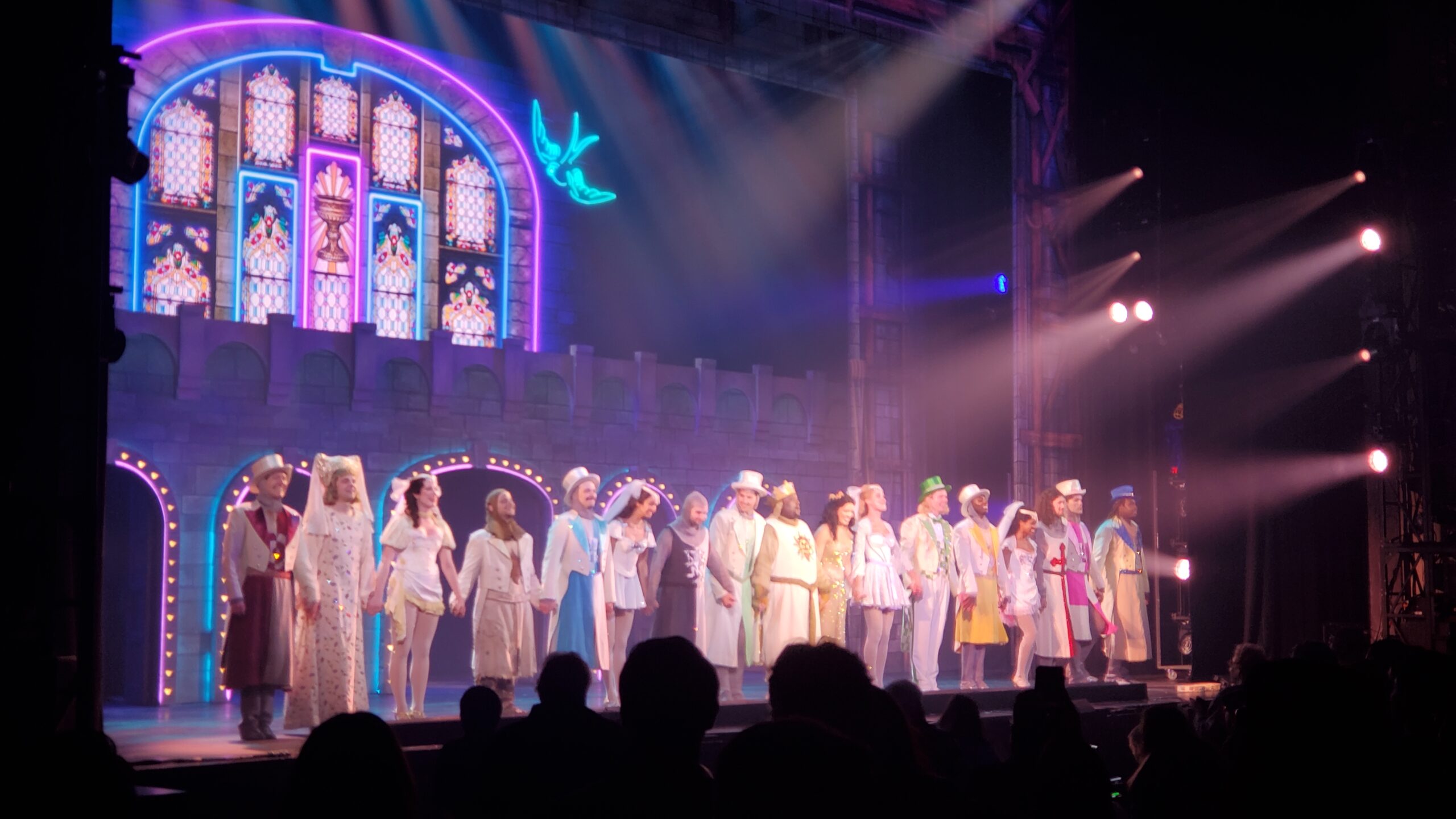
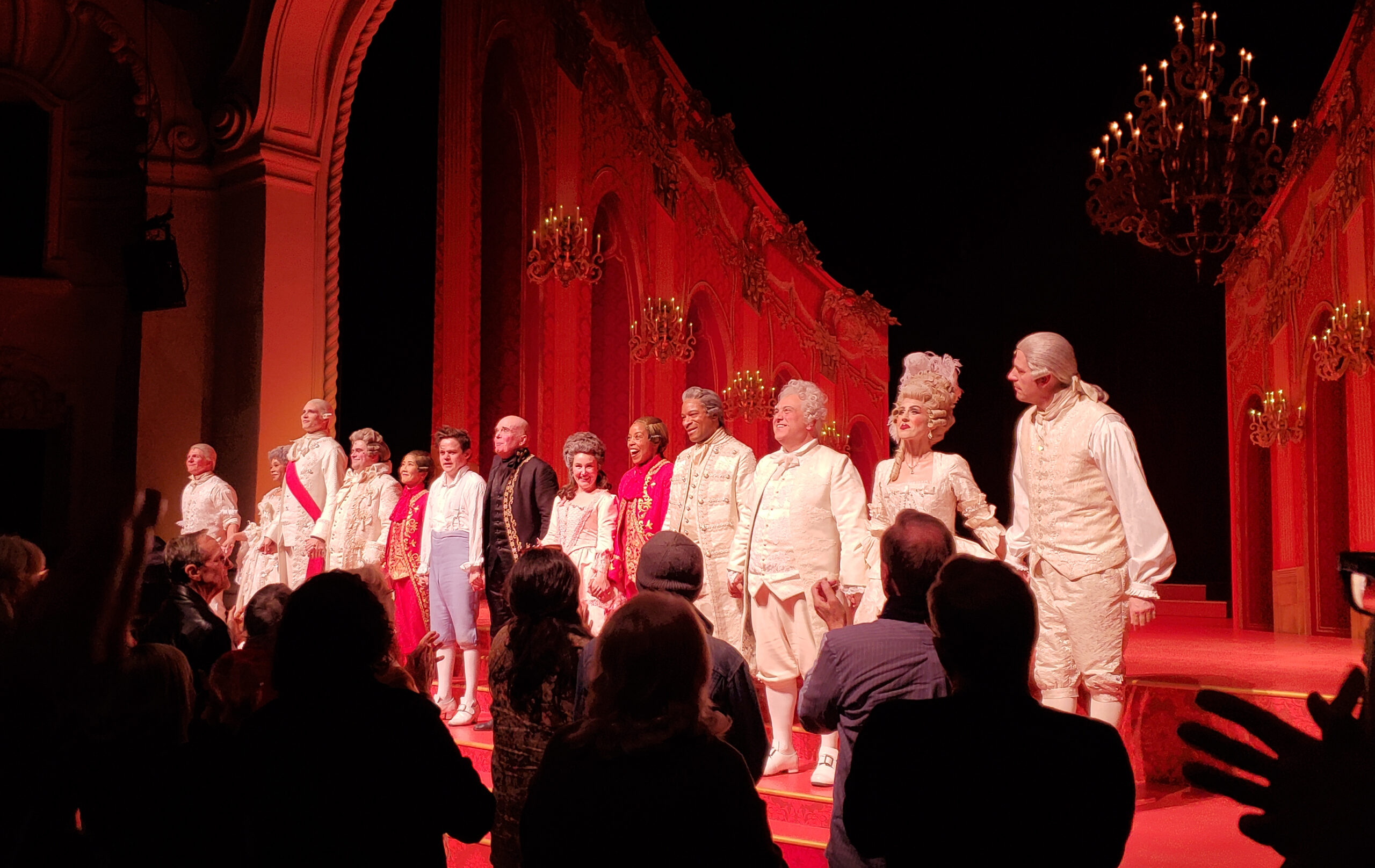
On 3/5/2026 I went to the Pasadena Playhouse to see Amadeus, Peter Shaffer’s play about Antonio Salieri and Wolfgang Amadeus Mozart, directed here by Darko Tresnjak. What a gorgeous production this was.
There was a remarkable amount of work put into just about everything I could see onstage, and at the center of it all was one hell of a performance by Jefferson Mays as Salieri.
The Play
Mays starts out as an elderly Salieri, bald and decrepit and barely able to get his words out. As he gets into his story, though, he starts to show a bit more life, and you can hear some of that old venom coming back into his voice. When we go back in time for the bulk of the play, people come out and dress him in his court clothes right there onstage. The transformation was incredible. Yes, the costume and the wig do some of the work here, but the change in the way Mays carries himself and speaks is so convincing. You could easily believe you’d just been watching a much older actor.
I loved the way he delivered some of Salieri’s lines with such acid in his voice. One of the things I find so interesting about Salieri in the writing of this play is that he’s sufficiently good at music to understand just how good Mozart is. Imagine having to listen to some of the most beautiful music you’ve ever heard and finding it personally offensive that it exists. And then imagine meeting the guy who wrote it! (Now imagine it was written by an octopus… wait, wrong play.) Mays was wonderful to watch as he recounted all of this, with all the bitterness that apparently hadn’t subsided much in the intervening years.
Sam Clemmett was great as Mozart. He had a tremendous amount of energy and was wildly inappropriate and childish, and I can see how one might find him a bit grating. I mean, that’s pretty much how Salieri feels about him too, isn’t it? Clemmett made it easy to understand just how maddening it would be for Salieri to have to deal with this guy, especially when it’s so clear from the music what Mozart is capable of.
I enjoyed Matthew Patrick Davis as Emperor Joseph II too, and really I thought this was a very good cast all around. It was nice having actual singers in the cast (Michelle Allie Drever and Alaysha Fox), as well as Brent Schindele on the keys. I’ve had plenty of opportunities to hear Mozart’s music performed live, and it was fun to hear some of it in the context of this story (even if it’s fictional). But boy, I could’ve listened to Mays talk for hours.
The Production Design
Even before the play got underway, there was a beautiful “scrim” onstage covered with musical notation, with some great red lighting behind it. Those are actually the notes to Mozart’s Phantasie für eine Orgelwalze (Fantasy for a Mechanical Organ), which took three scenic artists eight days to paint. I got some photos of it. It’s worth getting to your seat a little early just to admire it.
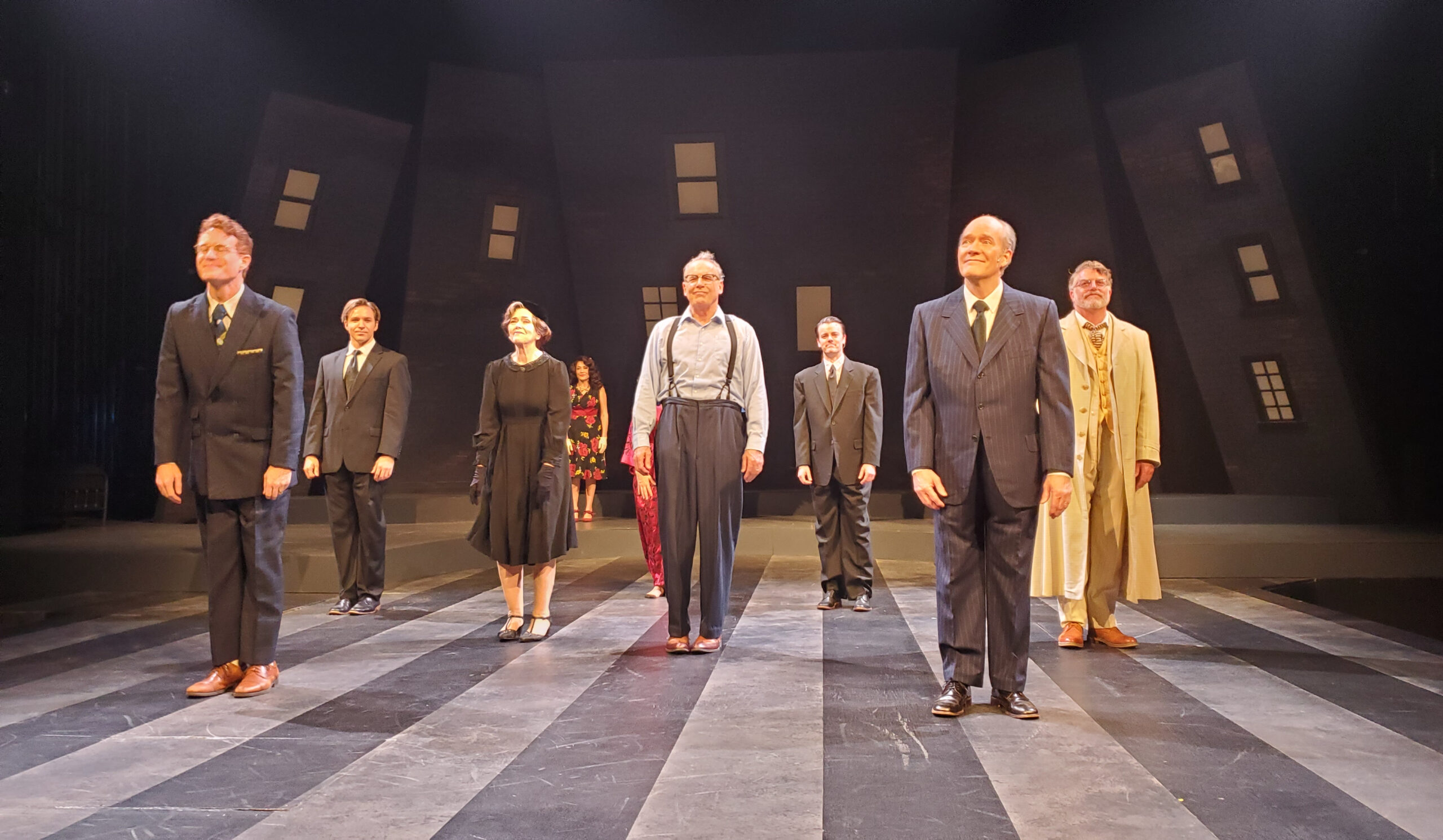
When we got to see Alexander Dodge’s set in its entirety, WOW. I loved the forced perspective, the succession of architectural details getting smaller and smaller towards the back of the stage, making this gorgeous red and gold royal interior look so much deeper than it was. There was also an upper level towards the back of the stage that was put to good use, and I enjoyed seeing some of the set pieces move around. Even the moving throne was operated with hand winches. There’s a behind-the-scenes feature on the construction of the show with some interesting details on how they did all this.
The costumes by Linda Cho were spectacular, too. They were made by LA Opera’s costume shop, and you could certainly see the work that went into them, even sitting several rows back. Between the clothes, the makeup and all those beautifully done wigs (Will Vicari), I felt like I was watching a particularly well-made period film. The lighting by Pablo Santiago, whose work I’d also enjoyed in Hildegard, was excellent.
I think all that extravagance served the play very well. We’re seeing this court largely as Salieri remembers it, and I rather liked that there was something so excessive about its beauty. This was the world he was so desperate to be successful in, and the music he loved so much was coming from the one person he couldn’t stand.
The Pasadena Playhouse
I had a nice trip out to Pasadena on the A Line, which even had an announcement telling me to get off for the Pasadena Playhouse. Well, okay then! I wish we had more of those for specific cultural institutions on the Metro.
I loved the Spanish architecture of the Playhouse and its courtyard, and got to wander around upstairs and through the library area. There was also a nice little preshow program called Micro Mozart, in conjunction with the Pasadena Conservatory of Music. There were a few very talented kids playing piano and accordion in the Playhouse Bar. I thought this was a lovely thing for the Playhouse to do, giving these kids a chance to play for an audience that’s come out to hear a story about Mozart.
There was a good selection of drinks and snacks, and they had the whole concessions line organized very well. The theater itself is beautiful, and I was a few rows back towards the right side of the orchestra with a great view. I think those seats towards the front on the sides are often a sweet spot in terms of price and proximity to the stage.
Full Cast & Context
The cast included:
- Sam Clemmett: Mozart
- Jefferson Mays: Salieri
- Kenajaun Bentley: Van Swieten
- Jared Andrew Bybee: Valet / Major-Domo
- Jennifer Chang: Venticelli
- Matthew Patrick Davis: Joseph II
- Michelle Allie Drever: Katherina Cavalieri / Soprano
- Alaysha Fox: Teresa Salieri / Soprano
- Matthew Henerson: Count Johann Kilian Von Strack
- John Lavelle: Orsini-Rosenberg
- Brent Schindele: Cook / Kappellmeister / Harpsichordist
- Hilary Ward: Venticelli
- Lauren Worsham: Constanze
The production team included:
- Peter Shaffer: Playwright
- Darko Tresnjak: Director
- Alexander Dodge: Scenic Designer
- Linda Cho: Costume Designer
- Will Vicari: Hair / Wig / Makeup Designer
- Pablo Santiago: Lighting Designer
- Jane Shaw: Sound Designer
- Aaron Rhyne: Projection Designer
- Sasha Nicolle Smith: Intimacy Consultant
- Ryan Bernard-Tymensky: Casting
Shaffer’s Amadeus premiered at the National Theatre in London in 1979. Shaffer also wrote the screenplay for Miloš Forman’s 1984 film adaptation. The idea of a murderous rivalry between the two composers predates both of those by quite some time: Alexander Pushkin wrote his short play Mozart and Salieri in 1830, which in turn became an opera by Rimsky-Korsakov. The historical evidence for the sort of relationship we see in Amadeus is rather thin.
The Pasadena Playhouse was founded in 1917 by Gilmor Brown. Its current home, designed by Elmer Grey in the Spanish Colonial Revival style, opened in 1925. The company was named the official state theater of California in 1937, having staged the whole Shakespeare canon. It also won the Regional Theatre Tony Award in 2023, and in 2025 the company regained ownership of its historic building, just in time for the building’s centennial.