I went to see William Shakespeare’s Coriolanus by The Porters of Hellsgate on the last day of its run (11/23/2025). This was at a little theater in North Hollywood that was so new to me that I wasn’t even entirely sure what theater I was going to.
The LACAE Mainstage
I had the address, 11031 Camarillo Street, and that was about all I had to go on. There was a little sign out on the sidewalk with a printout of the poster for the play. You go around behind St. Matthew’s Church to get to the theater, and for a while I was under the impression that I was seeing a play at the church itself. It didn’t seem to have much of an identity as a venue yet. (Looking at my photos, the letters LACAE were painted right there in the lobby, but I guess I assumed that must’ve stood for, like, Los Angeles Church… Annex… Extrabackroom)
The lobby was quite homey, with some nice autumnal decor and a little concession stand. What I particularly loved, though, was how much material The Porters had put out about the production. There were dramaturgical notes, information about the Roman Republic, the history of the play, a glossary, and some of the propaganda posters pertaining to this particular version of Rome. There was even a little scale model of the set! I always like getting to see some of the design work behind a play, and I’d love it if more theater companies put things like this out in the lobby. It’s also a great service to anyone who might be seeing a less frequently performed Shakespeare play for the first time.
There were exactly 61 chairs in the audience, spread across six rows. I was front and center, right by the center aisle. Though with a theater of this size, you could’ve been sitting in the very back and still been pretty darn close to the action.
This was also one of the designated masked-audience performances. I’d brought a mask with me, and there were masks available up front for anyone who hadn’t. I appreciate theaters making a few performances more accessible to people who would otherwise be hesitant to attend due to health concerns or facial ugliness.
The Cast
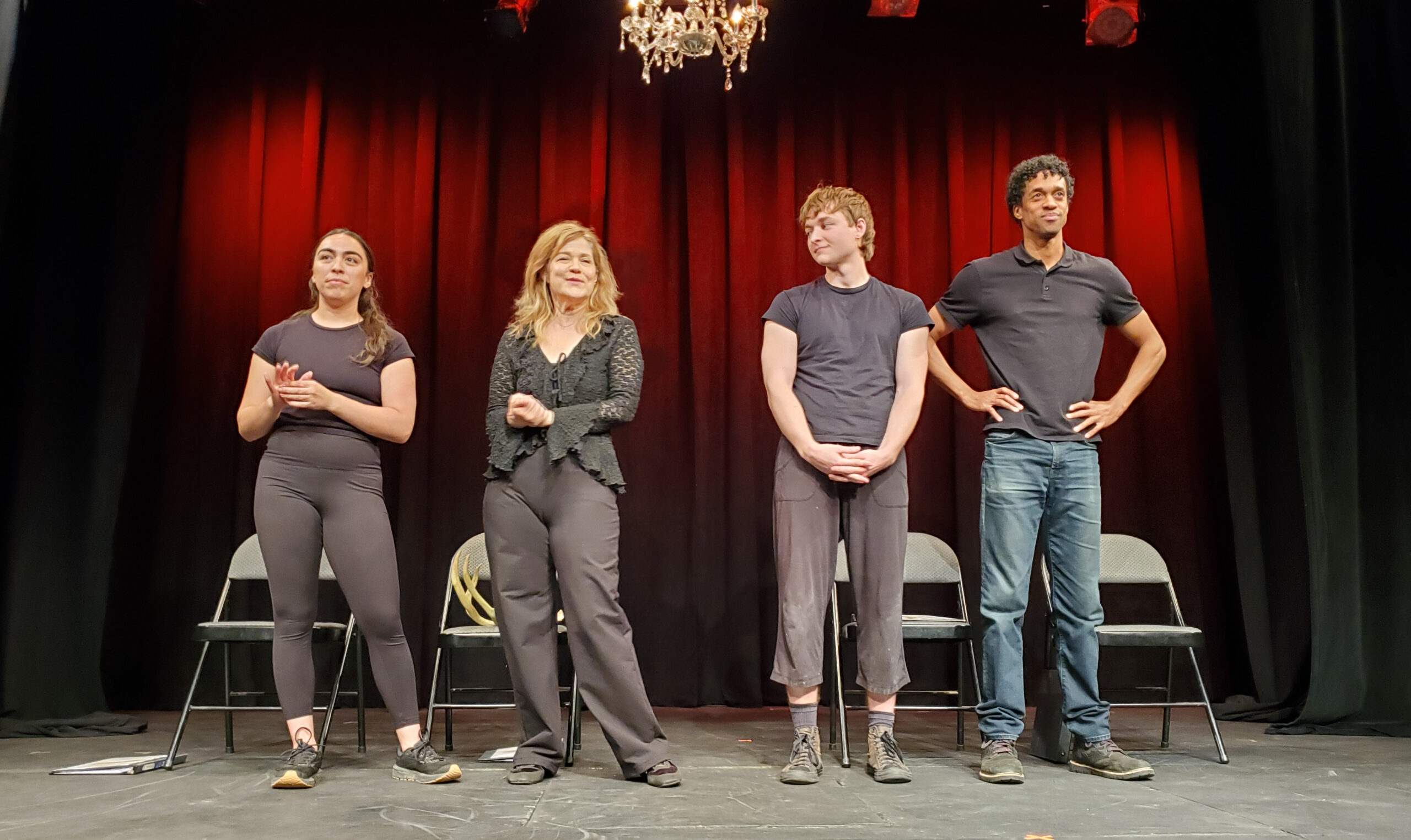
Michelle Grey was quite a force as Coriolanus. She had an impressive gravity to her performance and a wonderful command of the character’s seriousness. It’s a role that demands a considerable presence, particularly when the character has so little patience for the niceties of public life, and Grey was very convincing in it. What a professional.
Dawn Alden as Tullus Aufidius brought out a much rawer, almost primal sort of passion. I liked the intensity of the rivalry between the two characters, and I thought the combat itself was very well done. Alden was also responsible for the fight choreography for this production.
Two of my favorite actors to watch, though, were Renée Torchio MacDonald and Jono Eiland as Sicinius and Brutus, the two tribunes of the people. They were as slippery as greased eels. They were both such good smooth talkers, and I loved watching them work together. Their manner of dealing with people was so very different from Coriolanus’s, who has neither the inclination nor the temperament for that kind of political maneuvering. They brought a different flavor to a play that can be quite serious for long stretches, and in some of their scenes they just about stole the show for me. I liked this cast quite a bit overall.
The Adaptation
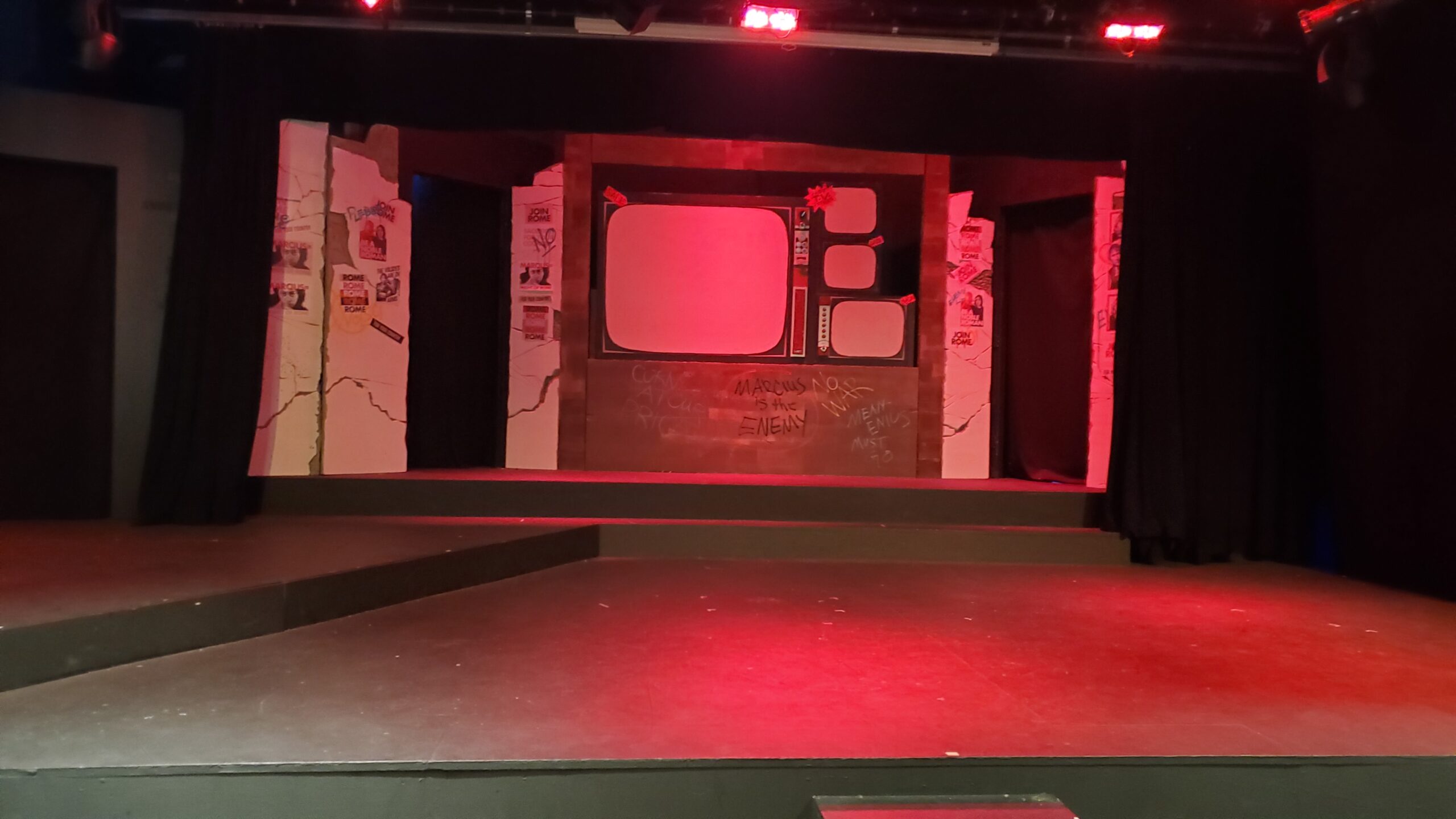
Director L. Stephanie Tait set the play in an alternate Rome with a very 1960s feel to it. Rome was still Rome, and the Romans were still concerned about the price of corn. I enjoyed the propaganda imagery and the use of projections that looked like an old television at the back of the stage. Some of the material in the lobby helped give a little more context to this version of Rome, too.
The production was relatively modest in terms of the physical set and its construction, particularly compared to some of the other Shakespeare productions I’ve seen lately. But I liked what Brian Carroll accomplished with the scenic and projection design, and the fight scenes worked well even in the confines of this little theater. Most importantly, I felt like Shakespeare’s story was front and center for the whole thing.
Several characters were also played with different genders, including Coriolanus and Aufidius. I can’t say that the change made a tremendous difference to my interpretation of the play. There are some interesting things one could explore about a woman in the position of Coriolanus, with all the expectations surrounding military prowess and public displays of humility, but I didn’t feel that the change fundamentally altered the story here. You’d have to change the script to make that hit harder, and they didn’t. And that’s fine by me. The actors were well suited to their respective roles, and I was very happy to get to see such a faithful telling of Coriolanus, even with the change of period.
Full Cast & Context
The cast included:
- Michelle Grey: Coriolanus
- Dawn Alden: Tullus Aufidius
- Thomas Bigley: Menenius
- Abhimanyu Katyal: Volumnia
- Jennifer Lee Weaver: Valeria
- Jono Eiland: Brutus and ensemble
- Renée Torchio MacDonald: Sicinius and ensemble
- Ahkei Togun: Cominius and ensemble
- Lili Fox-Lim: Lieutenant to Aufidius and ensemble
- Nneoma Sampson: First Citizen and ensemble
- Howard Leder: Volscian Soldier
- Julie Lanctot: Roman Soldier
- Dana DeRuyck: 1st Senator
- Dennis Gersten: 2nd Senator
- Kate Faye: Reporter
- Dane Oliver: Fighter
- Dina Cataldi: Fighter
- Emily Grace Gargiulo: Fighter
- Klinton Buechele: Fighter
The home videos also featured Susan Whitworth Tait as Young Marcius. The videos themselves were made by Elbert Whitworth.
The production crew included:
- L. Stephanie Tait: Director / Costume Design
- Mackenzie Simon: Stage Manager
- Dawn Alden: Fight Choreography
- Jen Albert: Intimacy Choreography
- Brian Carroll: Scenic and Projection Design
- Athziri Morales: Lighting Design
- Nick Neidorf: Sound Design
- Thomas Bigley: Property Master
- Kate Faye: Assistant Costume Design
William Shakespeare probably wrote Coriolanus around 1607-1608, and it was first published in the First Folio of 1623. Its principal source was the life of Caius Marcius Coriolanus in Plutarch’s Lives, which Shakespeare knew through Sir Thomas North’s English translation (1579). Though the play is set in the early Roman Republic, the Royal Shakespeare Company notes the possible influence of the Midlands food riots of 1607 on its opening scenes. The whole play is available to read through the Folger Shakespeare Library.
The Porters of Hellsgate were founded in 2006 by Edward Castuera, Jack Leahy and Charles Pasternak, with the company working toward performing all 38 plays in the commonly accepted Shakespearean canon. The company’s name comes from the speech of the drunken porter in Act II, Scene III of Macbeth, who imagines himself the gatekeeper of hell. This production of Coriolanus ran from November 6 through November 23, 2025.
The Los Angeles Community of Acting & Entertainment (LACAE) is a theater and performing arts training space operated by the nonprofit Future Artists of Los Angeles. It had VERY recently taken up residence in the former Loft Ensemble space behind St. Matthew’s Church in North Hollywood in the fall of 2025, which explains why I had a little trouble figuring out where I was going.